Flower Cluster Earrings: 2026 Botanical Trend Guide
Discover the 2026 trend forecast for flower cluster earrings. Explore gemstone melee grades, cartilage styling, and material investment frameworks.

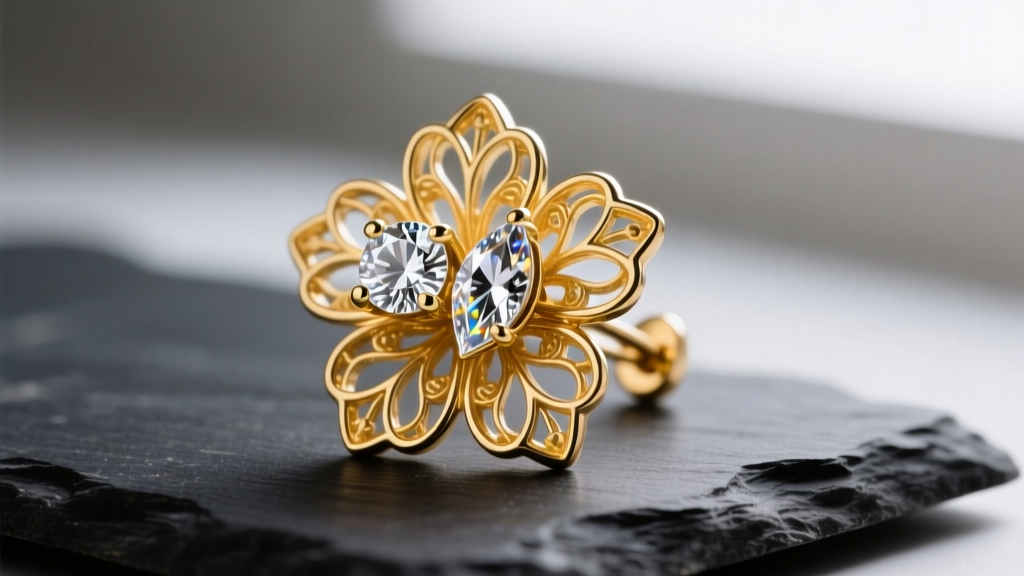
The 2026 Shift: From Vintage Revival to Wildflower Asymmetry
For the past few years, botanical jewelry has leaned heavily into nostalgic, vintage-inspired revivals. Symmetrical daisy motifs and perfectly uniform diamond halos dominated the market. However, as we move through 2026, the American Jewelry Design Council (AJDC) notes a distinct pivot in the fine and demi-fine jewelry sectors: the rise of the 'wildflower' aesthetic. Today's flower cluster earrings are no longer stiff, perfectly round, or entirely symmetrical. Instead, contemporary designers are embracing organic imperfection.
The modern flower cluster relies on asymmetric petal arrangements, utilizing a mix of marquise, pear, and trillion-cut gemstones to create overlapping, multi-dimensional blooms. This shift reflects a broader consumer desire for jewelry that feels personal and naturally grown rather than factory-stamped. Furthermore, the integration of negative space—where the metal framework is deliberately hidden or minimized to create a 'floating petal' illusion—has become a hallmark of high-end 2026 botanical designs. This evolution transforms the flower cluster from a traditional heirloom piece into an edgy, everyday statement.
Anatomy of a Cluster: Weight, Gauge, and Backing Mechanics
While the visual appeal of a floral cluster is undeniable, the structural engineering required to keep the earring upright on the earlobe is often overlooked by casual buyers. A standard solitaire stud weighs between 0.5 and 1.5 grams. In contrast, a fully realized 12mm to 15mm diamond flower cluster can easily weigh between 3.5 and 6 grams. This drastic increase in mass introduces a common failure mode: the dreaded 'drooping lobe' effect.
To combat this, the post gauge and backing mechanics must be carefully selected. A standard 20-gauge (0.81mm) wire is entirely insufficient for a heavy cluster; it will bend under the weight and cause the earring to face downward. Expert jewelers recommend a minimum of 18-gauge (1.02mm) or even 16-gauge (1.29mm) posts for substantial floral designs. Additionally, the backing must provide a wide surface area to distribute the weight across the back of the earlobe.
| Component | Standard Stud | Heavy Flower Cluster | Why It Matters |
|---|---|---|---|
| Post Gauge | 20g (0.81mm) | 18g (1.02mm) or 16g (1.29mm) | Prevents the metal wire from bending under the 4g+ weight of the cluster. |
| Backing Type | Standard Friction Butterfly | La Pousette or Omega Back | La Pousette backs use dual springs to grip tightly, while Omega backs distribute weight over a wider lobe area. |
| Metal Purity | 14k or 18k Gold | 14k Gold (Preferred) | 14k gold offers higher tensile strength and rigidity compared to the softer 18k or 24k gold, crucial for structural integrity. |
Gemstone Melee: The Science of the 'Petal'
The brilliance of a flower cluster earring relies entirely on 'melee'—the industry term for small gemstones typically ranging from 0.01 to 0.18 carats. According to the Gemological Institute of America (GIA), the cut quality of melee is just as critical as it is for larger center stones, yet it is frequently compromised in mass-produced jewelry to cut costs.
When evaluating flower cluster earrings, you must understand the difference between 'single-cut' and 'full-cut' melee. Single-cut diamonds feature only 17 or 18 facets. In a cluster setting, single-cut stones often look glassy, flat, and lifeless because they lack the complex light-return geometry required to mimic the shimmer of a delicate petal. Full-cut melee, featuring the standard 57 or 58 facets of a brilliant round diamond, is non-negotiable for high-quality floral clusters. The intense scintillation of full-cut stones is what gives the 'flower' its vibrant, dewy appearance.
Expert Color-Matching Tip: In a multi-stone cluster, color consistency is more visually important than absolute color grade. A cluster of perfectly matched 'H' color diamonds will look significantly more cohesive and premium than a cluster mixing 'F' and 'J' color stones. For yellow gold settings, jewelers can safely use 'I' or 'J' color melee, as the warm metal reflections mask slight diamond warmth, allowing you to allocate budget toward better cut quality.
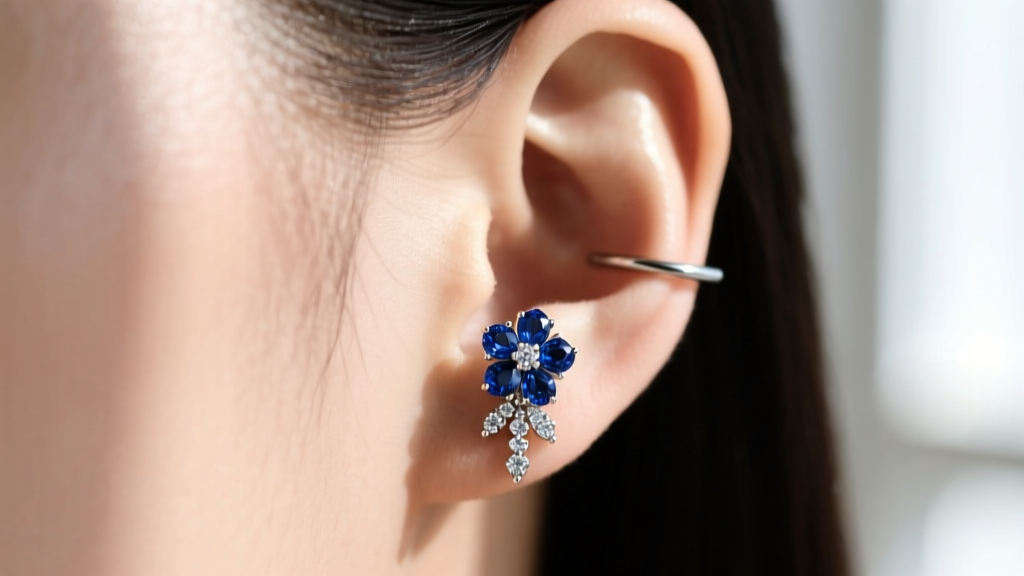
Cartilage Constellations: Styling Beyond the Standard Lobe
The most significant styling trend for 2026 is the migration of the flower cluster from the standard earlobe to the upper cartilage. Curated ear-scapes now frequently utilize miniature floral clusters as anchor pieces in the helix, flat, or conch regions. However, cartilage piercings require entirely different hardware than traditional lobes.
- Flat Piercings: The flat region of the ear provides a broad, relatively flush canvas ideal for medium-sized (8mm-10mm) flower clusters. Because flat piercings are typically done at 16-gauge or 14-gauge, you must ensure the cluster is designed as a 'threadless end' or 'internally threaded' top that fits a flat-back labret post.
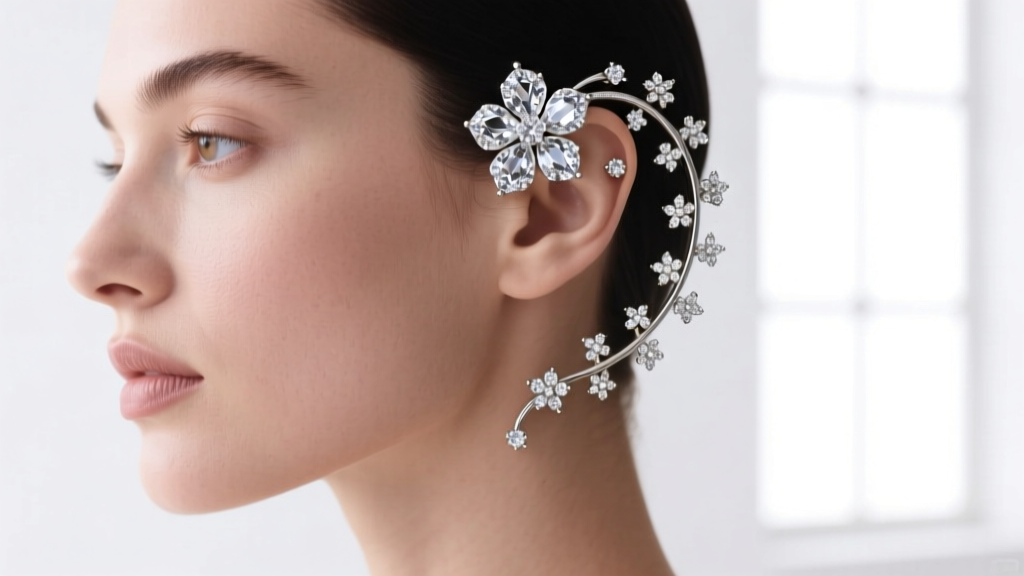
- Helix Placements: For the outer helix, smaller 5mm to 7mm wildflower clusters are trending. These are often stacked in an ascending 'constellation' pattern, decreasing in size as they follow the natural curve of the ear toward the lobe.
- Post Length Considerations: Cartilage thickness varies wildly. A standard 6mm post may be too tight for a fresh or swollen flat piercing, while an 8mm post might stick out too far on a healed helix. Always have your piercer measure your exact tissue depth before purchasing a fixed-length cartilage cluster.
Price vs. Longevity: The 2026 Investment Framework
When shopping for flower cluster earrings, buyers generally face a bifurcated market: demi-fine and fine jewelry. Understanding the material reality of these tiers is essential for making a sound investment.
The Demi-Fine Tier ($150 - $450): This category is dominated by gold vermeil and lab-grown diamond clusters. To ensure longevity, verify that the vermeil meets the legal standard of at least 2.5 microns of gold plating over a sterling silver base. Anything less will wear through the high-friction areas of the earring post and backing within months. Lab-grown melee diamonds in this tier offer identical optical and chemical properties to mined stones, making demi-fine clusters an excellent choice for trend-forward buyers who want high carat-weight impact without the fine jewelry markup.
The Fine Jewelry Tier ($1,200 - $5,000+): Solid 14k or 18k gold paired with natural, ethically sourced diamonds or precious gemstones like sapphires and rubies. In this tier, you are paying for the meticulous labor of stone-setting. A high-end 15-stone flower cluster requires a master setter to individually bead-set or prong-set each microscopic stone so that the metal is nearly invisible. Fine clusters are heirloom-grade, designed to withstand daily wear, swimming, and sleeping without the risk of plating degradation or structural failure.
Final Verdict: Are Flower Clusters a Passing Fad?
While the 'wildflower' asymmetry of 2026 is a distinct trend, the underlying concept of the flower cluster is deeply entrenched in jewelry history. By focusing on structural integrity—demanding proper gauge thickness, full-cut melee, and secure backings—you ensure that your botanical earrings remain a staple in your collection long after the current trend cycle evolves. Whether worn as a bold lobe statement or a delicate cartilage accent, the modern flower cluster offers a masterclass in combining organic beauty with precision engineering.


