Glasses Earrings: Technical Guide to Frame-Compatible Jewelry
Master the ergonomics of glasses earrings. Discover frame clearance metrics, flat-back mechanics, and titanium standards for optical wearers.


When curating a jewelry wardrobe, eyeglass wearers face a unique biomechanical challenge that is rarely addressed in mainstream style guides. The intersection of optical frames and ear jewelry creates a complex micro-environment of friction, pressure, and spatial constraints. Selecting the right glasses earrings is not merely an aesthetic choice; it is an exercise in ergonomic engineering. Standard earring designs often fail catastrophically when paired with thick temple arms or pronounced spring hinges, leading to localized pressure sores, contact dermatitis, and chronic snagging.
To navigate this, we must abandon generic styling advice and examine the physical clearances, backing mechanisms, and material biocompatibility required for optical wearers. This technical deep dive provides the precise metrics and structural frameworks needed to harmonize your piercings with your prescription frames.
The Physics of Frame Interference
The primary antagonist to ear jewelry is the glasses temple arm. According to optical fitting standards outlined by the American Optometric Association (AOA), a properly fitted frame should rest comfortably over the auricle without exerting lateral pressure on the skull. However, the physical footprint of the temple arm dictates the available negative space behind and around the ear.
Consider the anatomical mapping:
- The Lobule (Earlobe): Standard temple arms pass just above or directly behind the upper lobule. A standard post and butterfly back can protrude 8mm to 12mm from the skin. If the temple arm is thick (e.g., 6mm+), this protrusion acts as a fulcrum, forcing the metal backing into the mastoid bone or the posterior earlobe.
- The Scapha and Helix (Cartilage): Frames with heavy acetate fronts often feature reinforced, thick temple arms that press directly against the upper ear cartilage. Standard cartilage hoops or butterfly-backed studs will inevitably collide with the frame, causing the jewelry to tilt and the post to pierce the skin internally.
- Spring Hinges: Many modern frames utilize spring hinges for flexibility. These hinges create a bulbous, mechanical joint that sits exactly where the helix meets the scapha, completely eliminating the clearance required for traditional dangle or hoop earrings.
Optimal Backing Mechanisms
The most critical failure point for glasses earrings is the backing mechanism. The ubiquitous butterfly clutch is fundamentally incompatible with eyeglasses. Its uneven surface area and deep profile (often exceeding 6mm) trap sebum and create severe pressure points when compressed by a glasses arm.
For optical wearers, transitioning to low-profile, high-tension backing systems is mandatory. Below is a comparative analysis of backing types based on their spatial footprint and compatibility with eyeglass frames.
| Backing Type | Profile Depth | Snag Risk | Glasses Compatibility |
|---|---|---|---|
| Standard Butterfly Clutch | 6mm - 10mm | High | Poor (Causes pressure sores) |
| Flat Disc (Push-in) | 2mm - 3mm | Low | Excellent (Distributes pressure) |
| Threadless Labret | 1.5mm - 2.5mm | None | Superior (Flush fit, zero snag) |
| Screw-in Ball Back | 4mm - 6mm | Medium | Moderate (Spherical shape rolls) |
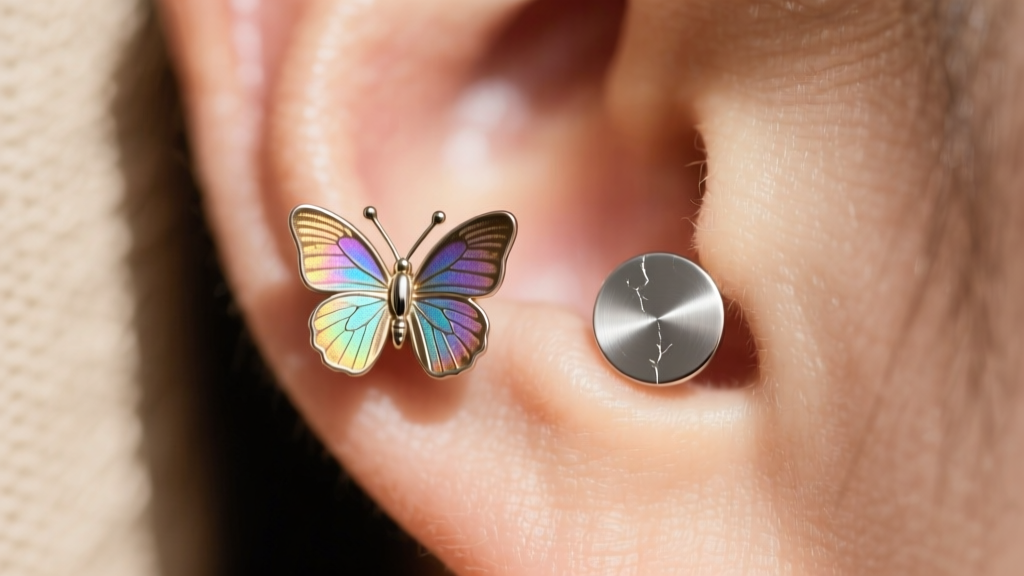
The Association of Professional Piercers (APP) heavily advocates for internally threaded or threadless labret studs for any piercing subjected to external pressure. A threadless labret utilizes a bent pin that creates tension against the inside of the post, eliminating the need for a bulky backing entirely. The flat disc sits completely flush against the posterior earlobe, allowing a glasses temple arm to glide over it without creating a localized pressure point.
Cartilage Considerations: Helix vs. Spring Hinges
Cartilage piercings require an entirely different spatial calculus. The helix and conch are situated in the direct path of the temple arm's descent toward the mastoid. When wearing glasses, any jewelry that protrudes outward (like a captive bead ring or a standard hoop) will be constantly pushed forward by the frame. This continuous lateral force can lead to migration, a process where the body slowly rejects the jewelry by pushing it through the tissue, resulting in scarring and crooked piercing angles.
Expert Rule: If your glasses feature heavy spring hinges, avoid all dangles, hoops, and outward-facing gems in the upper helix. Opt exclusively for flat-laying threadless ends, such as low-profile bezel-set stones or smooth titanium discs, which allow the hinge to rest against the jewelry without catching.
For those who prefer the aesthetic of hoops, huggies with a hinged, flat-backed clasp are the only viable option. Ensure the clasp mechanism sits at the very bottom of the hoop, away from the temporal friction zone.
Additionally, consider the ear cuff trend. While non-pierced ear cuffs seem like a safe alternative to avoid cartilage interference, the tension required to keep them in place makes them highly unstable when a glasses arm slides over the auricle. If you wear glasses daily, avoid upper-ear cuffs entirely, as they will inevitably be knocked loose and lost to the pavement.
Material Biocompatibility Under Pressure
The presence of eyeglasses fundamentally alters the micro-climate of your piercings. When a temple arm presses an earring into the skin, it restricts localized blood flow and traps ambient moisture, sweat, and dead skin cells. This high-friction, low-oxygen environment accelerates galvanic reactions and metal ion leaching.
The Friction Factor and Contact Dermatitis
Many commercial earrings are crafted from brass or stainless steel with a thin layer of gold or rhodium plating. Under normal conditions, these plated earrings may not cause a reaction. However, the continuous mechanical friction of a glasses arm rubbing against the earring post will rapidly wear away microscopic layers of plating, exposing the base metals to the epidermis. This is a primary catalyst for allergic contact dermatitis.
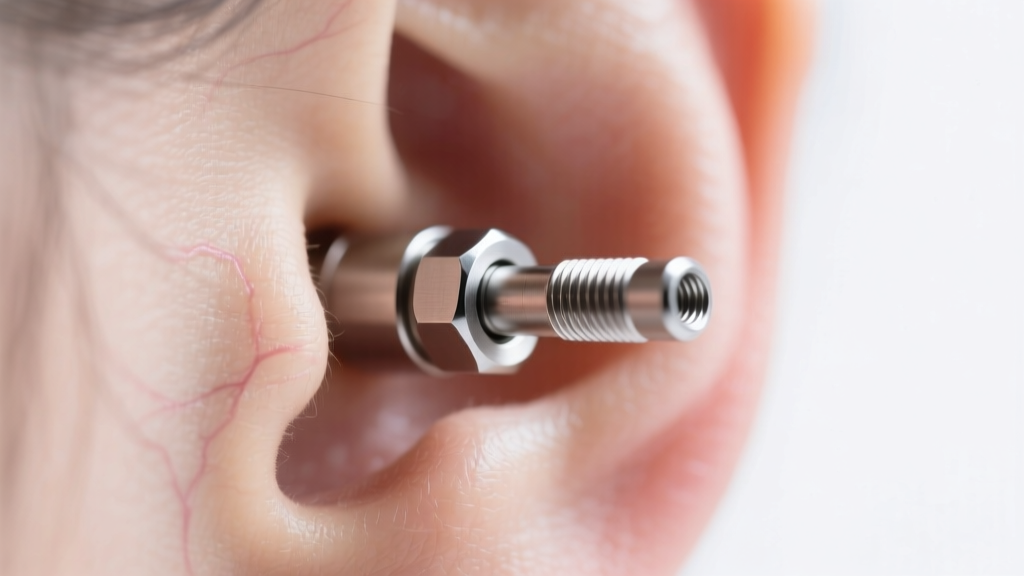
To mitigate this, optical wearers must strictly adhere to implant-grade material standards. ASTM F136 implant-grade titanium is the gold standard for glasses earrings. It is entirely nickel-free, highly resistant to friction-induced degradation, and possesses a mirror-finish surface that minimizes bacterial adhesion. Solid 14k or 18k gold (alloyed for biocompatibility, avoiding nickel-containing white gold) is also acceptable, provided the post is thick enough to resist bending under the lateral pressure of thick acetate frames.
Furthermore, the gauge (thickness) of the earring post plays a vital structural role. Standard fashion earrings often utilize 20-gauge (0.81mm) or 22-gauge (0.64mm) posts. These thin wires are highly susceptible to bending when a glasses temple arm catches them during removal. A bent post will harbor bacteria and cause micro-tears in the fistula (the piercing channel). Upgrading to 18-gauge (1.02mm) or 16-gauge (1.29mm) posts provides the necessary rigidity to withstand the daily mechanical stress of putting on and taking off your glasses.
Final Ergonomic Verdict
Mastering the art of glasses earrings requires a shift from purely visual styling to biomechanical awareness. By calculating the clearance of your temple arms, eliminating high-profile butterfly clutches in favor of threadless flat-back labrets, and strictly utilizing ASTM F136 titanium, you can eliminate the friction, pressure sores, and snagging that plague optical wearers. Your jewelry should complement your frames, not compete with them for physical space.


