The 2026 Gold Balls Earrings Trend: Sizing & Styling
Discover the 2026 gold balls earrings trend. Learn how to choose the right karat, gauge, and weight to prevent lobe stretching while maximizing style.

The Resurgence of the Sphere: Why Gold Balls Earrings Dominate 2026
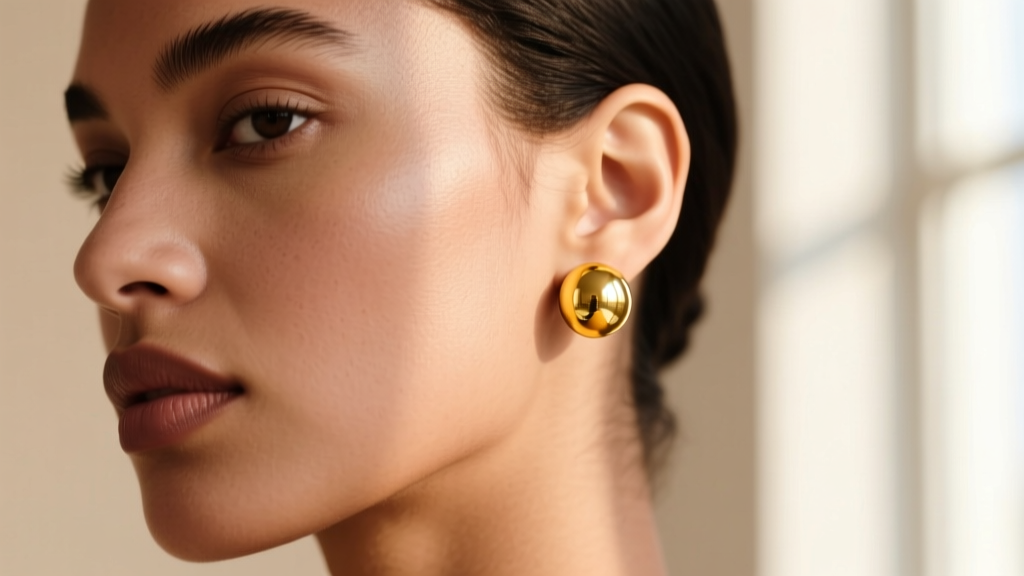
In the ever-evolving landscape of fine jewelry, few silhouettes possess the enduring geometric perfection of the sphere. As we navigate the style landscape of 2026, gold balls earrings have transcended their reputation as mere basic staples to become the focal point of curated ear stacks and minimalist styling. Unlike the hyper-embellished, maximalist trends of the early 2020s, today’s collectors and style enthusiasts are gravitating toward the tactile, light-catching properties of polished metallic orbs. However, the apparent simplicity of a spherical stud masks a complex web of metallurgical and anatomical considerations that dictate how these pieces wear over time.
The modern iteration of the gold sphere earring is no longer confined to the standard 4mm stud. We are seeing a massive surge in demand for oversized 10mm to 15mm statement spheres, graduated sphere clusters, and asymmetrical drop configurations. Yet, scaling up the size of a solid metal sphere introduces significant physical challenges. The weight of gold increases cubically with its diameter, meaning a seemingly small jump in millimeter size can exponentially increase the gravitational pull on your earlobe. Understanding the intersection of material science, gauge thickness, and ear anatomy is critical for anyone looking to invest in this enduring trend without compromising their tissue health.
Material Grades & Manufacturing: Solid Cast vs. Electroformed
When shopping for gold balls earrings, the karat weight and manufacturing method are the primary determinants of both price and longevity. According to the Gemological Institute of America (GIA), 24k gold is far too soft for everyday jewelry, making 14k and 18k the industry standards. For spherical earrings, 14k gold is often the superior choice. The higher alloy content (typically mixed with copper, silver, or zinc) increases the Vickers hardness of the metal, making it highly resistant to the surface scratching that inevitably occurs when smooth, polished balls rub against hair, phones, and clothing.
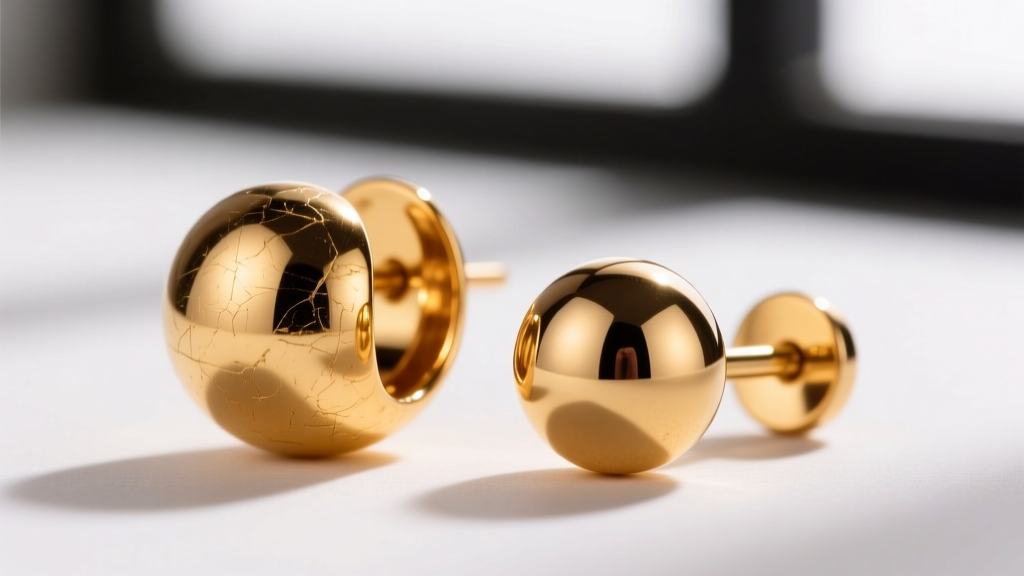
Manufacturing technique is equally vital. Traditional solid cast gold balls are durable but incredibly heavy. A solid 12mm 14k gold sphere can weigh upwards of 5 grams per earring—a load that will rapidly stretch a standard lobe piercing. To combat this, 2026’s leading jewelers are utilizing electroforming. This process involves depositing gold onto a wax or resin core, which is later melted away, leaving a hollow, lightweight, yet remarkably strong gold shell. Electroformed gold balls earrings allow wearers to sport massive 15mm or 20mm statement spheres that weigh less than 2 grams, completely bypassing the risk of lobe fatigue while maintaining the luxurious visual impact of solid gold.
The Physics of the Drop: Gauge Sizes and Lobe Stretching
The most common failure mode for heavy gold balls earrings is the 'cheese-cutter effect.' This occurs when a heavy earring rests on a thin post, causing the wire to slowly slice through the bottom of the piercing fistula. Standard fashion earrings are typically manufactured at 20-gauge (0.81mm) or 18-gauge (1.02mm). While perfectly fine for lightweight diamonds or delicate shapes, these gauges are entirely inadequate for solid gold spheres exceeding 6mm in diameter.
The Association of Professional Piercers (APP) consistently recommends thicker jewelry for heavy loads to distribute pressure evenly across the tissue. If you are investing in oversized gold balls, you must ensure the posts are at least 16-gauge (1.29mm) or 14-gauge (1.60mm). Below is a structural guide to matching sphere diameter with the appropriate hardware specifications.
| Sphere Diameter | Solid 14k Weight (Approx) | Recommended Gauge | Ideal Backing Type |
|---|---|---|---|
| 4mm - 6mm | 0.5g - 1.2g | 20G or 18G | Standard Butterfly Friction |
| 7mm - 9mm | 1.5g - 2.8g | 18G or 16G | La Pousette / Clutch |
| 10mm - 12mm | 3.5g - 5.2g | 16G or 14G | Screw-Back or Jumbo Disc |
| 13mm+ (Solid) | 6.0g+ | 14G Minimum | Threadless Press-Fit |
The Butterfly Back vs. La Pousette Debate
The structural integrity of your gold balls earrings relies heavily on the backing mechanism. Standard butterfly backs feature a tiny surface area that digs into the back of the earlobe when supporting a heavy sphere, causing localized pain and tissue necrosis over long wear periods. Furthermore, the friction grip on standard backs often fails to support the forward center-of-gravity shift caused by a heavy front-facing ball, resulting in the dreaded 'drooping' earring look.
For any gold ball earring over 2 grams, upgrade to a La Pousette (clutch) backing or a jumbo silicone disc. La Pousette backs utilize a spring-loaded internal mechanism that locks securely onto the post and features a wide, flat flange that distributes the weight across a broader area of the posterior lobe. For threadless or internally threaded 14k gold options favored by professional piercers, a flat-back labret post with a push-fit sphere end provides the ultimate security, ensuring the heavy ball sits perfectly flush and perpendicular to the ear.
Styling Frameworks: Face Shapes and Cartilage Placements
Styling gold balls earrings in 2026 requires an understanding of facial geometry and spatial balance. Because spheres lack directional lines (unlike teardrops or geometric angles), they act as visual anchors. For round or square face shapes, a single, oversized 12mm gold ball stud at the primary lobe piercing draws the eye outward, widening the lower half of the face. To elongate, pair a smaller 5mm gold ball at the lobe with a vertical drop chain ending in a second, slightly larger sphere.
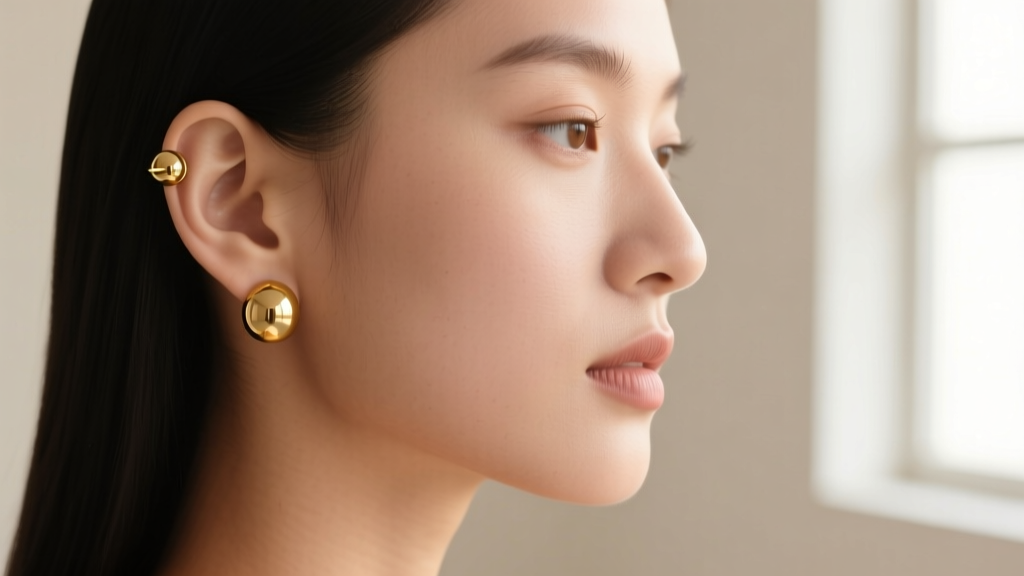
For oval and heart-shaped faces, clustered gold ball constellations work beautifully. Arranging three varying sizes (e.g., 3mm, 5mm, and 7mm) in a tight triangular formation on the lower lobe creates a customized, organic texture that complements the natural taper of the jawline without overwhelming the chin.
Cartilage Limitations: Helix and Tragus Rules
While gold balls are a staple for lobe piercings, placing them in upper cartilage requires strict weight management. Cartilage tissue lacks the elasticity and blood flow of the earlobe, making it highly susceptible to pressure bumps (hypertrophic scarring) if weighed down. A solid gold ball larger than 4mm should never be worn in a standard helix or tragus piercing. The leverage exerted by the sphere during sleep or when brushing hair can irritate the fistula. If you desire the look of a large sphere in the upper ear, you must opt for hollow electroformed designs or surface-set gemstone cabochons that mimic the spherical silhouette without the dense metallic mass.
Maintenance & Failure Modes: What Jewelers Won't Tell You
The mirror finish of polished gold balls earrings is their greatest asset and their biggest liability. Unlike textured or hammered gold, which hides micro-abrasions, a high-polish sphere acts as a magnifying glass for surface wear. Over time, contact with cosmetics, hairspray, and the natural oils of your skin will create a cloudy patina on the lower hemisphere of the ball.
To maintain the optical clarity of your spheres, avoid ultrasonic cleaners if your earrings feature any tension-set stones or glued components. Instead, use a mild, phosphate-free dish soap and a dedicated, ultra-soft baby toothbrush to gently agitate the surface. For deep scratches on solid 14k or 18k gold, a professional jeweler can utilize a rouge polishing wheel to restore the mirror finish. However, be aware that each polishing session removes a microscopic layer of gold; over a decade, this can slightly alter the perfect spherical geometry of smaller studs.
Final Verdict: Building Your Sphere Wardrobe
The 2026 gold balls earrings trend is a masterclass in the power of restrained geometry. By prioritizing 14k gold for its scratch resistance, insisting on 16-gauge or thicker posts for oversized pieces, and leveraging electroformed hollows for dramatic statement sizes, you can build a versatile, anatomically safe collection. Whether you are anchoring a complex cartilage stack with a 3mm tragus stud or framing your face with a pair of heavy, 12mm solid lobe orbs, the sphere remains the ultimate testament to the idea that true luxury lies in perfect proportions.


