Gold Chain Drop Earrings: A Technical Guide to Links and Drape
Explore the technical engineering of gold chain drop earrings. Learn how link types, karat weights, and soldering impact drape, durability, and lobe stress.

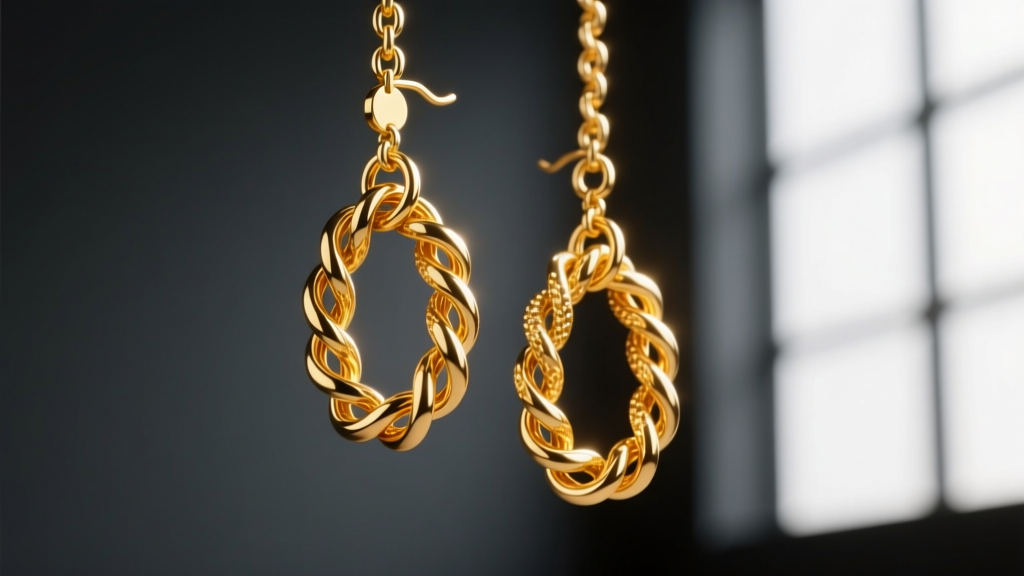
When evaluating gold chain drop earrings, the untrained eye focuses solely on the karat stamp and overall length. However, from a metallurgical and engineering perspective, a chain drop earring is a complex kinetic sculpture. The drape, tensile resilience, and structural failure points are dictated by precise link geometry, alloy composition, and micro-soldering techniques. This technical deep dive explores the engineering mechanics that separate mass-produced pieces from fine jewelry masterworks, providing a definitive framework for evaluating gold chain drop earrings.
The Physics of Drape: Link Geometry and Kinetic Fluidity
The 'drape' of a chain—how it folds, bends, and reacts to gravity—is a direct result of link topology. In gold chain drop earrings, the chain acts as a flexible pendulum, and its movement is governed by the friction and articulation limits of its individual links.
Cable, Curb, and Rope Topologies
Cable chains (uniform oval links) offer a structured, slightly rigid drape. The friction between the rounded apices of adjacent links limits kinetic fluidity. Curb chains, characterized by flattened, interlocking links, provide a heavier, more cohesive drape but are prone to torsional twisting if the wire gauge drops below 0.8mm. Rope chains, engineered from two or more twisted strands of oval links, exhibit the highest degree of multi-directional fluidity. The helical structure allows the chain to bend on multiple axes simultaneously, creating a liquid-metal effect that is highly prized in drop earrings. However, this complex topology introduces micro-crevices that trap sebum and environmental particulates.
Metallurgical Constraints: Karat Weight vs. Tensile Strength
The selection of gold karatage in chain manufacturing is a compromise between color saturation and mechanical yield strength. Pure 24k gold (Vickers Hardness ~25 HV) is entirely unsuitable for the structural links of drop earrings; the metal will stretch and deform under the dynamic load of a swinging drop pendant.
According to the Gemological Institute of America (GIA), alloying gold with copper, silver, and zinc drastically alters its crystalline lattice structure. 14k gold (58.3% gold) offers superior tensile strength (often exceeding 400 MPa depending on the annealing process), making it ideal for ultra-fine chains (0.4mm - 0.6mm wire thickness). However, the higher copper content can increase brittleness and reduce the 'silky' drape associated with higher-karat pieces. 18k gold (75% gold) remains the industry benchmark for luxury gold chain drop earrings, balancing a rich yellow hue with adequate yield strength, provided the wire gauge does not drop below 0.7mm.
| Karat | Vickers Hardness (HV) | Tensile Strength | Drape Fluidity | Min. Wire Gauge |
|---|---|---|---|---|
| 14k Yellow | 120 - 140 HV | High (~450 MPa) | Moderate (Stiffer) | 0.4mm |
| 18k Yellow | 90 - 110 HV | Medium (~320 MPa) | High (Fluid) | 0.7mm |
| 22k Yellow | 45 - 60 HV | Low (~180 MPa) | Very High (Silky) | 1.2mm+ |
Hollow vs. Solid Link Construction: The Weight-to-Volume Ratio
Many commercial gold chain drop earrings utilize hollow links (often called 'tubular' or 'puffed' links) to maximize visual volume while minimizing gold weight and cost. While a hollow curb chain might boast a 4mm width, its actual gold content could be equivalent to a 1.5mm solid chain. The technical drawback of hollow links in drop earrings is their susceptibility to compressive deformation. Because drop earrings are subject to accidental impacts (e.g., catching on clothing, resting against hard surfaces), hollow links will dent irreparably. Solid links, while heavier and more expensive, possess a uniform crystalline structure that can be polished and burnished to remove minor surface scratches. When evaluating gold chain drop earrings, the structural integrity ratio heavily favors solid wire construction for any chain intended for daily kinetic wear.
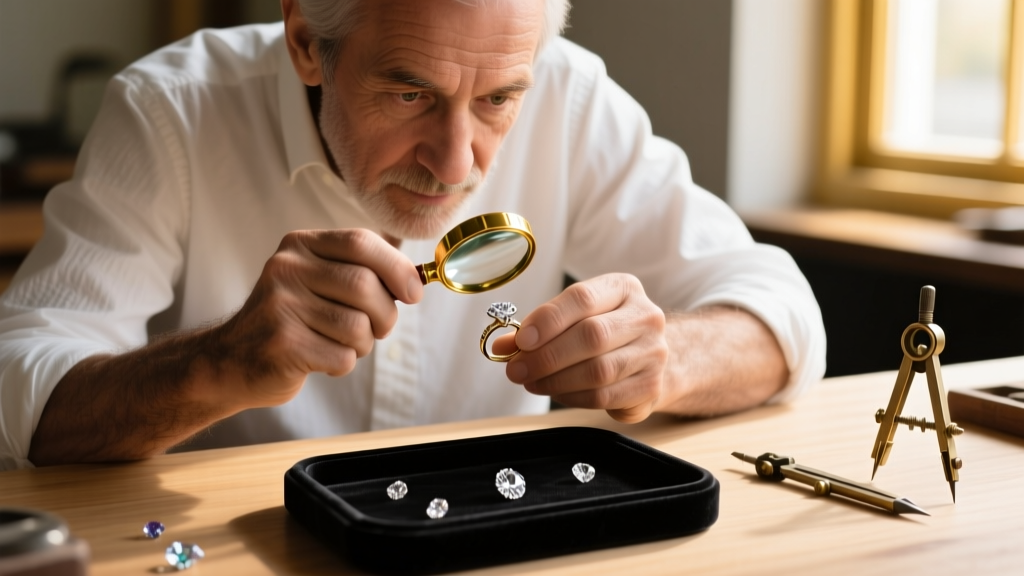
Structural Failure Points: Micro-Soldering and Jump Ring Mechanics
The most common catastrophic failure in gold chain drop earrings occurs at the junction points: the jump ring connecting the chain to the ear wire, and the terminal link holding the drop element. Traditional torch soldering requires flux and heat that can anneal (soften) the surrounding work-hardened links, creating a localized weak point.
Modern fine jewelry manufacturing utilizes laser welding for these micro-connections. Laser welding concentrates thermal energy into a 0.1mm focal point, fusing the metal without altering the temper of the adjacent chain links. When inspecting gold chain drop earrings, look for seamless, flush jump rings. A poorly filed jump ring will act as a microscopic saw, gradually abrading the softer gold of the ear wire hook until it snaps.
Diagnostic Checklist for Evaluating Chain Integrity
- Link Closure Flushness: Run a microfiber cloth over the chain. If it snags, the jump rings or soldered seams are protruding, indicating poor finishing.
- Torsional Memory: Twist the chain gently and release. A high-quality, properly annealed chain will immediately return to its neutral state without retaining a spiral memory.
- Acoustic Resonance: Drop the chain onto a glass surface. Solid 18k gold produces a dense, dull thud, whereas hollow or heavily alloyed base metals produce a high-pitched ring.
Biomechanics of the Earlobe: Mitigating Tensile Elongation
Drop earrings introduce a pendulum effect, amplifying the gravitational pull on the earlobe piercing. Over time, the repetitive micro-trauma from a swinging gold chain can cause the fistula (the piercing hole) to elongate, leading to irreversible lobe stretching.
To counteract this, the distribution of mass behind the earlobe is critical. Standard butterfly friction backs concentrate the earring's weight onto a 2mm post, creating high localized pressure. For gold chain drop earrings, jewelers recommend wide silicone disc backs (minimum 10mm diameter) or specialized locking mechanisms like the La Pousette. These distribute the shear force across a broader surface area of the posterior lobe, neutralizing the elongation vector.

Expert Insight: 'The kinetic load of a 5-gram chain drop earring is not static; the swinging motion generates momentary G-forces that can exceed 15 grams of localized pressure on the fistula. Wide-disc backs are not an aesthetic choice; they are a biomechanical necessity.' — Master Jeweler Bench Notes
Maintenance Protocols: Ultrasonic Risks and Chemical Cleaning
Cleaning gold chain drop earrings requires an understanding of their mechanical vulnerabilities. While ultrasonic cleaners are highly effective at cavitation-cleaning the micro-crevices of rope and box chains, they pose a severe risk to laser-welded jump rings and hollow link structures. The high-frequency acoustic waves can induce metal fatigue in poorly annealed solder joints, causing the chain to disintegrate inside the tank.
For routine maintenance, a thermal bath of distilled water and a few drops of non-detergent, pH-neutral soap (such as Castile soap) is optimal. Use a soft-bristled infant toothbrush to gently agitate the links parallel to the chain's axis. Never scrub perpendicular to the chain, as this can bend fine-gauge cable links out of their geometric alignment. As noted by industry experts at National Jeweler, proper at-home maintenance significantly extends the structural lifespan of fine chain jewelry, preserving both the metallurgical finish and the kinetic drape.


