Crafting Gold Cherry Earrings: A Technical Guide to Enamel & Alloys
Explore the technical anatomy of luxury gold cherry earrings. Discover expert insights on vitreous enamel, 14k vs 18k alloys, and structural stem settings.

Introduction: Elevating the Fruit Motif in High Jewelry
When most consumers think of fruit-themed jewelry, they envision mass-produced costume pieces or novelty accessories. However, in the upper echelons of high jewelry (joaillerie), crafting luxury gold cherry earrings requires a rigorous understanding of metallurgy, thermal dynamics, and micro-engineering. As we move through 2026, the demand for hyper-realistic, heirloom-quality botanical and fruit motifs has surged, pushing jewelers to combine centuries-old enameling techniques with modern laser-welding technology. This deep dive explores the exact specifications, material grades, and structural engineering required to produce fine gold cherry earrings that are as durable as they are visually striking.
Metallurgical Foundations: Alloy Selection and Weight Distribution
The foundation of any fine earring is its gold alloy. Pure 24k gold is entirely unsuitable for structural jewelry due to its extreme malleability. Therefore, master jewelers must choose between 18k and 14k gold, balancing color saturation with tensile strength.
18k vs. 14k Gold for Structural Integrity
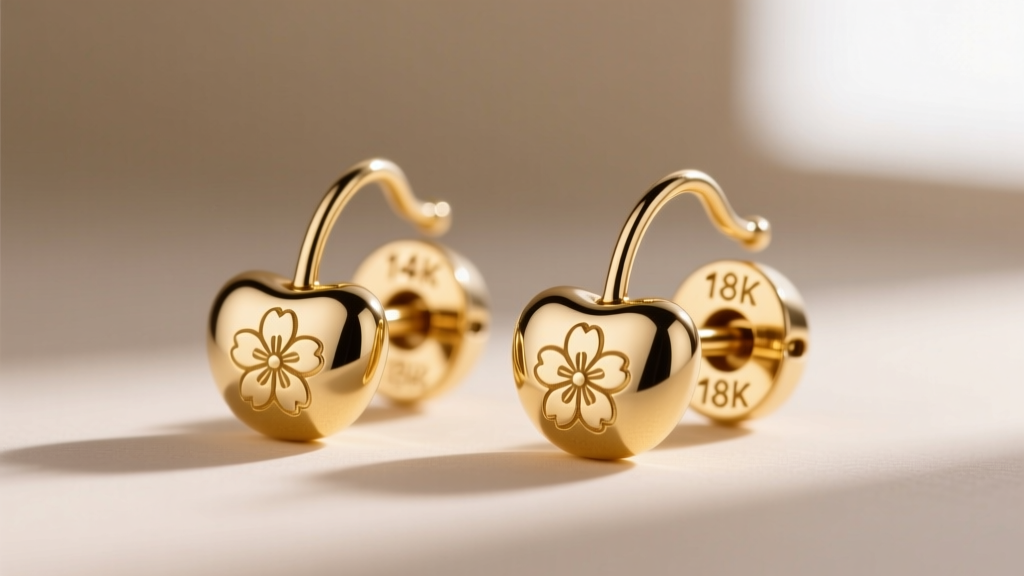
18k gold (75% pure gold, typically alloyed with silver and copper) offers a rich, warm yellow hue that perfectly complements the deep reds of cherry enamel. However, 18k gold is relatively soft. If a jeweler casts a solid 10mm cherry in 18k gold, the specific gravity of the metal means each earring could weigh upwards of 6 to 8 grams. This excessive weight causes the dreaded 'cheese cutter' effect, where the earring post slowly slices through the earlobe tissue over time.
To solve this, high-end manufacturers utilize hollow-form fabrication. By employing electroforming or lost-wax casting with a soluble ceramic core, the outer shell remains a luxurious 18k gold, but the internal volume is hollowed out, reducing the weight to a highly wearable 1.5 to 2 grams per earring. Conversely, the internal armature, post, and stem are often fabricated from 14k gold (58.3% pure gold). The higher copper and zinc content in 14k gold provides the necessary yield strength to prevent the post from bending during insertion.
The Science of the Crimson: Vitreous Enamel and Thermal Dynamics
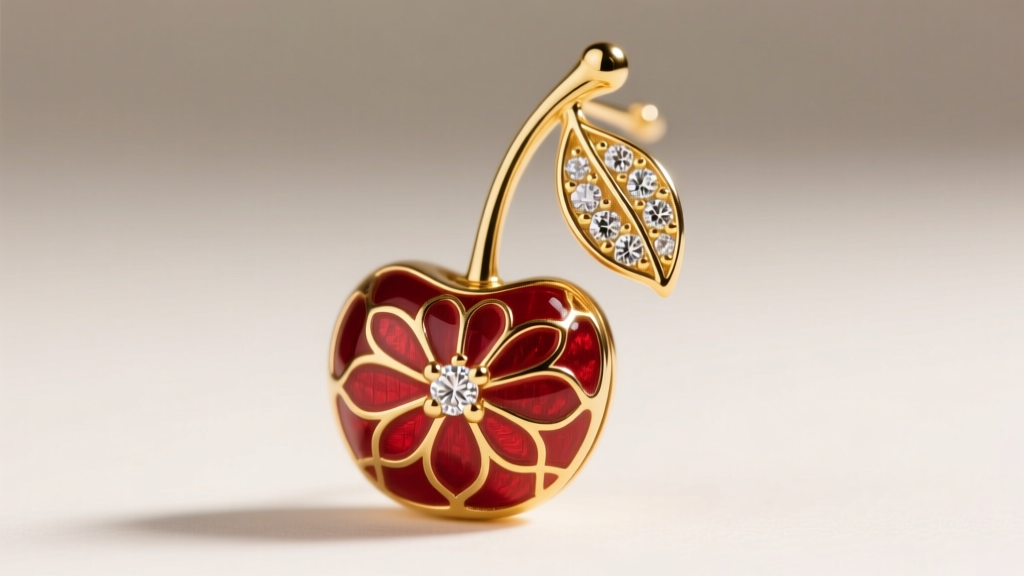
The vivid, translucent red of a luxury cherry cannot be achieved with paint or resin; it requires vitreous enamel. Vitreous enamel is essentially finely ground glass (silica, soda ash, and metallic oxides for color) that is fused to the gold substrate at temperatures exceeding 1400°F (760°C). The technical challenge here lies in the Coefficient of Thermal Expansion (CTE).
Managing Thermal Shock and Crazing
If the CTE of the gold alloy does not perfectly match the CTE of the glass enamel, the cherry will develop 'crazing' (a network of micro-cracks) as it cools, or the enamel will simply pop off the metal. According to the Victoria and Albert Museum's archives on decorative arts, master enamelists counter this by applying a 'counter-enamel' layer to the inside or back of the cherry. This balances the surface tension during the cooling phase, ensuring the glass remains under slight compression, which vastly increases its impact resistance.
Furthermore, the most prized gold cherry earrings utilize the guilloché technique. Before enameling, the gold surface of the cherry is engine-turned with a rose engine lathe to create microscopic, undulating waves. When the translucent red enamel is fired over this engraved surface, it creates a three-dimensional optical illusion of depth and internal light refraction that flat enamel cannot replicate.
| Enamel Type | Composition | Firing Temp | Impact Resistance | Best Application |
|---|---|---|---|---|
| Vitreous (Opaque) | Silica, Flux, Opacifiers | 1400°F - 1500°F | Moderate | Base layers, solid color blocking |
| Guilloché (Translucent) | Silica, Flux, Metallic Oxides | 1350°F - 1450°F | High (if counter-enameled) | Luxury cherry bodies over engine-turned gold |
| Plique-à-jour | Silica, Flux (no backing) | 1400°F | Very Low (Fragile) | Cherry blossom leaves, light-catching accents |
| Cold Enamel (Epoxy) | Polymer Resin, Pigment | None (Air Cured) | High (Shatterproof) | Commercial/Entry-level fruit motifs |
Structural Engineering: Stem Attachment and Shear Stress
The most common failure point in gold cherry earrings is the junction where the delicate gold stem meets the heavier spherical body of the cherry. This joint is subjected to immense shear stress every time the earring is handled, cleaned, or accidentally snagged on clothing.
Preventing Shear Stress at the Solder Joint
Traditional torch soldering is highly risky here; the ambient heat can easily melt or discolor the adjacent vitreous enamel. In modern 2026 workshops, jewelers utilize precision laser welding to attach the stem. Laser welding focuses a microscopic beam of light to melt the gold only at the exact point of contact, leaving the surrounding enamel entirely unaffected by thermal transfer.
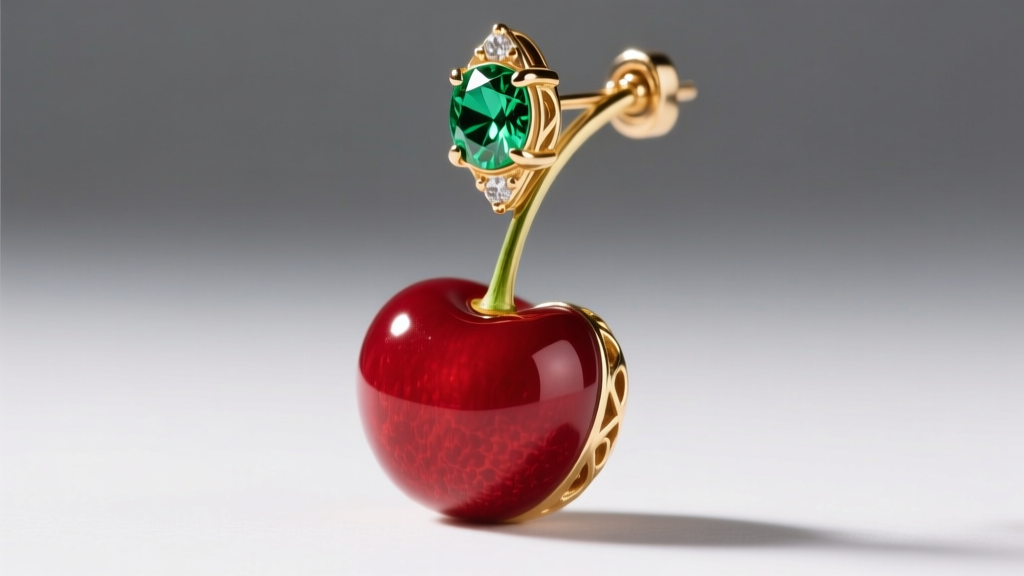
To further reinforce this joint, expert designers often incorporate a gemstone collar. By bezel-setting a 2mm tsavorite garnet or emerald at the exact point where the stem meets the cherry, the jeweler creates a physical metal sleeve that houses the solder joint, hiding the structural mechanics while adding a burst of green botanical contrast.
Gemstone Accents: Optical Physics of the 'Highlight'
A realistic cherry requires a 'highlight'—the spot where light reflects off the taut skin of the fruit. In high jewelry, this is achieved by flush-setting or bezel-setting a round brilliant diamond, typically measuring 1.5mm to 2.0mm (approximately 0.015 to 0.03 carats). The refractive index of diamond (2.42) ensures that even in low light, the cherry appears glossy and three-dimensional.
For the leaves and stems, jewelers favor tsavorite garnet over emerald. As noted by the Gemological Institute of America (GIA), tsavorite possesses a high refractive index (1.74) and excellent dispersion, but unlike emerald, it is typically free of internal fractures and does not require oiling. This makes tsavorite vastly superior for the intricate pavé settings often used on the tiny leaves of cherry earrings, as it can withstand the pressure of the setting tools without fracturing.
Wearability Metrics: Gauge Sizing and Lobe Biomechanics
The post gauge is critical for the longevity of the piercing and the comfort of the wearer. While standard fashion earrings often use 20-gauge (0.81mm) posts, luxury gold cherry earrings—especially those featuring solid gold leaves and diamond pavé—should utilize an 18-gauge (1.02mm) post. The thicker wire distributes the weight of the dangle across a wider surface area of the earlobe's fistula, preventing migration and tissue tearing.
Additionally, the choice of backing is paramount. Standard friction backs (butterfly clasps) rely on tension, which can loosen over time, leading to the loss of expensive pieces. Expert manufacturers equip heavy fruit-motif earrings with threaded screw-backs or specialized silicone O-ring lockers that physically secure the earring to the post, ensuring the piece remains safely on the ear regardless of movement.
Maintenance Protocols: What Destroys Enamel
Owning vitreous enamel gold cherry earrings requires strict adherence to specific cleaning protocols. The most common mistake consumers make is placing these earrings into an ultrasonic cleaner. The high-frequency acoustic cavitation bubbles generated by ultrasonic machines can easily shatter vitreous glass, causing the enamel to flake off the gold substrate in seconds.
Instead, the only safe cleaning method involves a soft-bristled baby toothbrush, lukewarm water, and a pH-neutral surfactant (like a mild dish soap). The earrings should be gently agitated, rinsed under a low-pressure stream, and patted dry with a microfiber cloth. By respecting the material science behind these pieces, collectors can ensure their gold cherry earrings remain vibrant, structurally sound heirlooms for generations.


