The Anatomy of Gold Earrings Leaf Designs: Expert Guide
Explore the metallurgy, casting methods, and gauge specs of gold earrings leaf designs. An expert technical guide to botanical fine jewelry.

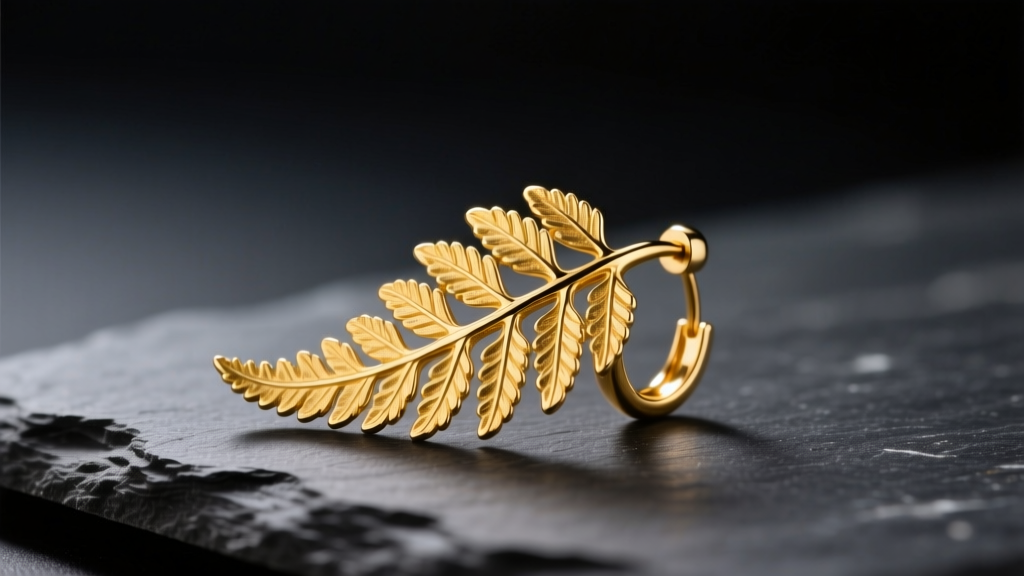
The Metallurgy of Botanical Gold: Alloy Hardness and Tensile Strength
When evaluating the structural viability of gold earrings leaf designs, jewelers must first address the Vickers Hardness (HV) of the chosen alloy. Pure 24k gold sits at approximately 25 HV, making it entirely unsuitable for the rigid stems and delicate venation required in botanical jewelry. According to the Gemological Institute of America (GIA), alloying gold with copper, silver, and zinc drastically alters its mechanical properties, dictating how well a piece will survive daily wear.
For leaf earrings, 18k gold (75% purity) offers a Vickers Hardness of roughly 120-140 HV, providing a luxurious color with adequate rigidity. However, 14k gold (58.3% purity) achieves 140-160 HV, making it the superior choice for high-stress areas like the petiole (the stem connecting the leaf blade to the earring post). The World Gold Council notes that higher copper content in 14k yellow and rose gold alloys not only increases tensile strength but also enhances the warm, organic undertones desirable in nature-inspired pieces.
| Gold Purity | Vickers Hardness (HV) | Tensile Strength (MPa) | Best Application in Leaf Earrings |
|---|---|---|---|
| 24k (99.9%) | ~25 HV | ~120 MPa | Avoid: Too soft, will bend under its own weight. |
| 22k (91.6%) | ~60 HV | ~200 MPa | Heavy cast leaves with no protruding stems. |
| 18k (75.0%) | ~125 HV | ~450 MPa | Standard leaf blades and intricate wire-wrapping. |
| 14k (58.3%) | ~150 HV | ~550 MPa | High-stress stems, shepherd hooks, and ear wires. |
Manufacturing Techniques: Lost-Wax Casting vs. Electroforming
The method used to fabricate gold earrings leaf pieces dictates their microscopic detail and overall weight. Traditional lost-wax casting, often driven by CAD (Computer-Aided Design), is the industry standard. A wax model is 3D-printed, invested in a plaster-like material, burned out in a kiln, and replaced by molten gold via centrifugal force. While efficient, lost-wax casting can suffer from microscopic porosity and slightly rounded edges on the sharpest leaf veins due to the surface tension of molten gold.
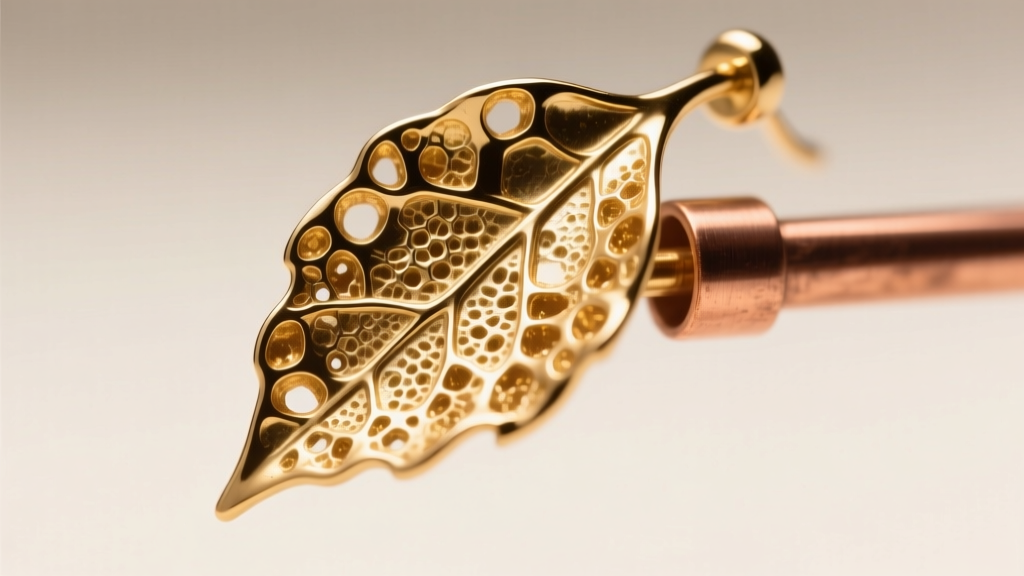
The Electroforming Advantage for Botanical Realism
For hyper-realistic botanical jewelry, expert goldsmiths utilize electroforming. This process involves taking an actual, preserved leaf and coating it in a conductive medium, such as graphite or copper paint. The leaf is then submerged in an electrolytic bath where gold (or a copper base later plated in gold) is deposited atom by atom onto the organic surface. Once the desired thickness (usually 0.15mm to 0.25mm) is achieved, the piece is heated in a kiln. The organic leaf burns away entirely, leaving behind a hollow, ultra-lightweight gold shell that retains the exact cellular structure, stomata, and microscopic imperfections of the original plant. This technique yields earrings that are up to 60% lighter than solid cast equivalents, reducing lobe fatigue during extended wear.
Structural Integrity: Gauge Sizes and Stem Failure Modes
The most common point of catastrophic failure in nature-inspired jewelry is the junction where the leaf blade meets the ear wire. In botanical terms, this is the petiole. In jewelry engineering, it is a high-stress cantilever beam. When a wearer sleeps on or accidentally snags a dangle earring, the bending moment concentrates entirely on this narrow connection point.
Expert Framework: To prevent stress fractures at the petiole, the connecting stem must never be thinner than 18-gauge (1.02mm) in 18k gold. If a delicate aesthetic demands a 20-gauge (0.81mm) wire, the goldsmith must employ severe work-hardening or use a specialized beryllium-copper alloy core, which is then heavily gold-plated.
Furthermore, the ear wire itself must be engineered for resilience. Standard shepherd hooks should be forged from 18-gauge or 16-gauge (1.29mm) spring-hard wire. Annealed (soft) wire will slowly pull open over time, leading to lost earrings. Work-hardening the wire through draw-plate compression ensures the hook retains its tension and shape after repeated insertion into the earlobe.
Botanical Accuracy and Advanced Enameling Techniques
To elevate gold earrings leaf designs beyond simple metalwork, master artisans often incorporate vitreous enameling. The most technically demanding of these is plique-à-jour, a technique that creates a stained-glass effect within the leaf's veins. Unlike standard cloisonné, plique-à-jour has no metal backing. The goldsmith constructs a microscopic gold framework mimicking the leaf's cellular veins and fills the negative space with transparent enamel frit.
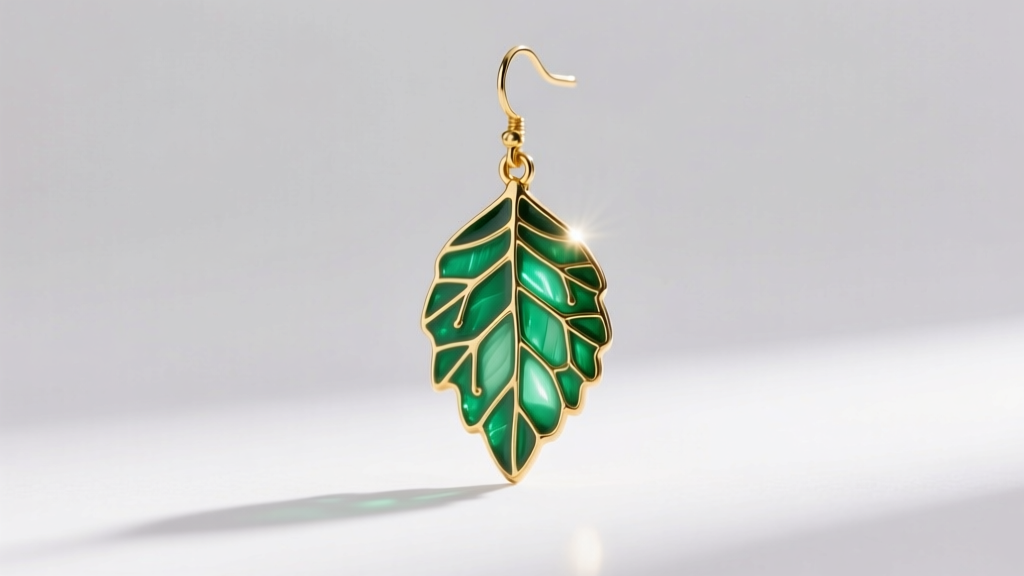
During the kiln firing process (typically around 1400°F or 760°C), the enamel must be supported by a temporary substrate, such as a thin sheet of mica or a copper backing that is later dissolved in acid. The result is a translucent, light-catching leaf vein that mimics the photosynthetic glow of real foliage. However, this technique introduces significant structural fragility. Plique-à-jour leaf earrings must be treated as high-art collector pieces rather than everyday wear, as a sharp impact will shatter the glass-like enamel matrix.
Surface Finishing: Manipulating Light on Botanical Textures
The final surface finish applied to gold earrings leaf pieces drastically alters their visual weight and realism. A uniform high-polish finish often makes a botanical piece look synthetic or plastic-like, as it flattens the micro-textures of the leaf surface. Expert goldsmiths utilize differential finishing to mimic the natural light-scattering properties of plant matter.
The upper surface of the leaf (the adaxial side) is typically finished with a satin or matte texture, achieved through fine-grit abrasive blasting or brushing with a fiberglass pen. This diffuses light, replicating the waxy cuticle of a living leaf. Conversely, the deep venation channels and the underside of the leaf are often high-polished using a magnetic tumbler or a split-lap polishing wheel. This contrast forces the eye to trace the intricate vascular network of the design. When applying these finishes, jewelers must use a protective lacquer mask to prevent cross-contamination of polishing compounds, ensuring the crisp boundary between matte and polished surfaces.
Maintenance Protocols and Ultrasonic Cleaning Risks
Proper maintenance of botanical gold earrings requires a nuanced approach. While solid 14k and 18k gold can generally withstand ultrasonic cleaning, the intricate geometry of leaf motifs creates hidden pockets where polishing compounds and skin oils accumulate. A soft-bristled brush with a mild, non-ammonia surfactant is usually sufficient for the leaf blade.
However, if the gold earrings leaf design incorporates micro-pavé diamond dew drops or the aforementioned plique-à-jour enamel, ultrasonic cleaners are strictly prohibited. The high-frequency acoustic cavitation will easily dislodge micro-set stones from their delicate prongs and will instantly shatter unsupported enamel. For these complex pieces, professional steam cleaning at low pressure or meticulous hand-cleaning with a wooden pick and cotton swab is the only safe protocol to preserve the structural and aesthetic integrity of the jewelry.


