The Loewe Earring: A Technical Deep Dive Into Craft & Materials
Explore the technical engineering, metallurgy, and authentication markers of the iconic Loewe earring in this expert deep dive guide.

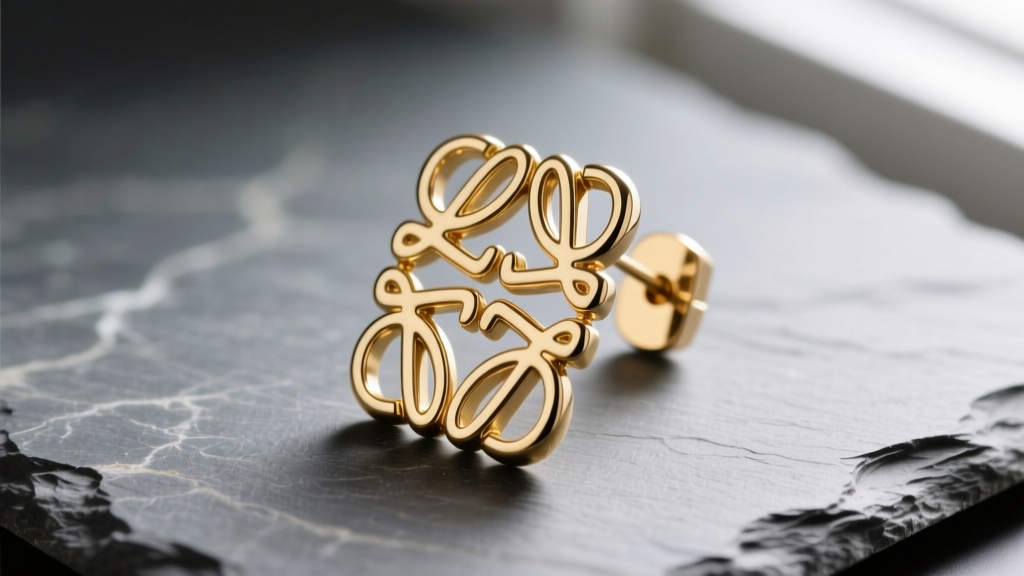
The Architecture of the Loewe Earring
When evaluating luxury fashion jewelry in 2026, the conversation often skews toward brand prestige rather than structural engineering. However, the anatomy of a genuine loewe earring reveals a fascinating intersection of avant-garde design and rigorous metallurgical standards. Far from simple stamped metal, these pieces are exercises in weight distribution, alloy selection, and micro-mechanics. Whether you are examining the iconic four-L Anagram monogram drops or the surrealist resin-and-pearl studs, understanding the technical specifications is crucial for collectors, authenticators, and enthusiasts alike.
In this expert deep dive, we bypass the marketing gloss to examine the exact material grades, casting methods, and ergonomic considerations that define Loewe’s earwear. By understanding these technical hallmarks, you can better assess the longevity, comfort, and authenticity of these highly sought-after accessories.
Metallurgy and Base Material Specifications
The foundation of most Loewe fashion earrings is not solid gold or silver, but rather a high-grade jeweler’s brass. Specifically, the brand frequently utilizes a CuZn30 alloy (70% copper, 30% zinc). This specific ratio is chosen for its optimal fluidity during the casting process, allowing for the razor-sharp edges and deep undercuts required by the intricate Anagram motif.
Lost-Wax Casting vs. Die Casting
While mass-market fashion jewelry relies on high-pressure die casting using zinc alloys (zamak), Loewe employs traditional lost-wax casting for its signature brass pieces. This method ensures a denser molecular structure, eliminating the microscopic air pockets that cause cheap earrings to snap under tension. The resulting brass base has a distinct yellowish-red hue, which provides a warm, natural undertone for the subsequent plating layers.
Plating Thickness and Tarnish Resistance
The gold-tone finish on a Loewe earring is typically achieved through advanced electroplating, often utilizing a Physical Vapor Deposition (PVD) process for enhanced durability. According to standards outlined by the Gemological Institute of America (GIA), fashion jewelry plating can range from a flash coat of 0.1 microns to a heavy plate of 2.5 microns. Loewe’s gold-tone finishes generally sit in the 1.5 to 2.0-micron range, providing a rich color depth that resists immediate wear.
To combat the natural oxidation of the brass core, the plated pieces are sealed with an electrophoretic e-coat (a clear epoxy resin layer). This microscopic barrier prevents sulfur and moisture in the air from reaching the base metal, significantly delaying the onset of verdigris (green tarnish) and preserving the high-polish finish.
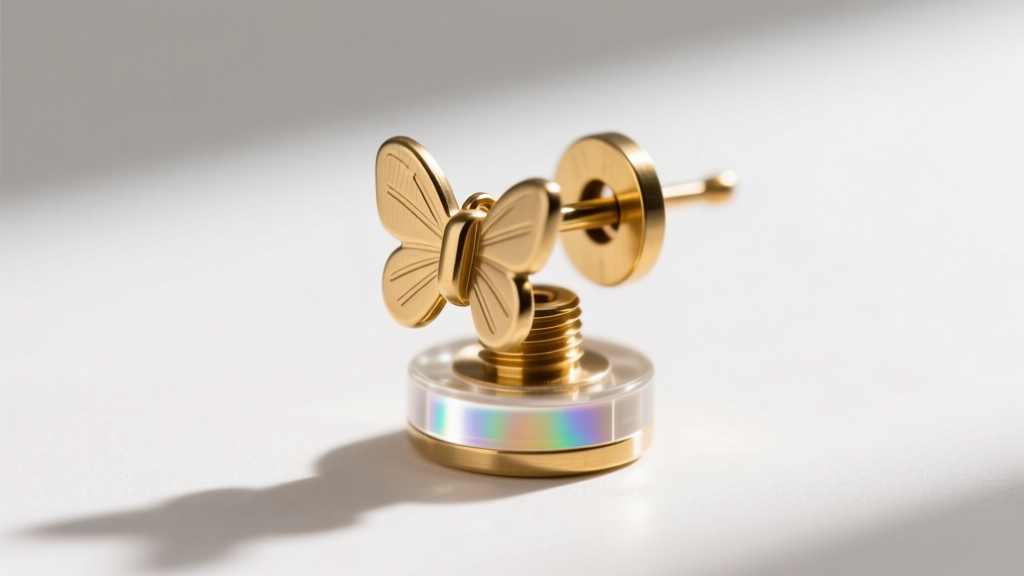
Ergonomics: Gauge, Weight, and Lobe Tension
A beautifully designed earring is a failure if it stretches the earlobe or falls out during wear. Loewe’s technical team pays meticulous attention to the post-and-clutch mechanism, adapting the engineering based on the overall mass of the earring.
Post Gauge and Friction Mechanics
Standard lightweight studs typically feature a 20-gauge (0.81mm) post. However, for the heavier brass Anagram drops and geometric hoops, Loewe upgrades to an 18-gauge (1.02mm) post. This thicker gauge prevents the metal from bending when the wearer inserts the earring or adjusts the backing. The posts are precision-machined with a deep, clean groove near the tip. This groove is critical: it locks into the spring-steel insert of the butterfly clutch (friction back), providing a tactile 'click' and requiring a specific Newton-force to remove, thereby preventing accidental loss.
The Counterweight Engineering in Drop Styles
Heavy drop earrings notoriously cause 'earlobe droop,' where the weight of the brass pulls the decorative element below the earlobe, hiding the design. To counteract this, Loewe engineers hidden counterweights into the clutch backs of their heavier drops, or utilizes hollow-casting techniques for the brass body. By reducing the overall mass of the decorative face to under 12 grams while maintaining the visual volume, the earring sits flush against the ear without requiring heavy, uncomfortable tension on the piercing.
Material Integration: Resin and Freshwater Pearls
Beyond metalwork, Loewe frequently integrates organic and synthetic materials, requiring entirely different manufacturing tolerances.
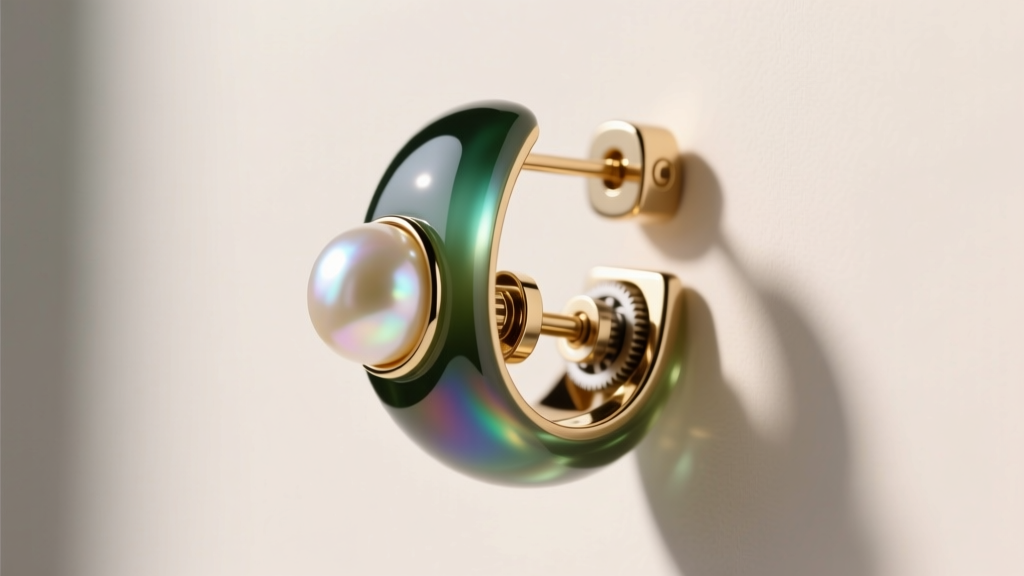
- Freshwater Pearls: When pearls are featured, they are rarely glued flat. Instead, they are half-drilled and mounted onto a brass peg using a two-part cyanoacrylate or epoxy adhesive, ensuring the pearl does not snap off under lateral stress.
- Acrylic and Resin: The brand’s surrealist motifs often use poured resin. The technical challenge here is the thermal expansion rate. The resin is formulated to match the expansion coefficient of the brass housing, preventing the material from cracking or popping out when exposed to body heat or varying environmental temperatures.
Authentication Matrix: Spotting Technical Flaws
As the secondary market for luxury accessories expands, so does the sophistication of counterfeits. However, replicating Loewe’s metallurgical and mechanical standards is cost-prohibitive for counterfeiters. Below is a technical comparison chart to help authenticate a Loewe earring based on physical properties.
| Technical Marker | Authentic Loewe Earring | Common Counterfeit |
|---|---|---|
| Base Metal Scratch Test | Yellowish-red (Jeweler's Brass) | Silvery-grey (Zamak/Zinc Alloy) |
| Hallmark Engraving | Deep, crisp laser or stamped 'LOEWE' and 'Made in Spain' with uniform depth | Shallow, fuzzy laser etching; often missing the country of origin |
| Post Thickness | Consistent 18G (1.0mm) on drops; smooth finishing | Thin, bendable 20G or 22G wire; sharp unpolished edges |
| Butterfly Clutch Tension | High-tension spring steel insert; deep post groove lock | Soft brass or plastic clutch; lacks a locking groove, slips easily |
| Anagram Joint Seams | Seamless lost-wax casting; joints are fully fused and polished | Visible soldering lines or glue residue at the letter intersections |
"The true hallmark of luxury fashion jewelry is not the logo, but the invisible engineering. A master-crafted piece will feel balanced in the hand, sit flush on the ear, and feature mechanical closures that operate with precision." — Master Bench Jeweler Assessment Standards.
Care and Maintenance of Plated Brass
Even with advanced e-coating, the longevity of a gold-plated brass earring depends heavily on user maintenance. The primary enemy of the e-coat is friction and chemical degradation from cosmetics.
- Chemical Avoidance: Hairsprays, perfumes, and lotions contain alcohols and volatile organic compounds (VOCs) that slowly dissolve the epoxy e-coat. Always apply cosmetics before putting on your earrings.
- Friction Management: Store pieces individually in microfiber pouches. Storing multiple pieces in a single hard box causes micro-scratches that breach the anti-tarnish layer, exposing the brass to oxygen.
- Cleaning Protocol: Never use ultrasonic cleaners or silver dip solutions, as these will strip the gold-tone PVD layer. Instead, use a dry, lint-free microfiber cloth to gently buff away skin oils after every wear.
Conclusion
The modern loewe earring is a masterclass in balancing artistic vision with material science. From the specific CuZn30 brass alloys and lost-wax casting techniques to the ergonomic 18-gauge posts and precision-machined butterfly clutches, every element is engineered for both aesthetic impact and structural integrity. By understanding these technical details, collectors and enthusiasts can better appreciate the craftsmanship involved, authenticate pieces with confidence, and maintain their jewelry for years to come. For more insights into luxury jewelry construction, explore the Loewe Official Jewelry Archives and industry metallurgical standards.


