Anatomy of a Luxury Mushroom Earring: Metals, Enamel & Gauge Guide
Discover the technical anatomy of a luxury mushroom earring. We break down vitreous enamel, 14k vs 18k gold casting, gauge sizing, and cartilage fit.

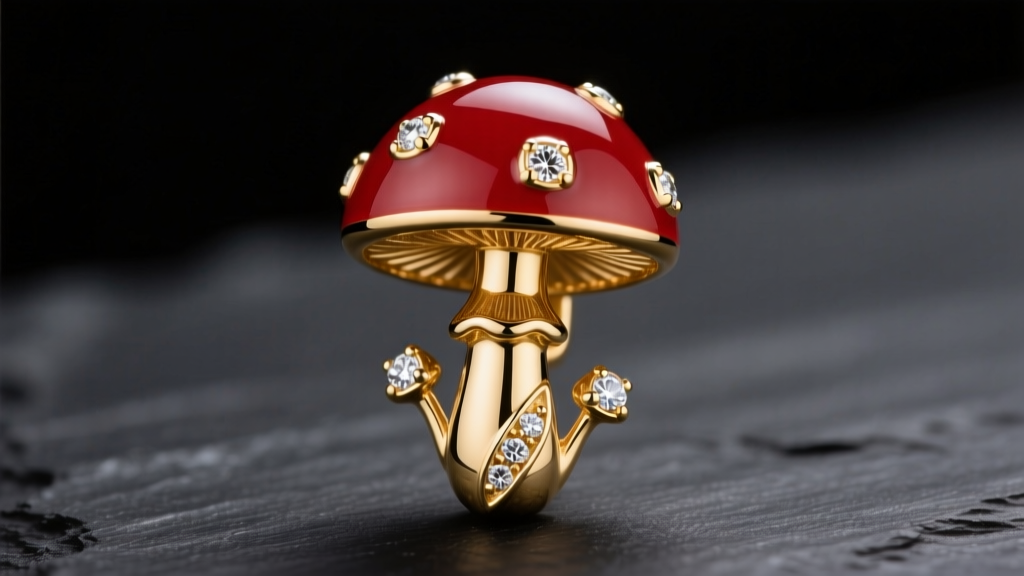
The transition of the mushroom earring from a fleeting cottagecore novelty to a staple of high jewelry and artisanal metalsmithing requires a rigorous approach to design, metallurgy, and ergonomics. While mass-market fashion jewelry relies on cheap alloys and painted resins, a true luxury mushroom earring demands a mastery of lost-wax casting, vitreous enameling, and precise gauge engineering. Whether designed for a standard lobe piercing or a complex cartilage flat, the structural integrity of these miniature sculptures is paramount. In this technical deep dive, we deconstruct the anatomy of fine jewelry mushroom earrings, examining the exact material grades, enameling temperatures, and post specifications that separate heirloom-quality pieces from disposable trends.
The Metallurgy of the Mushroom Cap and Stem
A common failure point in poorly engineered novelty earrings is the junction between the decorative cap and the structural stem. To prevent bending, snapping, or metal fatigue, high-end jewelers utilize a dual-alloy approach or carefully balance the Vickers hardness (HV) of a single karat gold.
Lost-Wax Casting and Alloy Selection
The stem of a mushroom earring must possess high tensile strength to survive daily insertion and removal. For this reason, master casters frequently use 14k yellow or white gold (58.5% pure gold) for the stem and post. The remaining 41.5% is typically an alloy of copper, silver, and sometimes zinc or nickel (though nickel is avoided in modern implant-grade jewelry due to contact dermatitis risks). This composition yields a Vickers hardness of approximately 130-150 HV, providing the necessary rigidity to resist warping in the ear canal.
Conversely, the mushroom cap—especially if it is to be enameled—requires a higher gold content. 18k gold (75% pure gold) or even 22k gold is preferred for the cap. Higher karat gold resists oxidation and fire-scale when subjected to the extreme temperatures of a kiln during the enameling process. If a jeweler attempts to fire vitreous enamel onto standard 14k gold without specialized depletion gilding, the copper in the alloy will oxidize, causing the glass enamel to bubble, pit, or fail to adhere entirely.
Enameling Techniques: Vitreous vs. Cold Epoxy
The vibrant, spotted caps of mushroom earrings are most commonly achieved through enameling. However, not all enamel is created equal. Understanding the distinction between vitreous glass enamel and cold epoxy resin is critical for assessing a piece's longevity and value.
| Enamel Type | Composition | Firing Temp | Mohs Hardness | Longevity & UV Resistance |
|---|---|---|---|---|
| Vitreous (Glass) | Silica, fluxes, metal oxides | 1400°F - 1500°F | 5.0 - 6.0 | Exceptional; will not yellow or degrade |
| Cold Enamel (Epoxy) | Resin and hardener | Room Temp / Low Heat | 2.0 - 3.0 | Poor; scratches easily, yellows under UV |
| Plique-à-jour | Translucent glass (no backing) | 1450°F+ | 5.0 - 6.0 | Fragile but visually stunning (stained glass) |
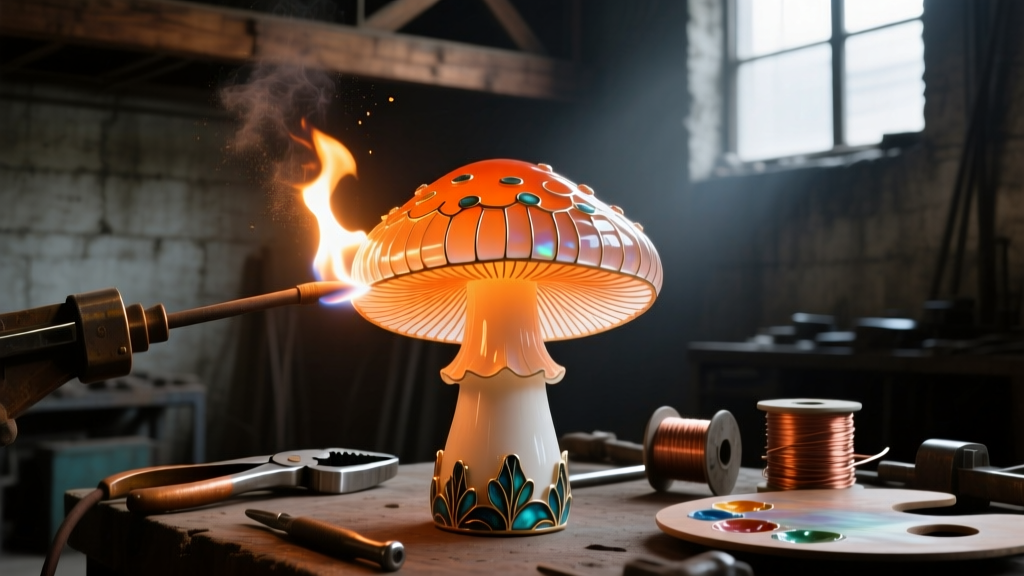
According to historical and technical resources like the Ganoksin Project, vitreous enameling involves grinding glass frit into a fine powder, washing it in distilled water, and packing it into gold cloisons (wire cells) or champlevé (carved out pockets). The piece is then fired in a kiln. For a mushroom earring, achieving the iconic white spots on a red cap requires multiple firings. The jeweler must fire the base red layer, stone it flat with carborundum, apply the white enamel dots, and fire again, carefully managing the melting points so the white dots do not bleed into the red base.
Plique-à-jour for Translucent Gills
For ultra-luxury pieces, artisans may use the plique-à-jour technique to create the translucent gills underneath the mushroom cap. This method involves suspending transparent enamel within a gold framework without a metal backing, allowing light to pass through like a stained-glass window. This requires immense technical skill, as the surface tension of the molten glass must be carefully controlled to prevent it from collapsing out of the microscopic gill cells during firing.
Ergonomics and Gauge Specifications
A beautifully cast mushroom earring is useless if the post geometry causes tissue irritation or migration. The ear's anatomy dictates strict requirements for gauge (thickness) and post length, particularly when transitioning from standard lobe wear to cartilage piercings like the helix, tragus, or flat.
Lobe vs. Cartilage Sizing
Standard friction-back earrings typically utilize a 20-gauge (0.81mm) or 18-gauge (1.02mm) wire. However, for cartilage piercings, the Association of Professional Piercers (APP) strongly recommends thicker, internally threaded, or threadless jewelry to prevent the 'cheese-cutter effect,' where thin wire slowly migrates through the tissue.
- Standard Lobe (Butterfly Clutch): 20G (0.81mm) or 18G (1.02mm). Post length: 8mm - 10mm.
- Cartilage / Helix (Flat-Back Labret): 16G (1.29mm) or 14G (1.63mm). Post length: 6mm (1/4") or 8mm (5/16").
- Tragus (Flat-Back Labret): 16G (1.29mm). Post length: 6mm (1/4") to accommodate the thicker tragal tissue.
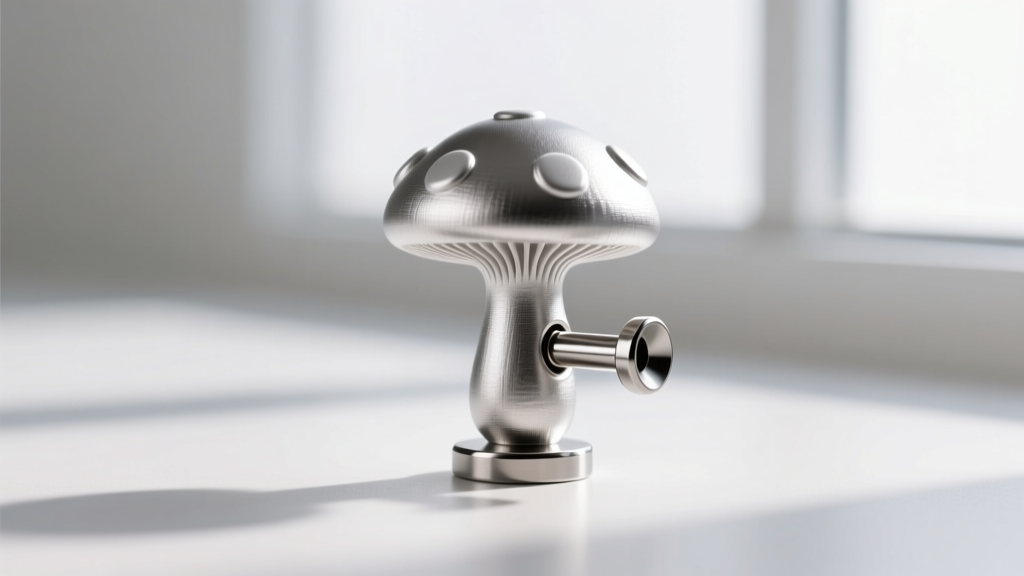
When designing a mushroom earring for a cartilage piercing, the jeweler must integrate a flat-back disc rather than a traditional butterfly clutch. The decorative mushroom cap is laser-welded or soldered to an ASTM F-136 implant-grade titanium or 14k solid gold labret post. The connection point must be smoothed and polished to a mirror finish to prevent the accumulation of sebum and dead skin cells, which can lead to irritation bumps (hypertrophic scarring) around the piercing fistula.
Gemstone Integration: Setting the 'Spores'
To elevate a mushroom earring from a simple enameled charm to a high-jewelry piece, designers often incorporate melee diamonds or colored gemstones to represent dew drops or spores. The setting technique must be flush and snag-free, as protruding prongs will catch on hair and clothing.
Flush and Gypsy Settings
The most common method for setting spores on the mushroom cap or stem is the flush setting (also known as a gypsy or burnish setting). The jeweler uses a hart burr to carve a precise seat into the gold, matching the exact pavilion angle of the diamond (typically 40.75 degrees for a round brilliant). The stone is pressed into the seat, and a highly polished burnisher is used to push the surrounding metal over the diamond's girdle. This creates a completely smooth surface where the gemstone appears to be embedded directly into the metal or enamel, ensuring zero snagging.
For the underside of the cap, micro-pavé settings can be used to line the gills with 0.005ct to 0.01ct single-cut diamonds, creating a hidden halo of sparkle that is only visible when the wearer moves their head or pulls their hair back.
Maintenance and Ultrasonic Cleaning Warnings
Proper maintenance of a luxury mushroom earring requires an understanding of its composite materials. While solid gold and diamonds can easily withstand the high-frequency vibrations of an ultrasonic cleaner, vitreous enamel and opals cannot. The microscopic fissures inherent in glass enamel can propagate under ultrasonic stress, leading to catastrophic cracking or crazing of the mushroom cap.
Furthermore, if the earring features a cold epoxy resin or glued-in pearls (often used to mimic the rounded, bulbous nature of certain fungi), ultrasonic waves and heat will dissolve the adhesives and cloud the resin. The only safe cleaning method for enameled mushroom earrings is a gentle soak in warm water with a mild, phosphate-free dish soap, followed by careful agitation with an extra-soft baby toothbrush. The post and threading should be dried immediately with compressed air or a lint-free cloth to prevent water spots and mineral buildup.
Conclusion
The creation of a fine jewelry mushroom earring is an exercise in balancing aesthetic whimsy with uncompromising structural engineering. From selecting the correct gold karat to withstand kiln temperatures, to calculating the exact gauge required for safe cartilage wear, every millimeter of the piece serves a functional purpose. By understanding the metallurgy, enameling techniques, and ergonomic standards outlined above, collectors and enthusiasts can confidently identify, evaluate, and care for luxury botanical jewelry that will endure for generations.


