Can You Wear Earrings During a Mammogram? A Material Science Guide
Wondering if you can wear earrings during a mammogram? Discover how different earring materials interact with X-rays and how to keep piercings safe.


The Short Answer: Radiopacity and Imaging Artifacts
If you are asking, 'can you wear earrings during a mammogram?' the strict medical answer is no. Standard metallic earrings must be removed before your imaging appointment. However, from a material science and body modification perspective, the more accurate answer is that you cannot wear radiopaque materials, but you absolutely can wear radiolucent piercing retainers to keep your fistulas open during the procedure.
Mammography relies on low-energy X-rays, typically operating between 25 and 35 kilovoltage peak (kVp). At this specific energy spectrum, the photoelectric effect dominates X-ray absorption. Materials with high atomic numbers (Z) absorb these photons almost entirely, creating stark white voids on the resulting digital radiograph. More problematically, dense metals cause 'beam hardening' and 'streak artifacts'—starburst patterns that scatter across the image. These artifacts can easily obscure underlying breast tissue, hide malignant microcalcifications, or mimic the very calcifications radiologists are trying to detect.
According to guidelines from the American Cancer Society, patients are instructed to remove all jewelry from the neck up, including earrings, necklaces, and hairpins, to ensure an unobstructed diagnostic field. But for those with fresh piercings, stretched lobes, or complex cartilage setups, removing jewelry entirely risks rapid closure or severe irritation. This is where understanding material properties becomes critical.
How Different Earring Materials React to X-Rays
To understand why your favorite studs or hoops are prohibited, we must look at the atomic structure of common jewelry metals. The higher the atomic number, the more radiopaque the material. Even metals celebrated for their biocompatibility in the piercing world, like implant-grade titanium, are entirely unsuitable for X-ray imaging.
| Material | Atomic Number (Z) | Radiopacity Level | Mammogram Safe? |
|---|---|---|---|
| Platinum (Pt) | 78 | Extreme (Blocks 100% of low-kVp X-rays) | No |
| Gold (Au - 14k/18k) | 79 (Alloyed) | Extreme (Severe starburst artifacts) | No |
| Surgical Steel (316L) | 26 (Fe base) | High (Obscures tissue margins) | No |
| Titanium (Ti - Grade 23) | 22 | High (Causes beam hardening streaks) | No |
| Niobium (Nb) | 41 | Moderate to High (Visible artifacting) | No |
| Borosilicate Glass | ~11 (Si/Na/O) | Very Low (Radiolucent) | Yes |
| PTFE (Teflon) | 6 (C) / 9 (F) | None (Completely Radiolucent) | Yes |
| Quartz (SiO2) | 14 (Si) / 8 (O) | Very Low (Radiolucent) | Yes |
As highlighted by RadiologyInfo.org, a collaborative resource by the American College of Radiology, even small metallic objects near the periphery of the imaging field can cause scatter that degrades the contrast resolution of the entire breast profile. Therefore, swapping to low-Z materials is the only viable workaround.
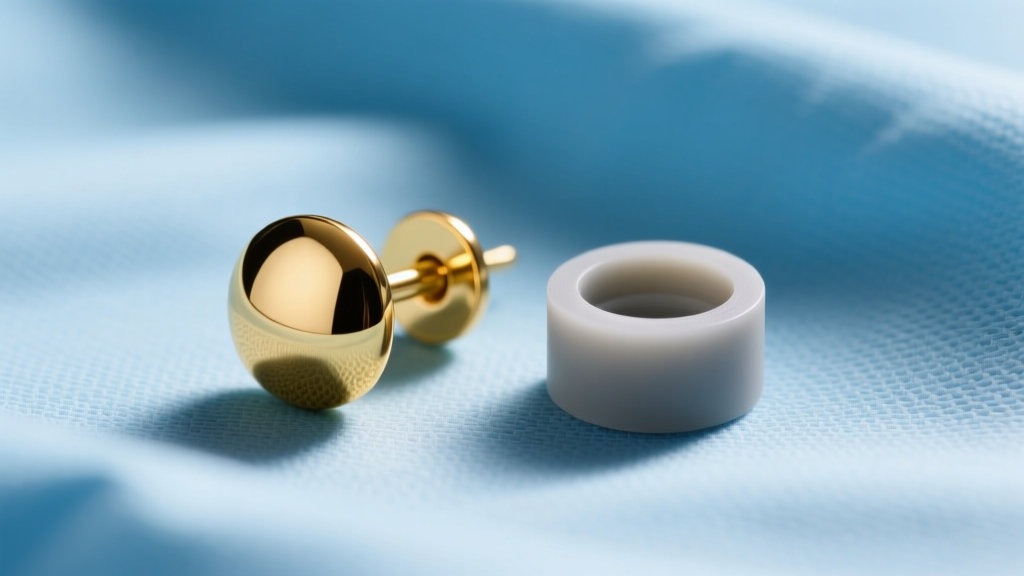
Safe Piercing Retainers: Material Properties for Medical Scans
When you must remove metal for a mammogram, MRI, or CT scan, you need a retainer that is biocompatible, structurally sound, and entirely radiolucent. Here is a deep dive into the three best materials for medical imaging retainers.
Borosilicate Glass
Borosilicate glass (often known by the brand name Pyrex) is the gold standard for medical imaging retainers. Unlike standard soda-lime glass, borosilicate contains boron trioxide, which gives it a very low coefficient of thermal expansion. This means it can be autoclaved for sterilization without shattering. From an imaging perspective, its low atomic number components (Silicon, Oxygen, Sodium, and Boron) allow X-rays to pass through unimpeded. For standard lobe piercings (typically 18g to 14g), glass eyelets or flat-back glass plugs provide a smooth, non-porous surface that will not harbor bacteria while you wait for your scan.
PTFE (Polytetrafluoroethylene)
PTFE, commonly known as Teflon, is a synthetic fluoropolymer that is completely radiolucent and highly flexible. It is an excellent choice for cartilage piercings (like helixes or tragus) where a rigid glass plug might cause pressure necrosis or discomfort when lying against the mammogram compression plates. PTFE is biocompatible and can be cut to custom lengths, making it ideal for awkward angles. However, PTFE is slightly porous on a microscopic level and can scratch. It should not be used in unhealed piercings, and it must be replaced regularly to prevent bacterial biofilm buildup.
Fused Quartz and Obsidian
For those seeking natural or semi-precious stone options, fused quartz and polished obsidian are entirely radiolucent. Quartz is incredibly hard (7 on the Mohs scale) and takes a high polish, reducing friction during insertion. However, stone retainers are brittle. They are best suited for fully healed, straight fistulas like standard earlobes, and should be avoided in areas prone to impact or bending.
Piercing Closure Timelines: Why You Need a Retainer
Many patients wonder if they can simply remove their earrings for the 20-minute mammogram appointment and reinsert them immediately after. The feasibility of this depends entirely on the anatomy and age of the piercing.
- Standard Earlobes (Healed, >2 years old): Can typically remain empty for 2 to 4 hours without significant shrinkage. Reinsertion may require a gentle taper.
- Standard Earlobes (Fresh, <6 months): Will begin to close within minutes. A glass or PTFE retainer is mandatory.
- Cartilage (Helix, Conch, Tragus): Cartilage fistulas are notorious for rapid contraction. Even fully healed cartilage piercings can shrink enough to prevent jewelry reinsertion within 30 to 60 minutes of removal.
- Stretched Lobes (00g and larger): While the hole will not close completely, the tissue will rapidly contract, making reinsertion of heavy metal jewelry painful and prone to causing micro-tears.

Step-by-Step Protocol for Your Mammogram Appointment
To ensure a smooth experience and protect your piercings, follow this material-focused protocol recommended by the Association of Professional Piercers (APP) and radiology technicians:
- Source Your Retainers Early: Purchase high-quality borosilicate glass or PTFE retainers at least a week before your appointment. Ensure the gauge matches your current jewelry exactly (e.g., do not force a 16g retainer into a 14g piercing).
- Swap 24 Hours Prior: Do not wait until you are in the clinic waiting room. Swap your metal earrings for retainers the night before. This gives your tissue time to settle and reduces the risk of swelling or irritation.
- Sterilize the Retainers: If using glass or quartz, boil them in distilled water for 10 minutes or wipe with a sterile saline solution before insertion. Do not use harsh chemical alcohols on PTFE, as it can degrade the polymer over time.
- Inform the Technician: When you arrive, explicitly tell the mammography technologist that you are wearing non-metallic, radiolucent glass or plastic retainers. While they likely will not show up on the X-ray, transparency ensures they do not mistake a dense shadow for an anomaly if a retainer has a slight manufacturing defect.
- Reinsert Metal Post-Scan: Once your imaging is complete, you can immediately swap back to your titanium, gold, or steel earrings. Wash your hands and use a water-based lubricant if the tissue feels tight.
What If You Forget and Wear Metal Earrings?
If you arrive at the clinic wearing your standard 18k gold hoops or titanium studs and have no retainers on hand, you will be asked to remove them. If your piercings are fully healed and mature, simply place your earrings in a secure container in your purse. The compression and positioning of a mammogram take only a few minutes per breast. The total time your ears will be empty is usually less than 20 minutes. While cartilage may feel slightly tight when you reinsert your jewelry afterward, a warm compress and gentle wiggling of the post will usually ease the metal back through the fistula without causing trauma.
Never attempt to tape metal earrings down or cover them with bandages during a mammogram. The metal will still cause severe X-ray scatter artifacts, and the adhesive can irritate the delicate skin around the piercing site, complicating both the imaging and the healing process.
Ultimately, understanding the intersection of jewelry metallurgy and medical imaging empowers you to maintain your personal style and body modifications without compromising your diagnostic health. By keeping a dedicated set of borosilicate glass or PTFE retainers in your jewelry box, you ensure that you are always prepared for your annual screening.


