Metallurgy & Sizing: The Hoop Earring Mens Silver Guide
Discover the technical details behind the perfect hoop earring mens silver styles, from alloy grades and gauge sizes to clasp mechanics and care.

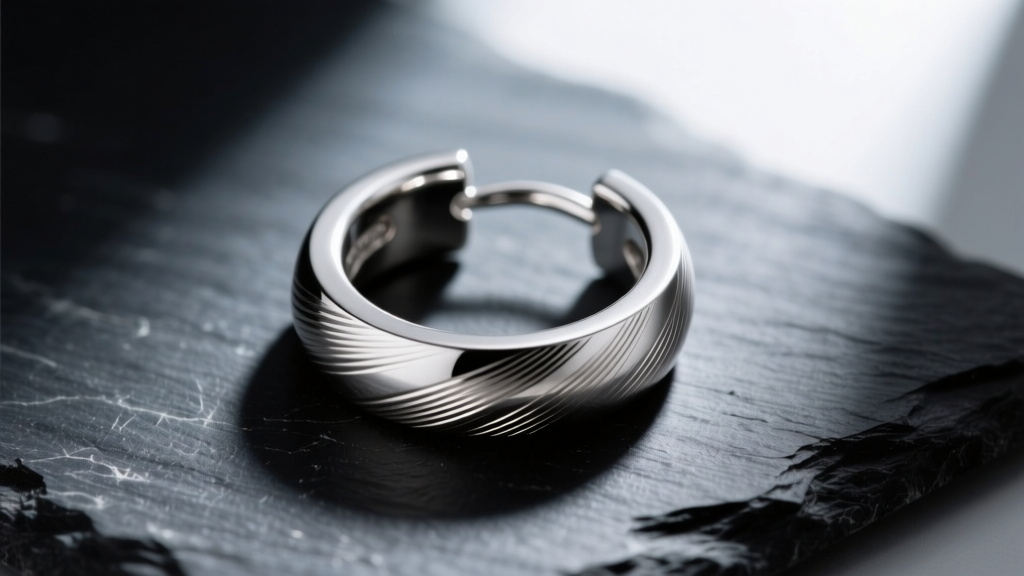
The Engineering Behind the Hoop Earring Mens Silver Market
When evaluating a hoop earring mens silver styles, most buyers focus purely on aesthetics, overlooking the complex metallurgical and structural engineering required to make the jewelry durable for daily wear. The modern men's jewelry market has evolved significantly, moving away from flimsy, mass-produced accessories toward substantial, structurally sound pieces that can withstand the rigors of an active lifestyle. As a domain expert in jewelry manufacturing and material science, I approach the selection of silver hoops not just as a fashion choice, but as an exercise in applied metallurgy, biomechanics, and precision engineering.
Whether you are navigating the transition from a standard lobe piercing to a heavier gauge, or seeking a piece that resists the inevitable oxidation caused by skin acidity and environmental sulfur, understanding the technical specifications of your jewelry is paramount. This deep dive will dissect the alloy compositions, gauge-to-diameter ratios, clasp failure modes, and advanced maintenance protocols that separate a premium men's silver hoop from a disposable accessory.
Metallurgical Breakdown: 925 Sterling vs. 935 Argentium
The term "silver" in the jewelry industry is heavily regulated, but the specific alloy used drastically alters the performance of a hoop earring. Pure silver (999 fine silver) is entirely unsuitable for structural jewelry. On the Vickers Hardness (HV) scale, pure silver measures a mere 25 HV, making it so malleable that a thick hoop would easily bend out of shape under the weight of a heavy jacket hood or a careless tug.
Standard 925 Sterling Silver
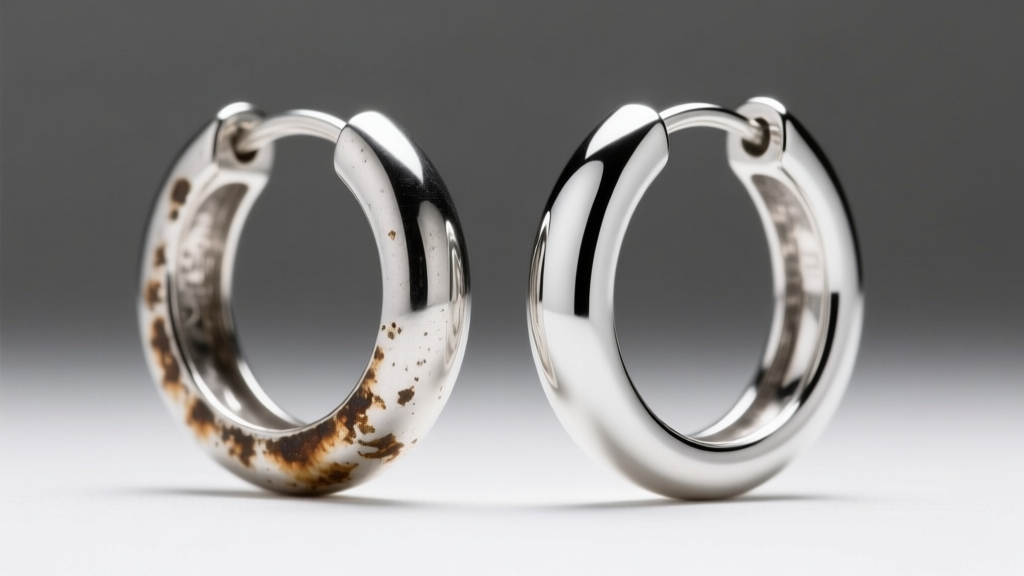
To solve the softness issue, the industry standardizes 925 sterling silver, which consists of 92.5% pure silver and 7.5% copper. This copper addition increases the hardness to approximately 65 HV, providing the necessary tensile strength for a hoop to maintain its circular geometry. However, copper is highly reactive. According to The Silver Institute, the copper content is entirely responsible for the formation of silver sulfide (tarnish) when exposed to atmospheric sulfur and moisture. For men who work in industrial environments, live in high-humidity coastal areas, or have highly acidic skin pH, standard 925 hoops will require frequent polishing.
The Argentium 935 Advantage
For the ultimate low-maintenance hoop earring mens silver buyers should look toward Argentium silver. Patented in the 1990s, Argentium replaces a portion of the copper alloy with germanium. The resulting 93.5% or 96% silver alloy achieves a higher hardness (up to 75 HV when work-hardened) and, crucially, forms a transparent, self-healing layer of germanium dioxide on the surface. This barrier actively blocks sulfur from reaching the copper atoms beneath, making Argentium up to seven times more tarnish-resistant than standard sterling. While Argentium commands a 20-30% price premium over 925 sterling, the reduction in maintenance and the superior structural integrity make it the superior choice for heavy-gauge men's hoops.
Gauge Thickness and Diameter Sizing Matrix
The visual weight and physical comfort of a men's hoop are dictated by the interplay between wire gauge (thickness) and outer diameter. Men's earlobes typically possess denser connective tissue than women's, allowing for thicker gauges without the risk of "cheese-cutter" migration, provided the piercing was initially healed at an appropriate size. Below is the technical sizing matrix for male ear anatomy.
| Gauge (G) | Thickness (mm) | Visual Weight | Best Placement | Structural Notes |
|---|---|---|---|---|
| 20G | 0.81mm | Delicate / Minimalist | Standard Lobe, Upper Helix | Prone to bending; lacks masculine visual weight. |
| 18G | 1.02mm | Standard / Versatile | Standard Lobe, Cartilage | The industry baseline; good balance of comfort and durability. |
| 16G | 1.29mm | Substantial / Bold | Lobe, Helix, Conch | Ideal for huggie styles; resists deformation during sleep. |
| 14G | 1.63mm | Heavy / Statement | Healed Lobe Only | Requires a stretched or naturally thick piercing; maximum durability. |
| 10G - 8G | 2.5mm - 3.2mm | Industrial / Extreme | Stretched Lobes | Requires specialized hinged clasps; continuous wire is impossible. |
For the classic, masculine look, a 16-gauge (1.29mm) or 14-gauge (1.63mm) wire paired with a 15mm to 25mm outer diameter provides the optimal ratio of presence to comfort. Anything thinner than 18G often reads as fragile, while diameters exceeding 35mm can interfere with over-ear headphones or motorcycle helmets, introducing leverage points that can tear the piercing.
Clasp Mechanics and Structural Failure Modes
The clasp is the single most critical point of failure on any hoop earring. The physics of a circular earring means that any lateral pressure applied to the hoop transfers directly to the hinge and the latch. Understanding these mechanisms is vital for preventing loss and ensuring longevity.
Hinged Snap Clasps (The Gold Standard)
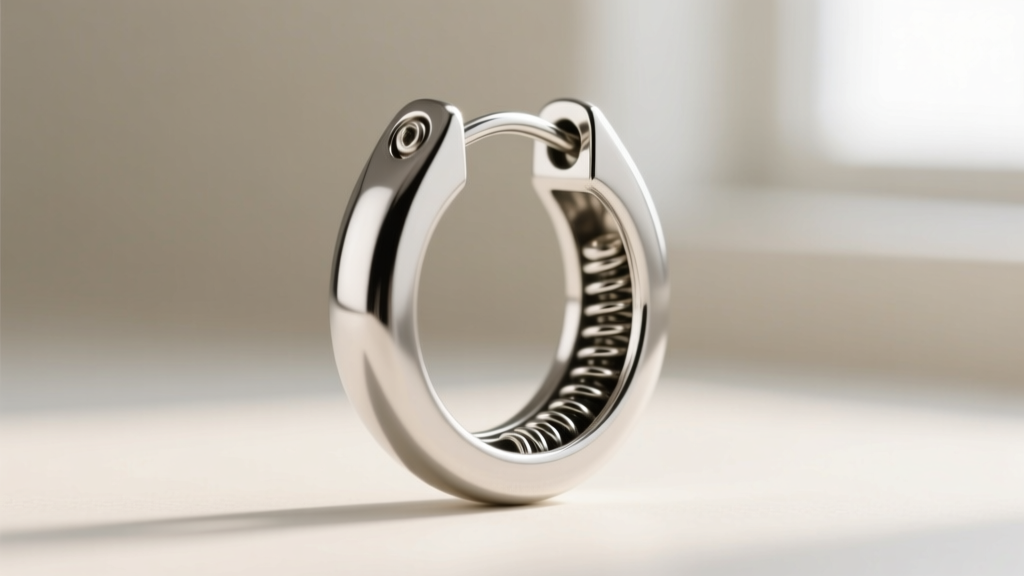
For gauges 16G and thicker, the hinged snap clasp is the only mechanically sound option. This design features a precision-machined hinge on one side and a tension-fit latch on the other. The latch relies on a microscopic groove and a corresponding ridge that snap together. High-end manufacturers use a slight taper in the wire to create a friction lock. The primary failure mode of a hinged snap is metal fatigue at the hinge pin if the earring is repeatedly forced open past its 90-degree stopping point. Always open the hoop gently and never use the earring itself as leverage to pry it apart.
Continuous (Endless) Wire Hoops
Continuous hoops feature a thin, slightly tempered wire that slides through the piercing and tucks into a hollow receiving tube on the opposite end. While they offer a seamless aesthetic, they are a structural liability for men's jewelry. The constant bending required to open and close the wire work-hardens the silver, eventually leading to a brittle snap. Furthermore, the tension holding the wire inside the tube degrades over time, making continuous hoops highly susceptible to falling out during physical activity or while changing shirts.
Captive Bead Rings (CBR)
CBRs rely on the inherent tensile strength of the metal ring to hold a small bead in place via compression. While incredibly secure once installed, they require specialized ring-opening pliers to remove. For a daily-wear men's hoop, CBRs are generally impractical due to the difficulty of operation, but they remain the most secure option for active individuals who do not plan to remove the jewelry frequently.
Oxidation Control and Long-Term Maintenance
Tarnish on silver is not a sign of poor quality; it is a predictable chemical reaction. According to the Gemological Institute of America (GIA), silver reacts with hydrogen sulfide in the air to form silver sulfide, the black compound we recognize as tarnish. The traditional method of removing this is abrasive polishing with a jeweler's cloth. However, abrasive polishing physically removes a microscopic layer of silver every time it is used. Over years of maintenance, this can round off sharp edges and degrade intricate engravings.
The Electrochemical Reduction Method
For heavy tarnish on solid silver hoops (without gemstones or intentional oxidized blackening), the electrochemical reduction method is vastly superior. This process reverses the chemical reaction without removing any base metal.
- Step 1: Line a glass or ceramic bowl with aluminum foil, shiny side up.
- Step 2: Place the silver hoops in direct contact with the foil.
- Step 3: Add one tablespoon of sodium bicarbonate (baking soda) per cup of water.
- Step 4: Pour boiling water into the bowl, submerging the earrings entirely.
- Step 5: The galvanic reaction will transfer the sulfur from the silver to the aluminum foil. Within 60 seconds, the hoops will be restored to their original luster.
- Step 6: Remove with wooden tongs, rinse in distilled water, and dry with a microfiber cloth.
Conclusion: Investing in Precision
Selecting the ideal hoop earring mens silver requires looking past the surface shine and evaluating the structural reality of the piece. By prioritizing Argentium alloys for superior tarnish resistance, selecting a 14G or 16G wire for appropriate masculine visual weight, and insisting on precision-machined hinged snap clasps, you ensure that your jewelry will survive the physical demands of daily life. True style is not just about how a piece looks on the day of purchase, but how its engineering holds up over years of continuous wear.


