How to Choose the Perfect Orange Hoop Earrings: 2026 Guide
Discover how to choose the perfect orange hoop earrings in 2026. Compare enamel, spessartite, and PVD titanium options, gauges, and pricing.

The 2026 Landscape of Orange Hoop Earrings
Orange has firmly established itself as a dominant force in contemporary jewelry design. Moving far beyond the niche bohemian accents of the past decade, orange hoop earrings are now celebrated as versatile, high-impact wardrobe staples. Whether you are drawn to the fiery depths of a spessartite garnet, the glass-like sheen of kiln-fired enamel, or the modern edge of PVD-coated titanium, selecting the right pair requires a nuanced understanding of materials, mechanics, and structural integrity.
As a senior jewelry analyst, I frequently see consumers purchase vibrant hoops only to be disappointed by chipped pigments, bent hardware, or dulling gemstones within months. This comprehensive 2026 buying guide cuts through the marketing fluff, providing you with the exact technical specifications, material grades, and mechanical insights needed to invest in orange hoops that will last a lifetime.
Decoding Orange: Enamel, Gemstones, and Metals
The method used to achieve the color orange drastically dictates the earring's price point, weight, and longevity. Let us break down the three primary categories you will encounter on the market today.
Vitreous Enamel vs. Epoxy Resin
Not all enamel is created equal. When shopping for orange enamel hoops, you must distinguish between epoxy resin and vitreous enamel. Epoxy is essentially a hardened plastic painted onto the metal and baked at low temperatures. It is prone to yellowing under UV exposure and will chip if the hoop is subjected to torsional stress.
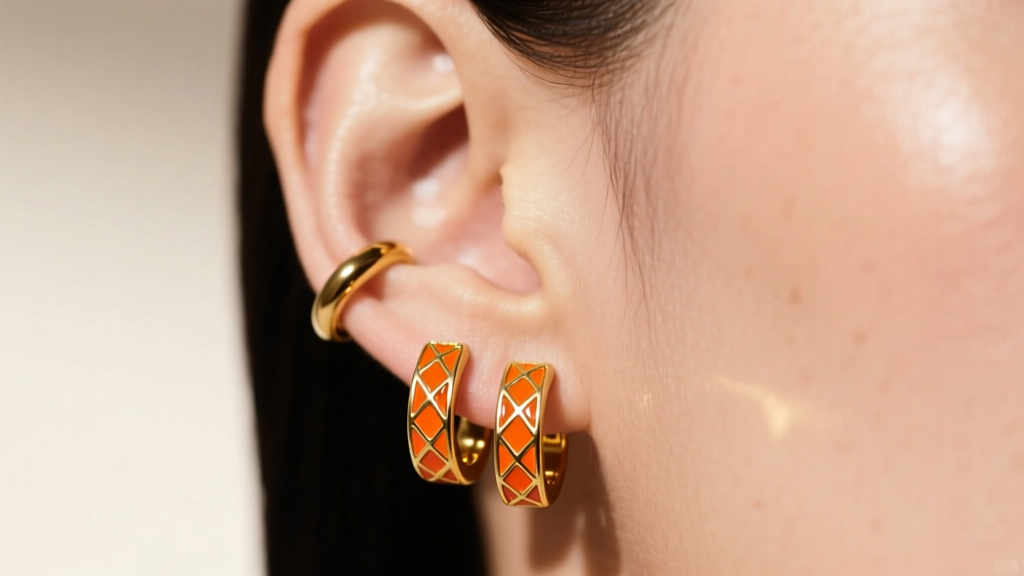
Conversely, high-end vitreous enamel is made from finely ground silica and metallic oxides (which provide the orange hue) that are kiln-fired at temperatures exceeding 1,400°F (760°C). This fuses the glass directly to the metal base. For hoop earrings, the champlevé technique is vastly superior to cloisonné. Champlevé involves carving troughs directly into the metal base (usually copper or 18k gold) and filling them with enamel. Because hoops experience twisting when being inserted into the ear, cloisonné—which relies on delicate wire cells glued to the surface—can easily pop out under stress. Champlevé remains structurally integral to the metal itself.
The Gemstone Hierarchy
If you prefer natural gemstones, the orange spectrum offers three distinct options, each with unique physical properties:
- Spessartite Garnet: The undisputed king of orange gems. Ranging from vivid tangerine to deep reddish-orange, spessartite is a nesosilicate with a Mohs hardness of 7 to 7.5. Crucially, it lacks cleavage planes, meaning it is highly resistant to chipping from daily knocks. According to the Gemological Institute of America (GIA), spessartite is almost never treated with heat or radiation, making it a purist's dream.
- Carnelian: A microcrystalline quartz (Mohs 7) that offers a more muted, earthy reddish-orange. It is highly durable and affordable, though it is porous and can absorb oils from the skin over time, slightly darkening its hue.
- Fire Opal: Famous for its electric, jelly-like orange body color. However, with a Mohs hardness of only 5.5 to 6.5 and a high water content, fire opal is fragile. If you buy fire opal hoops, ensure the stones are set in deep bezels rather than prongs, and never wear them during physical activities.
The PVD vs. Anodized Titanium Reality
For those with metal sensitivities, titanium is the gold standard. The Association of Professional Piercers (APP) strictly recommends ASTM F136 implant-grade titanium for fresh and sensitive piercings. However, achieving a true, vibrant orange on titanium is a metallurgical challenge.
Many brands claim to offer "anodized" orange titanium. Anodizing uses an electrolytic bath and DC voltage to thicken the metal's natural oxide layer, which refracts light to create color. While this works beautifully for purples, blues, and greens, true orange is notoriously difficult to achieve via anodizing; it often results in a muddy bronze or copper hue. In 2026, the most vivid, colorfast orange titanium hoops utilize PVD (Physical Vapor Deposition). This vacuum-chamber process bonds a microscopic layer of titanium nitride or zirconium nitride to the ASTM F136 base, yielding a brilliant, scratch-resistant tangerine finish that will never flake or fade.
Hoop Mechanics and Gauge Sizing
The closure mechanism of a hoop earring is just as important as its aesthetic. The wrong hardware can lead to lost earrings or irritated piercings.
Clickers vs. Hinged Saddles vs. Continuous
Clickers feature a hinged segment that snaps into a specialized groove with an audible "click." They are the most secure option for 16g (1.29mm) cartilage piercings and 18g (1.02mm) lobes. The seamless closure prevents hair and clothing from snagging.
Hinged Saddles utilize a thicker, curved wire that snaps into a hollow tube. While excellent for standard 20g (0.81mm) lobe piercings, the visible hinge line can sometimes disrupt the continuous flow of an orange enamel design.
Continuous (Endless) Hoops consist of a single wire that bends to enter the piercing and threads into a hollow receiving tube. Expert Warning: Never buy continuous hoops if they feature champlevé enamel or pave gemstones. The act of bending the wire to open and close the hoop introduces torsional stress that will eventually crack the enamel or loosen the stone settings.
Sizing Proportions and Face Shapes
The diameter and thickness of your orange hoops should complement your facial structure and piercing placement:
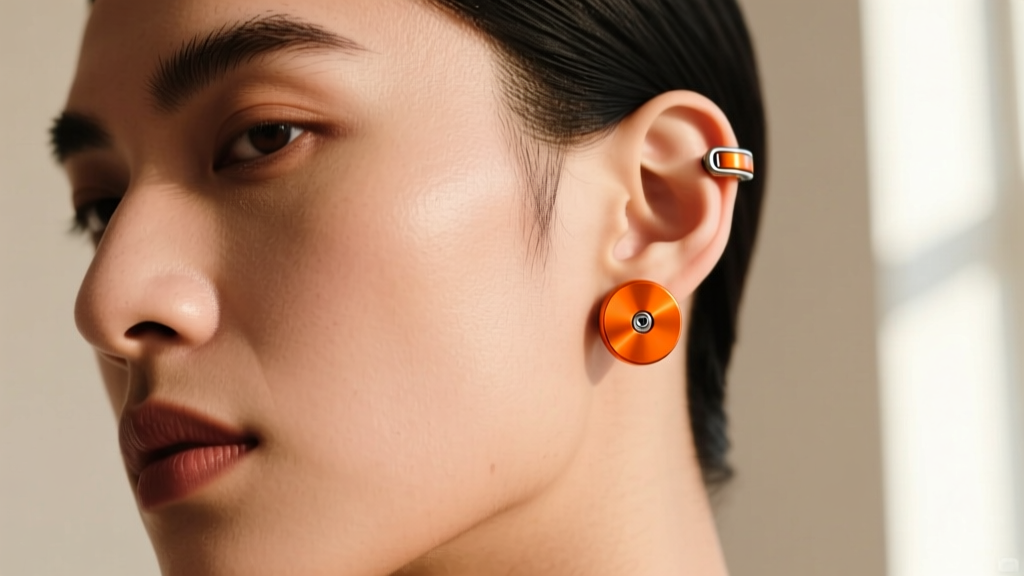
- Huggies (10mm - 14mm inner diameter): Ideal for helix, tragus, and tight lobe piercings. Because they sit flush against the ear, opt for high-impact colors like fire opal or bright PVD titanium to ensure the color registers from a distance.
- Standard Hoops (20mm - 30mm): The most universally flattering size. They frame the jawline beautifully. For round face shapes, choose hoops with a slightly heavier gauge (e.g., 3mm tube thickness) and a deeper burnt-orange enamel to add structural definition.
- Statement Hoops (40mm+): Best for elongated or oval face shapes. When sizing up, weight becomes a critical factor. Solid gold statement hoops can stretch the earlobe over time. Opt for lightweight vitreous enamel over a copper or sterling silver base to maintain a bold silhouette without the gravitational drag.
Investment Matrix: Price vs. Longevity
Understanding the correlation between material, manufacturing technique, and price will help you identify genuine quality versus overpriced costume jewelry.
| Material & Technique | Avg Price Range (Per Pair) | Durability & Colorfastness | Best Use Case |
|---|---|---|---|
| Epoxy Resin over Brass | $25 - $60 | Low. Prone to chipping and UV yellowing. | Occasional wear, fast fashion trends. |
| Carnelian Cabochon (925 Silver) | $80 - $150 | High. Stone is durable, but silver may tarnish. | Everyday lobe wear, earthy aesthetics. |
| Champlevé Enamel (14k/18k Gold) | $350 - $900+ | Exceptional. Glass fuses to gold; will not fade. | Heirloom pieces, daily luxury wear. |
| Spessartite Garnet (18k Gold) | $1,200 - $3,500+ | Superior. Untreated, highly scratch-resistant. | Fine jewelry collectors, investment pieces. |
| PVD Orange (ASTM F136 Titanium) | $90 - $220 | Excellent. Hypoallergenic, scratch-resistant coating. | Cartilage piercings, sensitive skin, active lifestyles. |
Care Protocols for Orange Pigments
Proper maintenance is non-negotiable for preserving the vibrancy of orange jewelry. Never use ultrasonic cleaners on fire opal or enamel hoops. The high-frequency vibrations can cause internal crazing in opals and micro-fractures in glass enamel. Furthermore, the heat generated by ultrasonic baths can soften the adhesives used in lower-tier epoxy pieces.
For routine cleaning, use a few drops of pH-neutral dish soap and lukewarm water. Gently agitate with a soft-bristled baby toothbrush, paying special attention to the underside of the hoop where skin oils and hair products accumulate. For spessartite garnet and PVD titanium, you can safely use a specialized jewelry polishing cloth, but avoid harsh chemical dips, which can strip the microscopic PVD layers or dull the natural luster of unheated garnets.
Final Verdict
When investing in orange hoop earrings in 2026, prioritize structural integrity and material transparency. Demand vitreous champlevé over epoxy, seek out untreated spessartite for gemstone options, and trust PVD-coated ASTM F136 titanium for sensitive cartilage piercings. By matching the correct gauge, closure mechanism, and material to your specific lifestyle, you secure a piece of jewelry that is as technically sound as it is visually striking.