Orange Stud Earrings: A Gemological & Technical Guide
Explore the gemology of orange stud earrings. We analyze spessartite garnet, sapphire, and fire opal specs, setting types, and metal grades for daily wear.

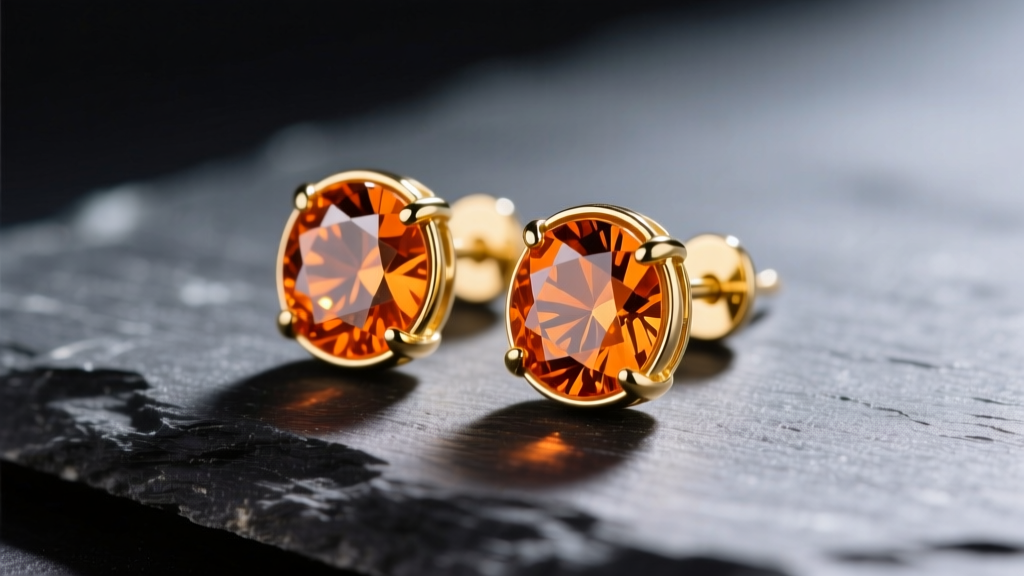
The Science of Color: Sourcing Matched Orange Gemstones
When evaluating orange stud earrings, the primary challenge for gemologists and jewelers is achieving perfect chromatic symmetry. Unlike diamonds, where the 4Cs provide a rigid grading framework, colored gemstones require a nuanced understanding of hue, tone, and saturation. Orange is a secondary spectral color that bridges red and yellow, meaning stones often exhibit modifying hues (e.g., reddish-orange or brownish-orange). For a pair of studs to be considered gemologically matched, their refractive index (RI) and pleochroism must align under both daylight (6500K) and incandescent (3000K) lighting conditions. A mismatched pair will result in one stone appearing 'muddy' while the other remains vivid, drastically reducing the aesthetic and monetary value of the earrings.
Gemological Breakdown: Spessartite vs. Sapphire vs. Fire Opal
The market for orange stud earrings is dominated by three distinct gemological families, each presenting unique structural properties, durability profiles, and pricing metrics. Understanding these differences is critical for selecting a stone that aligns with your wear habits.
| Gemstone | Mohs Hardness | Refractive Index (RI) | Typical Treatment | Price Range (per carat) | Durability Rating |
|---|---|---|---|---|---|
| Spessartite Garnet | 7.0 - 7.5 | 1.73 - 1.75 | None (Unheated) | $150 - $800 | Good (Daily Wear) |
| Orange Sapphire | 9.0 | 1.76 - 1.78 | Heat / Beryllium Diffusion | $1,000 - $5,000+ | Excellent (Heavy Impact) |
| Mexican Fire Opal | 5.5 - 6.5 | 1.45 | None | $50 - $300 | Poor (Occasional Wear) |
| Citrine (Madeira) | 7.0 | 1.54 - 1.55 | Heat Treatment | $10 - $50 | Good (Daily Wear) |
According to the Gemological Institute of America (GIA), Spessartite garnet is highly prized because it is almost never subjected to artificial treatments. Its vivid 'Fanta' orange hue is a result of manganese content within the crystal lattice. Conversely, orange sapphires are frequently subjected to beryllium diffusion—a process where beryllium is introduced during heating to artificially enhance the orange color. Always request a spectroscopic analysis report to confirm whether an orange sapphire is naturally colored or lattice-diffused.
Technical Setting Analysis: Prong vs. Bezel Security
The setting architecture dictates the survival rate of your gemstone. The choice between prong and bezel settings for orange stud earrings must be dictated by the stone's cleavage planes and brittleness.
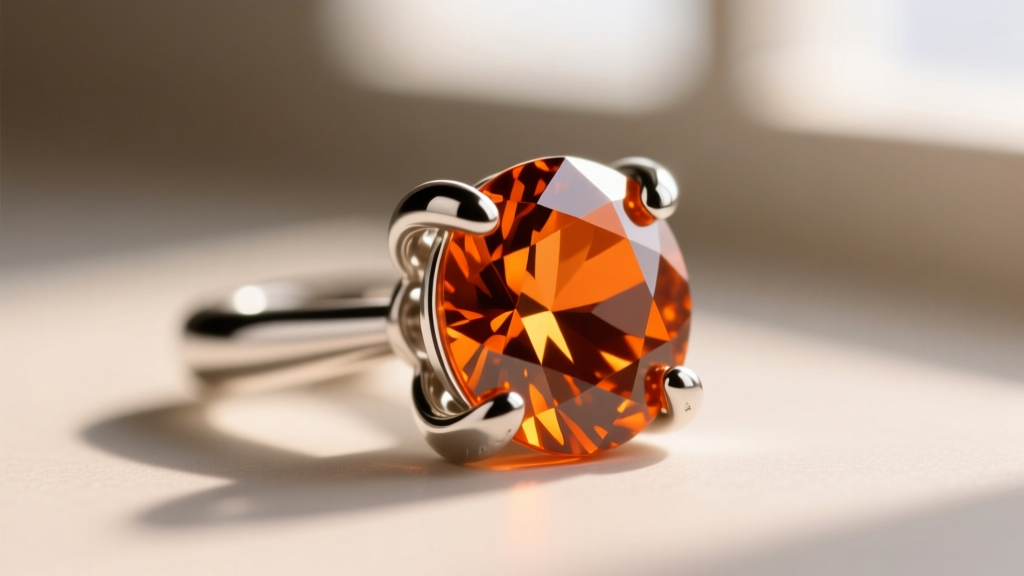
The Physics of Prong Wear
A standard 4-prong setting maximizes light return by leaving the crown and pavilion largely unobstructed. This is ideal for Spessartite garnet and Orange Sapphire, which rely on high refractive indices to generate brilliance. However, prongs are subject to shear stress. Over 18 to 24 months of daily wear, friction against hair, clothing, and bedding will thin an 18k gold prong by approximately 0.05mm to 0.10mm. For stones over 1.5 carats, a 6-prong setting is technically superior, as it distributes the holding force more evenly and provides a fail-safe if one prong snags and lifts.
Bezel Settings for Brittle Stones
Fire opal contains 3% to 10% water within its amorphous silica structure. It lacks crystalline cleavage but is highly susceptible to 'crazing'—a network of fine surface cracks caused by rapid moisture loss or thermal shock. Furthermore, opal is too soft for prongs; the localized pressure of a prong tip will fracture the stone. A full bezel setting in 14k gold or platinum is mandatory for fire opal studs. The bezel must feature a slightly domed top edge to protect the girdle from direct impact, and the backing should be semi-open to allow the stone to breathe and prevent moisture trapping, which can lead to internal clouding.
Metallurgy and Post Gauge Specifications
The structural integrity of orange stud earrings relies heavily on the metallurgical composition of the post and the friction back. Allergic contact dermatitis (ACD) is a common failure mode in cheap jewelry, usually triggered by nickel alloys used in brass or low-karat gold bases.
- 14k and 18k Solid Gold: The industry standard for lobe piercings. 14k (58.5% gold) offers superior tensile strength for the post, resisting bending. 18k (75% gold) provides a richer yellow hue that complements orange stones but is softer and more prone to thread stripping over time.
- ASTM F136 Titanium: For fresh piercings or cartilage placements, implant-grade titanium is non-negotiable. As defined by ASTM International, F136 titanium is entirely nickel-free and highly biocompatible, preventing the body from rejecting the jewelry or forming hypertrophic scars.
- Platinum (950/50): An alloy of 95% platinum and 5% ruthenium or iridium. It is the most secure metal for prong settings due to its high density and malleability, which allows prongs to be burnished tightly against the stone without work-hardening and snapping.
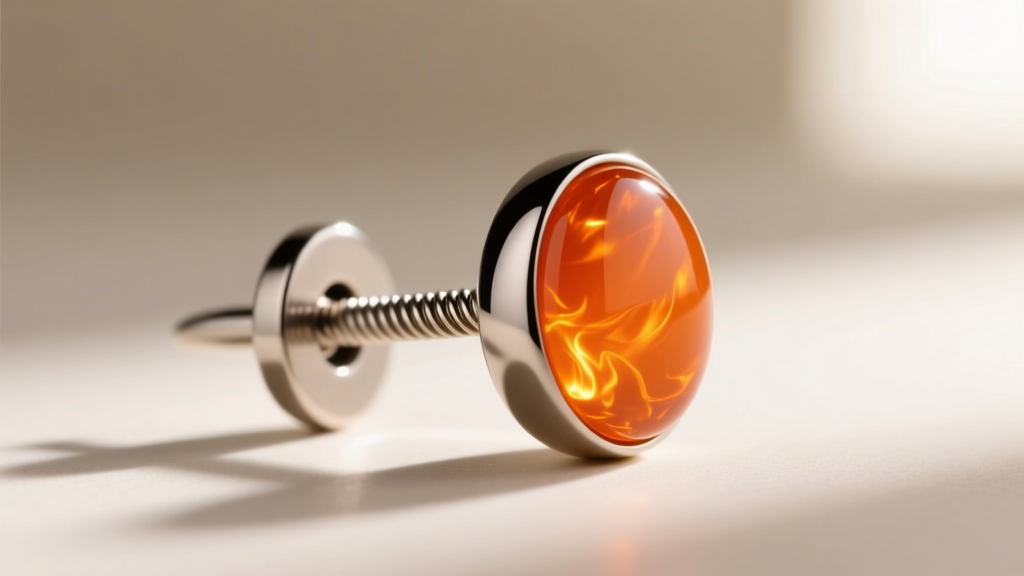
Post gauge thickness is equally critical. Standard lobe piercings are typically 20-gauge (0.81mm) or 18-gauge (1.02mm). However, if you are mounting a dense, 2-carat orange sapphire (which can weigh upwards of 0.7 grams), a 20-gauge post will cause the earring to droop forward at a 30-to-45-degree angle due to the leverage exerted on the earlobe tissue. Upgrading to a 16-gauge (1.29mm) or 14-gauge (1.63mm) post, paired with a wide-base 'jumbo' friction back or a threaded screw-back, provides the necessary structural support to keep the stud facing perfectly forward.
Lobe vs. Cartilage Placement Dynamics
Expert Fitting Rule: Never place heavy, large-diameter orange gemstone studs in the upper cartilage (helix or forward helix). The tissue density and angle of the cartilage will cause the heavy setting to migrate or reject over time. Reserve heavy studs for the primary lobe piercing, and utilize lightweight, bezel-set 3mm to 4mm orange studs with flat-back threaded posts for cartilage placements.
When setting orange studs for the tragus or conch, the post length must be meticulously measured. A standard cartilage post is 6mm to 8mm. If the post is too long, the friction back will slide down the post, creating a gap where bacteria and sebum can accumulate, leading to localized infections. Always opt for internally threaded or threadless (push-pin) mechanisms for cartilage, as external threads can tear the delicate fistula tract during insertion.
Failure Modes and Preventative Maintenance
Even the highest quality orange stud earrings will degrade without a strict maintenance protocol. The most common failure modes include prong lifting, girdle abrasion, and backing loss.
Ultrasonic Cleaning Warnings: While ultrasonic cleaners are excellent for removing sebum and lotions from diamond and sapphire settings, they are catastrophic for fire opal and heavily included spessartite garnets. The high-frequency cavitation bubbles can shatter opals and expand internal fractures in garnets. Instead, use a soft-bristled baby toothbrush with a few drops of mild, phosphate-free dish soap and lukewarm water.
Prong Audits: Every six months, inspect your prong settings under a 10x jeweler's loupe. Run a piece of cotton gauze over the setting; if the cotton snags, a prong has lifted and requires immediate professional burnishing. Catching a lifted prong early prevents the total loss of the orange gemstone.
Final Technical Verdict
Selecting the perfect pair of orange stud earrings requires looking beyond the initial visual appeal of the color. For daily, worry-free wear, an unheated Spessartite garnet set in a 4-prong 14k gold setting on an 18-gauge post offers the best balance of durability, natural beauty, and structural integrity. For collectors seeking maximum hardness and prestige, a beryllium-free orange sapphire in a platinum 6-prong setting is the ultimate technical achievement. By respecting the gemological properties and metallurgical requirements of these stones, you ensure your earrings remain secure, vibrant, and structurally sound for decades.


