The Ultimate Buying Guide for Painted Wood Earrings
Discover what to look for when buying painted wood earrings. Learn about wood density, non-toxic sealants, hardware gauges, and lobe health.

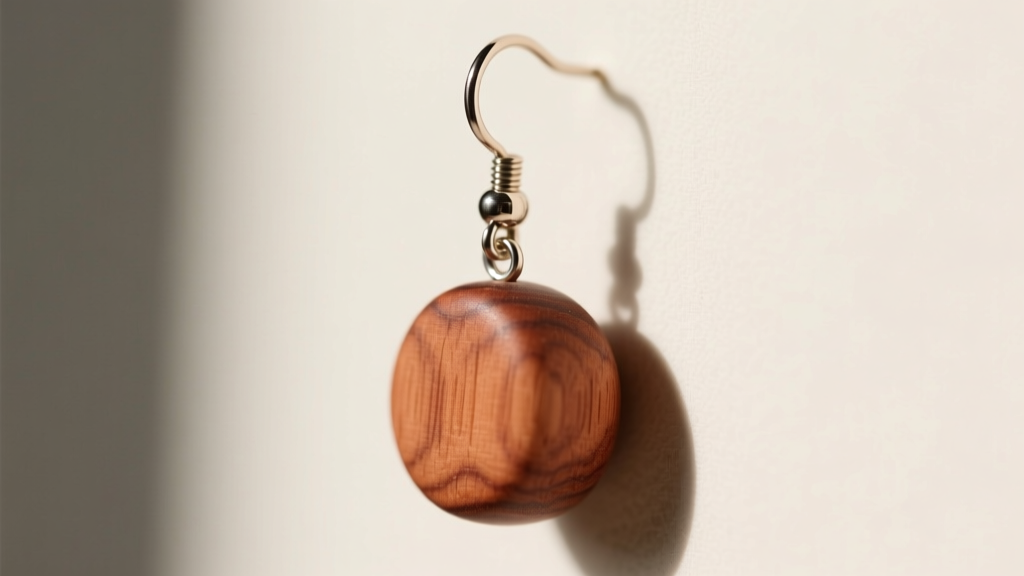
The Appeal and Anatomy of Painted Wood Earrings
Painted wood earrings have transitioned from niche craft fair staples to mainstream fashion essentials, prized for their lightweight nature, sustainable material profiles, and limitless artistic potential. However, the intersection of organic materials, chemical pigments, and metal hardware creates a unique set of challenges for the consumer. A poorly constructed pair can lead to contact dermatitis, lobe fatigue, or rapid structural degradation. This comprehensive buying guide dissects the critical material specifications, hardware mechanics, and safety standards you must evaluate before adding painted wood earrings to your collection.
Wood Species: Density, Weight, and Lobe Fatigue
The foundational integrity of any wood earring relies on the specific gravity and grain structure of the timber used. While wood is inherently lighter than polymer clay or metal, the wrong species can still cause lobe stretching or fail to support the hardware.
Basswood (Tilia Americana)
Basswood is the gold standard for hand-carved and painted earrings. With a specific gravity of roughly 0.32 to 0.59, it is exceptionally lightweight. More importantly, its tight, uniform grain lacks the porous vessels found in oak or ash, meaning it absorbs paint evenly without requiring heavy, weight-adding grain fillers. A standard 2-inch basswood dangle typically weighs between 3 and 5 grams, well below the 15-gram threshold where earlobe fatigue begins to set in.
Birch Plywood
For laser-cut, geometric painted studs, marine-grade or Baltic birch plywood is the industry standard. The cross-laminated layers provide immense dimensional stability, preventing the warping that solid woods experience when exposed to the humidity of human skin. However, buyers must verify that the plywood uses formaldehyde-free adhesives, as off-gassing from cheap urea-formaldehyde glues can cause localized skin irritation.
Materials to Avoid: MDF and Balsa
Medium-Density Fiberboard (MDF) should be strictly avoided. MDF is essentially wood dust held together by synthetic resins that swell and disintegrate upon contact with moisture or sweat. Conversely, while Balsa wood is incredibly light, its cellular structure is too friable (crumbly) to securely hold a jump ring or post without tearing out under the dynamic movement of a dangle earring.
Paint Chemistry and Sealant Safety
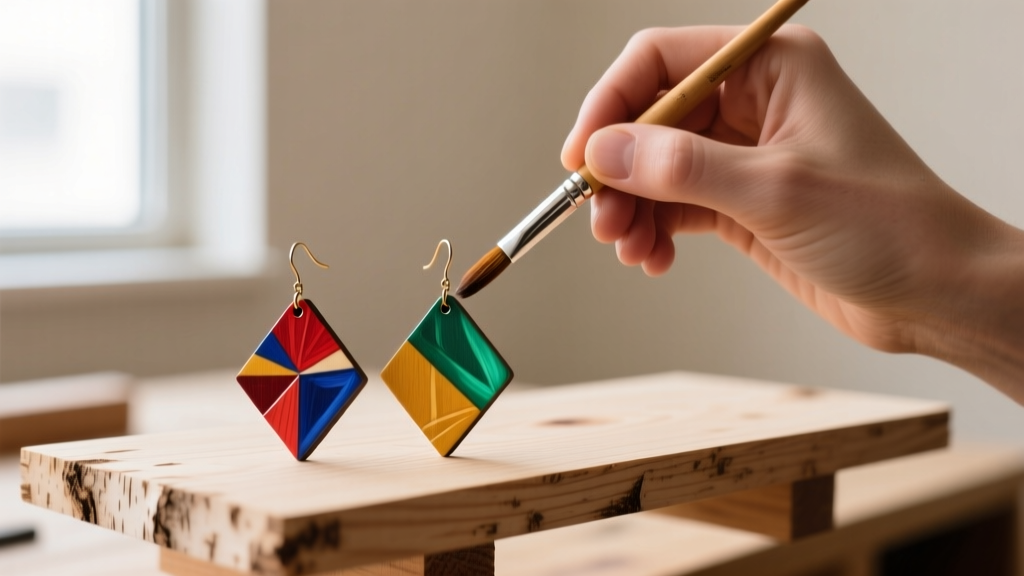
The visual appeal of painted wood earrings is only as safe as the chemical composition of the pigments and topcoats. Because earrings sit in direct, prolonged contact with the skin—and occasionally near the mouth or eyes for those who touch their jewelry—chemical leaching is a primary concern.
Pigment Standards
Reputable artisans use high-quality acrylics or traditional milk paints. When purchasing, look for paints that comply with ASTM D-4236 standards, which ensures the materials have been evaluated by a toxicologist for chronic health hazards. Avoid earrings painted with industrial enamels or unverified spray paints, which often contain heavy metals like lead or cadmium to achieve vibrant reds and yellows.
The Critical Role of the Topcoat
Raw acrylic paint is slightly porous and can harbor bacteria. A sealant is mandatory, but not all sealants are skin-safe once cured.
- Water-Based Polycrylic: The safest and most common choice. It cures to a hard, non-toxic finish that will not trigger contact dermatitis.
- Polyurethane (Oil-Based): Highly durable but contains volatile organic compounds (VOCs). It must be fully cured (often taking up to 30 days) before it is safe for sensitive skin.
- UV Resin: Provides a glass-like, waterproof finish. However, if the artisan does not cure the resin completely under UV light, uncured photoinitiators can leach out and cause severe allergic reactions.
Expert Insight: If a pair of painted wood earrings emits a distinct chemical or "plasticky" odor out of the box, the sealant has not fully off-gassed. Allow them to air out in a well-ventilated space for 72 hours before wearing.
Hardware: The Structural Weak Point
The most common failure point in painted wood earrings is not the wood or the paint, but the hardware attachment. Wood expands and contracts with ambient humidity, which can break rigid glue bonds and widen drilled holes over time.
Post and Hook Gauges
Standard ear piercings are typically 20-gauge (0.81mm) or 18-gauge (1.02mm). Ensure the metal hardware matches these specifications. Thicker 16-gauge wires can cause micro-tears in standard lobe piercings, while ultra-thin 22-gauge wires act like cheese wire, slowly slicing through the earlobe under the pendulum effect of a dangle earring.
Attachment Mechanics
Avoid earrings where the metal post is simply glued flat against the back of the wood using hot glue or basic cyanoacrylate (Super Glue). The shear force of a dangle earring will snap this bond within weeks. Instead, look for:
- Recessed Embedding: The post pad is seated inside a shallow, countersunk recess in the wood, reducing lateral shear stress.
- Jeweler's Epoxy: A two-part epoxy (like G-S Hypo Cement or Devcon) provides a flexible, shock-absorbing bond that moves with the wood's natural expansion.
- Mechanical Fastening: For dangles, the jump ring should pass completely through the wood blank and be secured with a flush-cut pin or a secondary backing ring, rather than relying on a screw-eye glued into an end-grain hole.
Furthermore, to prevent nickel allergies—which affect nearly 18% of the population according to the American Academy of Dermatology—always verify that the posts and hooks are made of implant-grade titanium (ASTM F136) or 316L surgical stainless steel.
Material Comparison Matrix
Use this decision framework to match the wood species to your preferred earring style and lifestyle needs.
| Wood Type | Density (g/cm³) | Best Earring Style | Hardware Durability | Moisture Resistance |
|---|---|---|---|---|
| Basswood | 0.32 - 0.59 | Hand-carved dangles, statement pieces | Moderate (requires recessed posts) | Low (relies heavily on sealant) |
| Birch Plywood | 0.65 - 0.70 | Laser-cut studs, geometric shapes | High (cross-grain holds jump rings well) | High (dimensionally stable) |
| Maple (Solid) | 0.63 - 0.75 | Small painted hoops, huggies | Very High (dense grain grips threads) | Moderate |
| MDF | 0.70 - 0.85 | None (Avoid) | Very Low (strips and crumbles) | Very Low (swells and degrades) |
Longevity and Care Framework
Wood is a hygroscopic material, meaning it absorbs and releases moisture from the air. This characteristic dictates how you must care for painted wood earrings to prevent warping, paint cracking, or hardware failure.
Storage Protocols
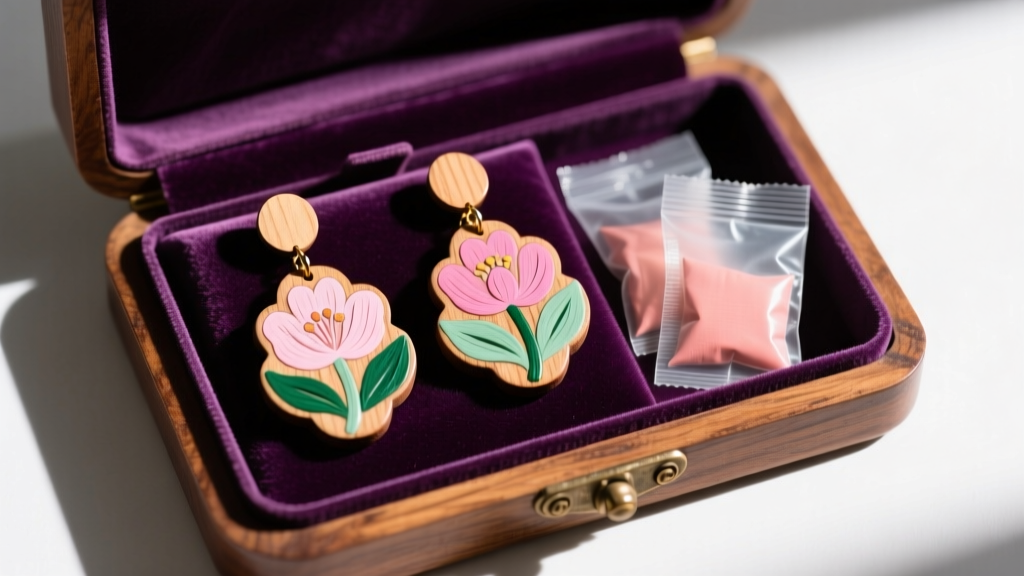
Never store painted wood earrings in a bathroom or other high-humidity environment. The rapid cycling of steam and dry air will cause the wood substrate to swell and shrink, eventually cracking the rigid acrylic paint layer. Store them flat in a lined jewelry box with a small silica gel desiccant packet to maintain a stable microclimate.
Cleaning Without Stripping
Body oils, hairspray, and sweat will accumulate on the painted surface. Do not use alcohol-based cleaners, makeup wipes, or ultrasonic cleaners, as these will dissolve water-based polycrylic sealants and strip the paint. Instead, use a slightly damp microfiber cloth with a drop of mild, fragrance-free castile soap. Wipe gently, and immediately dry with a soft towel. Never submerge painted wood earrings in water.
Maintaining the Hardware
Every few months, inspect the jump rings and screw-eyes. If you notice the hole in the wood widening or the hardware becoming loose, apply a microscopic drop of thin cyanoacrylate into the hole, let it cure to reinforce the wood fibers, and reinsert the hardware with a dab of two-part epoxy. This proactive maintenance can extend the lifespan of artisan painted wood earrings from a single season to a lifetime of wear.


