How to Choose and Style a Pendant Earring: Step-by-Step
Master the pendant earring. Learn how to match gauge sizes, manage weight distribution, and select secure clasps in our step-by-step guide.

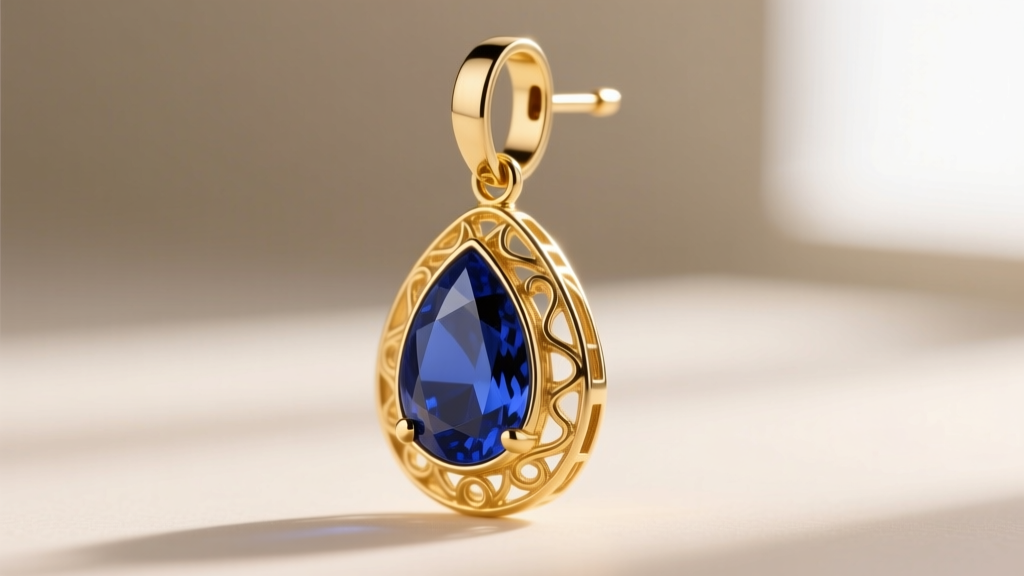
The Anatomy of a Perfect Pendant Earring
A pendant earring bridges the gap between subtle studs and dramatic chandelier styles. Unlike a standard drop earring, which typically features a rigid, continuous design, a true pendant earring utilizes a flexible connection—usually a jump ring, bail, or delicate chain—allowing the focal element to swing freely. This kinetic movement catches the light beautifully but introduces unique structural challenges. As we navigate the 2026 jewelry landscape, the shift toward modular, convertible fine jewelry means understanding the mechanics of your earrings is more critical than ever. This step-by-step guide will teach you how to select, fit, and maintain a pendant earring with absolute precision, ensuring both comfort and longevity.
Step 1: Match the Wire Gauge to Your Piercing
The most common mistake consumers make is ignoring the wire thickness (gauge) of the earring hook. If the wire is too thick for your healed fistula (the piercing channel), it will cause micro-tears, inflammation, and eventual tissue migration. Conversely, a wire that is too thin paired with a heavy pendant will trigger the "cheese-cutter effect," where the thin wire slowly slices through the earlobe tissue.
Gauge Conversion & Tolerance Chart
| Gauge Size | Millimeter (mm) | Standard Application | Weight Tolerance |
|---|---|---|---|
| 22G | 0.64mm | Petite lobes, ultra-lightweight pendants | Under 4 grams |
| 20G | 0.81mm | Standard healed lobe piercings | 4 to 10 grams |
| 18G | 1.02mm | Thicker lobes, light cartilage | 10 to 15 grams |
| 16G | 1.29mm | Cartilage, helix, or stretched lobes | 15+ grams |
For sensitive or freshly healed piercings, always verify the metallurgy. According to the Association of Professional Piercers, only implant-grade titanium (ASTM F-136), niobium, or solid 14k/18k gold should be worn. Avoid "surgical steel," which often contains nickel alloys that cause contact dermatitis when the wire moves back and forth inside the piercing channel.
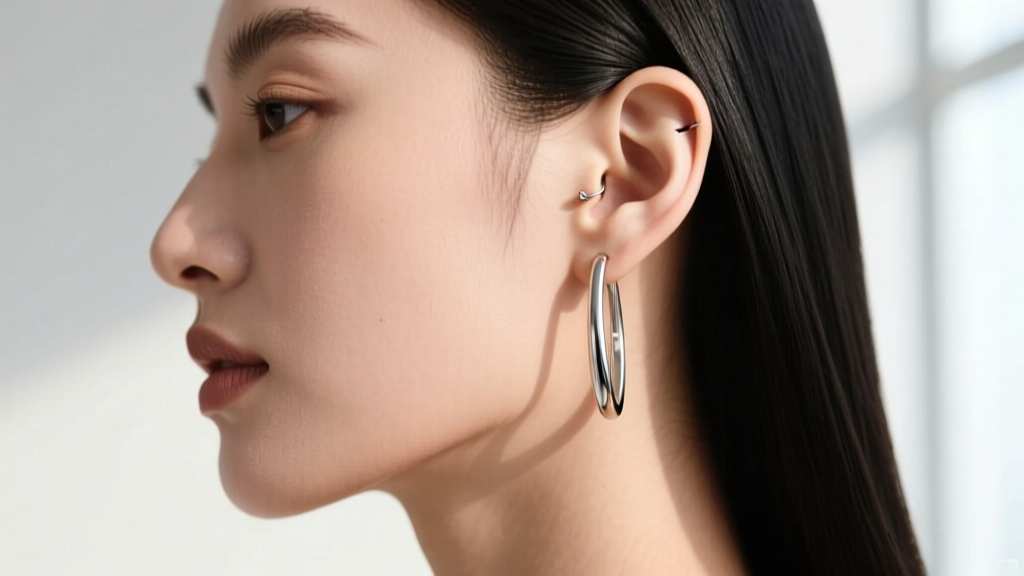
Step 2: Evaluate Weight and Center of Gravity
The physics of a pendant earring dictate how it will wear throughout the day. The center of gravity must be carefully balanced. If the pendant is excessively heavy or hangs too far below the earlobe, it will pull the earlobe downward, causing discomfort and stretching the piercing over time.
Expert Framework: For all-day wear, a pendant earring should not exceed 12 grams per ear. If you are styling a statement piece weighing 20 grams or more, utilize a silicone earring support patch behind the lobe to distribute the kinetic load across a wider surface area of skin.
Additionally, consider the swing radius. A pendant suspended on a long, 15mm chain will generate more momentum when you turn your head than one hanging from a rigid 3mm jump ring. High-momentum pendants are more likely to tangle in hair or catch on clothing collars, increasing the risk of traumatic avulsion (the earring being ripped out).
Step 3: Select the Right Clasp Mechanism
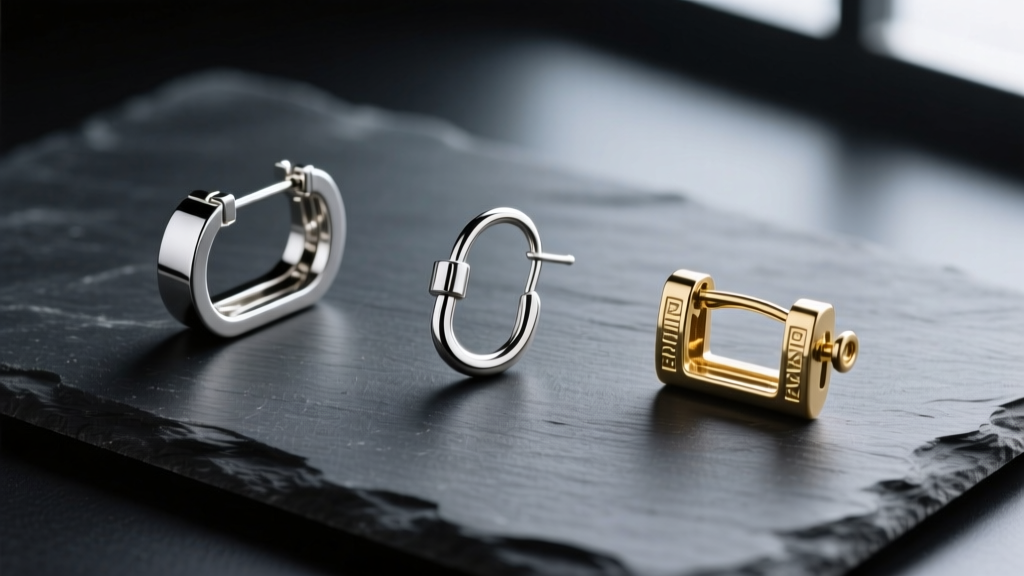
The clasp is the primary failure point of any pendant earring. Because the pendant swings, it creates continuous micro-tension on the wire. Choosing the correct closure mechanism is vital for security.
- Leverback: The gold standard for pendant earrings. A hinged wire snaps securely into a catch. Ensure the tension spring inside the hinge is stiff; a loose leverback will pop open when the pendant swings forward.
- French Wire (Fishhook): A classic, elegant curve that passes through the ear and hangs freely. While beautiful, it offers zero security on its own. You must pair French wires with high-quality silicone O-rings or friction backs to prevent the earring from sliding out when removing sweaters.
- Clicker Latch: Often used in thicker gauges (16G or 14G), this features a hinged segment that clicks securely into a seamless tube. It is highly secure but adds slight bulk, making it less ideal for delicate, ultra-fine pendants.
Step 4: Proportions and Face Shape Styling
Styling a pendant earring requires an understanding of facial geometry and neckline framing. The kinetic nature of the pendant draws the eye downward, which can be used to manipulate visual proportions.
The Proportion Matrix
- Round Faces: Opt for elongated, linear pendant earrings that drop at least 1.5 inches below the earlobe. The vertical swing creates an optical illusion that lengthens the jawline and neck. Avoid wide, teardrop-shaped pendants that add horizontal volume.
- Square Faces: Choose pendants with soft, curved silhouettes—such as oval cabochons or fluid, molten-gold organic shapes. The movement of a rounded pendant softens sharp angular jawlines.
- Heart-Shaped Faces: Select pendants that are wider at the bottom than at the top (like a classic pear or teardrop). This adds visual weight to the narrower lower half of the face, balancing a wider forehead.
When coordinating with necklines, ensure the pendant earring does not compete with your clothing. With a high crew neck, opt for shorter pendants that rest just below the earlobe. With a deep V-neck or scoop neck, longer, dramatic pendants that mirror the neckline's plunge create a cohesive, styled aesthetic.
Troubleshooting Common Failure Modes
Even high-quality pendant earrings experience wear and tear. Here is how to diagnose and fix the most common structural issues:
- Bail Aperture Wear: The bail (the loop connecting the pendant to the wire) rubs against the earring wire continuously. Over 3 to 5 years, this friction can wear a groove into the metal, eventually causing the bail to snap. Fix: Have a jeweler inspect the bail loop annually and replace it if the metal has thinned by more than 20%.
- Prong Snagging: Pendant earrings swing and hit objects. If the gemstone is set in high-profile prongs, they will catch on knitwear and bend outward, risking stone loss. Fix: Opt for bezel settings or low-profile V-prongs for daily-wear pendants.
- Work-Hardened Wire: Repeatedly bending a French wire hook to adjust the fit will cause the metal to "work-harden" and become brittle, leading to a sudden snap. Fix: Never bend the wire with pliers; use your fingers to gently coax the shape, or take it to a professional for adjustment.
Maintenance and Gemstone Care
Because pendant earrings are constantly in motion, they accumulate oils, hair products, and environmental dust at the connection points. The jump rings and bail loops require specific attention during cleaning.
For gemstone pendants, always check the Gemological Institute of America (GIA) guidelines for your specific stone. While a diamond or sapphire pendant (Mohs hardness 9-10) can be safely cleaned in an ultrasonic machine, porous stones like opals, emeralds, or turquoise commonly used in bohemian pendant styles will fracture or lose their luster in ultrasonic vibrations. Instead, use a soft-bristled baby toothbrush, warm water, and a drop of mild, phosphate-free dish soap to gently clean the bail and the back of the gemstone setting. Dry thoroughly with a microfiber cloth before storing to prevent water spots on the metal.
Final Thoughts
A well-chosen pendant earring is a masterclass in kinetic jewelry design. By rigorously matching the wire gauge to your anatomy, respecting weight tolerances, and selecting a secure clasp mechanism, you transform a simple accessory into a lifelong staple. Treat the connection points with the same care you give the gemstone, and your pendant earrings will swing beautifully for decades to come.


