How to Remove a Earring That Is Stuck: Material Guide
Learn how to remove a earring that is stuck based on material properties. Expert extraction guides for titanium, silver, wood, and acrylic.

Why Material Properties Dictate Stuck Earring Removal
When a piece of jewelry refuses to budge, panic often sets in. However, learning how to remove a earring that is stuck requires more than just brute force; it demands an understanding of metallurgy, material science, and human biology. An earring does not simply "get stuck" by chance. The failure is almost always a predictable result of the specific material's interaction with the micro-environment of your fistula (the piercing channel).
Whether you are dealing with the galvanic corrosion of cheap alloys, the hydrophilic swelling of organic wood plugs, or the mechanical thread-stripping of poorly machined steel, the extraction protocol must be tailored to the material. Applying the wrong removal technique—such as using water-based lubricants on a swollen wooden plug or twisting a cross-threaded titanium labret—can lead to severe tissue tearing, embedded jewelry, and permanent scarring. In this comprehensive guide, we break down the exact physical and chemical properties that cause earrings to jam, and provide professional-grade extraction protocols for every material type.
The Physics and Chemistry of a Jammed Fistula
Before attempting removal, it is crucial to understand the three primary mechanical forces that lock jewelry in place:
- Friction Locking via Gauge Tolerances: A standard 14-gauge (1.6mm) earring post in a fully healed 14G fistula leaves only microns of clearance. If the jewelry has microscopic manufacturing burrs (common in mass-produced external threading), these burrs act like fishhooks, catching on the delicate epithelial lining of the piercing channel.
- Oxidation and Sebum Cementing: Metals containing copper (like sterling silver or brass) oxidize when exposed to air and moisture. This oxidation mixes with natural skin sebum and dead cellular debris, creating a hardened, green-tinted matrix that effectively glues the earring backing to the post.
- Hydrophilic Swelling: Organic materials like wood, bone, and horn are porous. They absorb ambient humidity and bodily fluids, causing the jewelry to physically expand in diameter, creating immense outward pressure against the fistula walls.
Material-Specific Failure Modes and Extraction Tactics
The Association of Professional Piercers (APP) emphasizes that not all jewelry materials are created equal. Their unique physical properties dictate how they fail and how they must be removed.
Implant-Grade Titanium and Surgical Steel
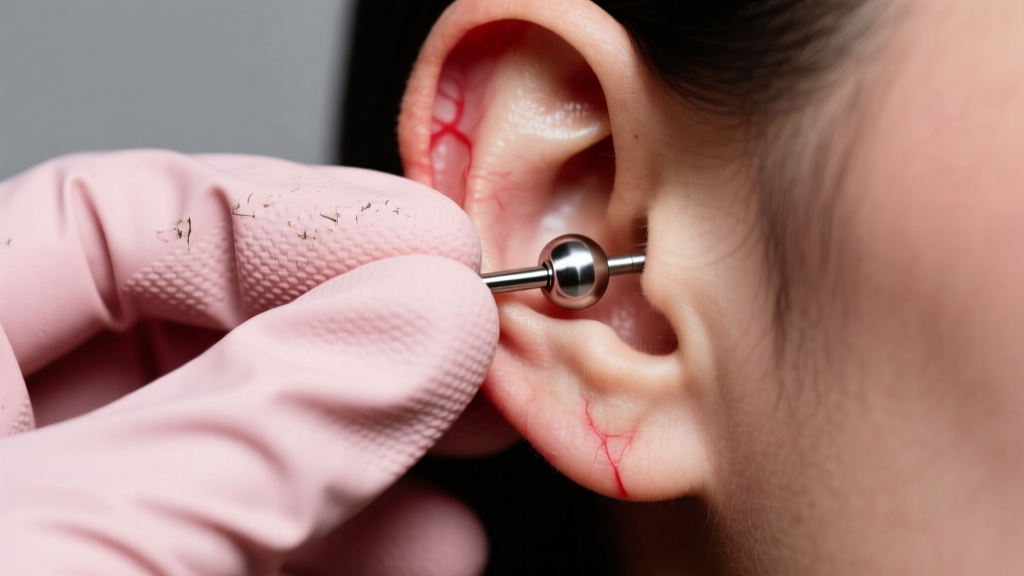
Titanium (specifically ASTM F136) and 316L surgical steel are highly biocompatible and resistant to corrosion. When these metals get stuck, the issue is rarely chemical; it is almost entirely mechanical. The most common culprit is cross-threading on internally threaded jewelry, or thread stripping on externally threaded pieces. If the ball on a titanium labret spins endlessly without unscrewing, the external threads have been stripped flat. Solution: Do not pull. You must use a pair of hemostats with silicone tubing slipped over the jaws to grip the flat surface of the ball, providing the lateral torque needed to break the mechanical lock without damaging the metal or your skin.
Sterling Silver and Copper Alloys
Sterling silver (925) contains 7.5% copper. When left in the ear for extended periods without cleaning, the copper reacts with sulfur and moisture, forming copper sulfide. This tarnish acts as an abrasive and an adhesive. If a sterling silver butterfly back is fused to the post, twisting it will tear the tissue. Solution: Soak a cotton swab in an enzymatic cleaner or warm sterile saline and hold it against the backing for 5 to 10 minutes to break down the sebum-tarnish matrix. Once softened, use rubber gloves to increase your grip friction and gently slide the backing off.
Organic Materials: Wood, Bone, and Horn
Wooden plugs and tapers are hydrophilic. If you sleep with wood earrings or expose them to high humidity, they absorb moisture and swell. A 12G wood plug can easily expand to the diameter of a 10G, locking it inside the earlobe. Solution: Never use water or steam to loosen wood. Instead, apply a heavy, oil-based lubricant like pure jojoba oil or vitamin E oil. The oil repels the water inside the wood, causing it to slightly contract while simultaneously lubricating the fistula. Massage the oil into the earlobe, wait 15 minutes, and gently rotate the plug while pulling outward.
Acrylic and Bioplastics
Acrylic is notorious for developing micro-cracks over time due to its brittle nature. These microscopic fissures harbor bacteria and create jagged edges that catch on the interior of the piercing. Furthermore, acrylic is sensitive to thermal expansion. Solution: Apply a warm compress to the earlobe. The heat causes the tissue to relax and slightly expand, while the acrylic remains dimensionally stable. Use a gentle, wiggling motion rather than a straight pull to navigate the micro-cracks past the tissue ridges.
Lubricant and Solvent Compatibility Chart
Using the wrong chemical agent can ruin the jewelry or irritate the skin's delicate barrier. Refer to this matrix before applying any liquids to a stuck earring.
| Material | Primary Sticking Cause | Recommended Lubricant | Solvents to Avoid |
|---|---|---|---|
| ASTM F136 Titanium | Cross-threading, tissue swelling | Sterile saline, Jojoba oil | Alcohol, Peroxide |
| 925 Sterling Silver | Copper oxidation, sebum buildup | Warm saline, Enzymatic soap | Harsh chemical dips |
| Organic Wood/Horn | Hydrophilic moisture swelling | Jojoba oil, Vitamin E oil | Water, Steam, Saline |
| Acrylic / PTFE | Micro-cracks, thermal friction | Water-based personal lubricant | Oil-based products, Alcohol |
| 14k/18k Solid Gold | Soft metal warping, denting | Coconut oil, Jojoba oil | Chlorine, Iodine |
Backing Mechanisms: Overcoming Mechanical Locks
Sometimes the material is fine, but the backing mechanism has failed. Understanding the engineering of your earring back is critical for safe removal.
The Butterfly Friction Back
Standard push-pin butterfly backs rely on the tension of the metal loops. Over time, metal fatigue causes these loops to squeeze tighter around the post's notch. If a butterfly back is jammed, do not pull it straight back. Instead, use two pairs of flat-nose pliers (padded with medical tape to prevent scratching). Grip the post with one pair and the backing with the other, and gently twist while pulling to widen the tension loops.
Threadless (Push-Pin) Jewelry
Threadless jewelry stays together via a slight bend in the pin that creates tension inside the hollow post. If it is stuck, the tension is too high. Solution: Grip the front gem and the back disc firmly with rubber-gloved hands. Do not pull straight apart. Instead, bend the jewelry slightly at a 45-degree angle to create a fulcrum point, which breaks the internal tension lock, and then pull apart.
Step-by-Step Extraction Protocol
When you are ready to attempt removal, follow this professional protocol to minimize tissue trauma:
- Preparation: Wash your hands thoroughly. Put on nitrile or latex medical gloves. The rubber provides a 300% increase in grip friction compared to bare skin, which is often all that is needed to unscrew a tight ball.
- Lubrication: Apply the appropriate lubricant from the chart above to both the front and back of the earring post. Allow it to penetrate the fistula for at least 5 minutes.
- Stabilization: Pinch the earlobe or cartilage firmly behind the earring to prevent the skin from twisting. Tissue torsion is what causes micro-tears and bleeding.
- Extraction: For threaded pieces, turn counter-clockwise. If it resists, turn clockwise a quarter-turn to realign the threads, then try counter-clockwise again. For push-pins or friction backs, use a slow, steady wiggling motion rather than a sharp yank.
When to Seek Professional Intervention
There is a distinct line between a stubborn earring and a medical emergency. You must abandon DIY removal and visit a professional piercer or a dermatologist if you observe any of the following:
- Embedding: The skin has completely grown over the front or back of the earring. This requires a minor scalpel incision by a medical professional.
- Severe Infection: The area is hot to the touch, throbbing, and leaking yellow or green purulent discharge. Removing the jewelry can trap the infection inside the fistula, leading to an abscess.
- Complete Thread Failure: The ball is spinning freely, and you do not have access to hemostats or silicone tubing. A piercer can use specialized jewelry removal tools to extract the post without damaging the piercing channel.
By respecting the unique material properties of your jewelry, you can safely navigate the frustrating experience of a stuck earring, preserving both your precious metals and your piercing's long-term health.


