Troubleshooting the Earring on Right Ear Meaning & Style Myths
Worried about the outdated earring on right ear meaning? Learn how to troubleshoot style myths, choose modern metals, and rock asymmetrical ear curation.


For decades, a persistent cultural ghost has haunted men, women, and non-binary individuals alike: the infamous "code" of the single ear piercing. If you have ever hesitated to curate your right ear or wear a solitary stud due to outdated 20th-century societal coding, you are not alone. When researching the earring on right ear meaning, most people stumble upon archaic forum posts and outdated stereotypes that no longer reflect modern fashion or societal norms.
In 2026, asymmetrical styling and ear curation are staple elements of high fashion, streetwear, and everyday personal expression. This comprehensive troubleshooting guide will debunk the historical myths, provide a metallurgical framework for selecting the right jewelry, and offer actionable styling advice to help you wear your right-ear jewelry with absolute confidence.
The Historical "Code": Where Did the Right Ear Myth Originate?
To troubleshoot a style anxiety, we must first understand its root cause. The "earring on right ear meaning" originated in the mid-to-late 20th century as a covert signaling system. During the 1970s and 1980s, LGBTQ+ individuals faced severe societal discrimination and lacked mainstream representation. To identify one another safely, the community adopted subtle visual cues, most notably the hanky code and specific piercing placements.
A popular, albeit homophobic, rhyming slang emerged in schoolyards and locker rooms during the 1980s and 1990s: "Left is right, and right is wrong." In this outdated paradigm, a left-ear piercing on a man was deemed heterosexual, while a right-ear piercing was used as a covert signal for homosexuality.
Expert Insight: The "code" was never a universal rule. It was highly regional, predominantly affecting suburban North America and parts of the UK. In many indigenous, African, and Asian cultures, right-ear piercings on men held spiritual, tribal, or marital significance, completely divorced from Western sexual orientation coding.
Troubleshooting Modern Anxiety: Does the Meaning Still Apply?
The short answer is a definitive no. As documented by Vogue's menswear and style archives, the 2010s and 2020s completely dismantled gendered jewelry norms. Today, wearing an earring on the right ear signifies nothing more than a deliberate aesthetic choice. However, because generational trauma and outdated mindsets linger, you may still encounter individuals who misinterpret your style.
Below is a troubleshooting matrix to help you contextualize the shift in cultural perception:
| Era | The "Code" & Cultural Perception | Modern Reality (2026 Perspective) |
|---|---|---|
| 1970s - 1980s | Covert LGBTQ+ signaling; right ear meant gay. | Historical footnote; recognized as a survival tactic of a marginalized era. |
| 1990s - 2000s | Mainstream panic; "left is right, right is wrong" slang peaks. | Viewed as cringe-worthy, outdated, and mildly offensive by younger generations. |
| 2010s - Present | Asymmetry becomes high fashion (e.g., Harry Styles, A$AP Rocky). | Right-ear piercings denote confidence, curation, and modern style awareness. |
Material & Gauge Guide for the Solitary Right Ear
If you are breaking an outdated "code," you must do it with impeccable quality. A flimsy, tarnished earring looks accidental; a precision-machined piece of jewelry looks intentional. When troubleshooting your jewelry box, discard anything hollow or plated.
1. Metallurgy: What to Actually Wear
- Implant-Grade Titanium (ASTM F136): The gold standard for fresh piercings or sensitive lobes. It contains zero nickel and is highly biocompatible. Brands like Industrial Strength and NeoMetal offer threadless titanium ends that are secure and hypoallergenic.
- Solid 14k or 18k Gold: Avoid gold-plated or gold-vermeil, as the brass or sterling silver bases will oxidize and cause contact dermatitis. 14k gold offers superior durability for active lifestyles, while 18k gold provides a richer, warmer hue ideal for luxury statement pieces from brands like Maria Tash or BVLA.
- Platinum: The ultimate hypoallergenic, high-density metal. It will not tarnish and develops a beautiful patina over time, though it commands a premium price point ($300+ for basic studs).
2. Gauge Sizing & The "Cheese Cutter" Effect
Standard lobe piercings are typically done at 20g (0.8mm) or 18g (1.0mm). If you are wearing a continuous hoop or huggie on your right ear, never drop below 18g for the wire thickness. Wearing a heavy hoop on a thin 22g (0.6mm) wire creates a mechanical failure known as the "cheese cutter effect," where the thin metal slowly migrates through the lobe tissue, causing tearing and permanent stretching.
Asymmetrical Curation: Styling Frameworks
Wearing a single earring on the right ear requires an understanding of visual weight. If your right ear is adorned, the left side of your face and body may feel visually "empty" to the observer. Here is how to troubleshoot asymmetrical balance:
- The Cross-Body Balance Rule: If your right ear features a statement piece (like a diamond-encrusted huggie), balance it with a visual anchor on your left side. This could be a prominent signet ring on your left hand, a bold watch, or a left-side facial tattoo.
- Hair Parting Dynamics: Your hair part dictates visibility. If you part your hair on the left, your right ear is fully exposed. In this scenario, opt for a slightly larger silhouette, such as a 10mm-12mm hoop or a dangling chain earring, to maximize the exposure. If your hair covers the right ear, choose a high-sparkle diamond or gemstone stud that catches the light even when partially obscured.
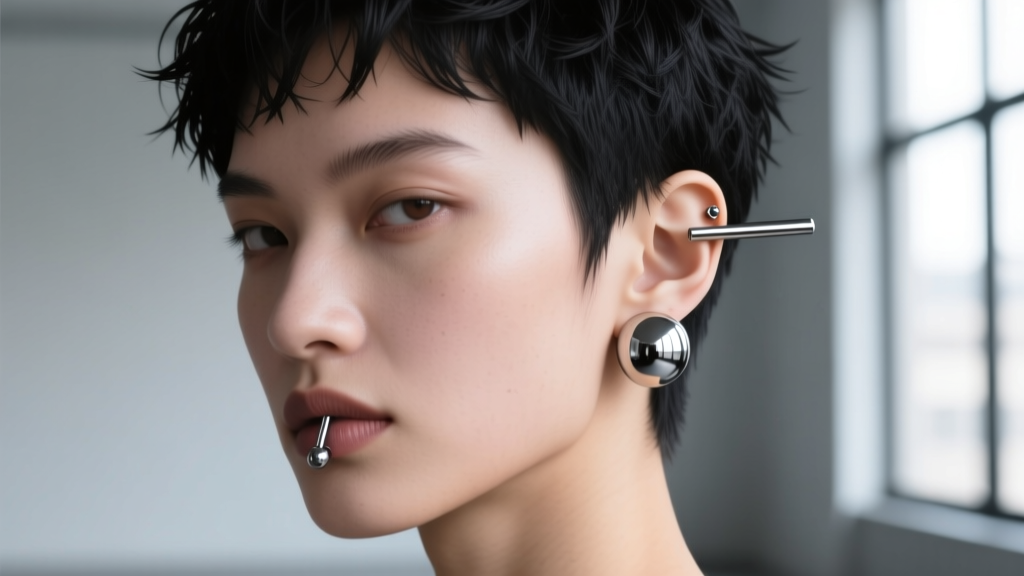
- Cartilage vs. Lobe: The "right ear meaning" trope historically applied strictly to the lobe. To completely bypass any lingering boomer-era assumptions, place your jewelry in the right helix, tragus, or conch. Cartilage piercings are universally read as modern, intentional, and edgy.
Social Troubleshooting: Handling Outdated Assumptions
Despite the fashion industry's evolution, you may still encounter older relatives, conservative colleagues, or out-of-touch acquaintances who attempt to apply the "earring on right ear meaning" to your personal style. Troubleshooting these social interactions requires poise and a firm boundary.
Scenario 1: The "Joke"
The Comment: "Oh, you got your right ear pierced? You know what that means, right?"
The Fix: Deploy polite indifference. "I'm aware of the 1980s slang, but I just prefer how it looks with my jawline. Anyway, how is the project going?" This acknowledges their comment, dismisses its relevance, and immediately pivots the conversation.
Scenario 2: The Genuine Confusion
The Comment: "Why only the right ear? Isn't that usually the other side?"
The Fix: Frame it as an aesthetic choice. "I'm doing an asymmetrical curation. I balance the jewelry with my watch on the left wrist." This elevates the conversation from sociology to high fashion, effectively shutting down any further probing into your personal life.
Final Verdict: Reclaiming Your Right Ear
The "earring on right ear meaning" is a relic of a bygone era, a ghost of 20th-century anxiety that has no place in a modern wardrobe. By focusing on premium materials like ASTM F136 titanium and solid 14k gold, respecting proper gauge mechanics, and utilizing cross-body visual balance, you transform a potential social liability into a masterclass of personal styling. Wear your right-ear jewelry not as a signal to a specific demographic, but as a testament to your own curated, unapologetic aesthetic.


