Earring in Right Ear Meaning & Asymmetrical Buying Guide
Explore the earring in right ear meaning, from historical myths to 2026 asymmetrical trends, plus a buying guide for single-ear styling.


Decoding the Earring in Right Ear Meaning
If you have ever searched for the earring in right ear meaning, you have likely encountered a tangled web of historical superstitions and outdated 20th-century cultural codes. In the 1980s and 1990s, a pervasive urban dictionary trope dictated that a single earring in the left ear signaled heterosexuality, while the right ear signaled homosexuality. This reductive coding has been entirely dismantled in modern fashion. Looking back even further, maritime folklore suggested that sailors pierced their right ears to pay Charon, the mythological ferryman, for passage across the River Styx should they drown at sea, or to magically improve their long-distance eyesight.
Today, in 2026, the jewelry industry and style authorities recognize that the side of your piercing holds no inherent moral, sexual, or superstitious weight. Instead, the single-ear earring has evolved into a deliberate exercise in asymmetrical styling. Men, women, and non-binary individuals curate single-ear looks to manipulate visual weight, draw attention to specific facial features, and break the monotony of traditional symmetrical jewelry sets.
The Modern Shift: Asymmetry and Single-Ear Styling
Asymmetrical ear curation is no longer just a niche editorial trend; it is a foundational element of contemporary personal style. When you choose to wear a statement piece exclusively in the right ear, you are engaging in visual balancing. The right side of the face is often considered the 'public' or 'active' side in portrait photography and social interaction. Placing a heavy, intricate, or brightly colored earring on the right ear creates an immediate focal point that anchors the entire profile.
"Asymmetry in jewelry allows the wearer to control the visual narrative of their profile. A single, well-chosen statement piece on the right ear forces the eye to engage with the architecture of the face rather than scanning symmetrically." — Contemporary Jewelry Design Theory
What to Look For When Buying a Solo Right-Ear Earring
Buying a single statement earring requires a completely different technical approach than buying a symmetrical pair. Because there is no matching piece to distribute physical weight or visual interest, the hardware and material integrity of your right-ear piece must be flawless.
1. Hardware and Weight Distribution
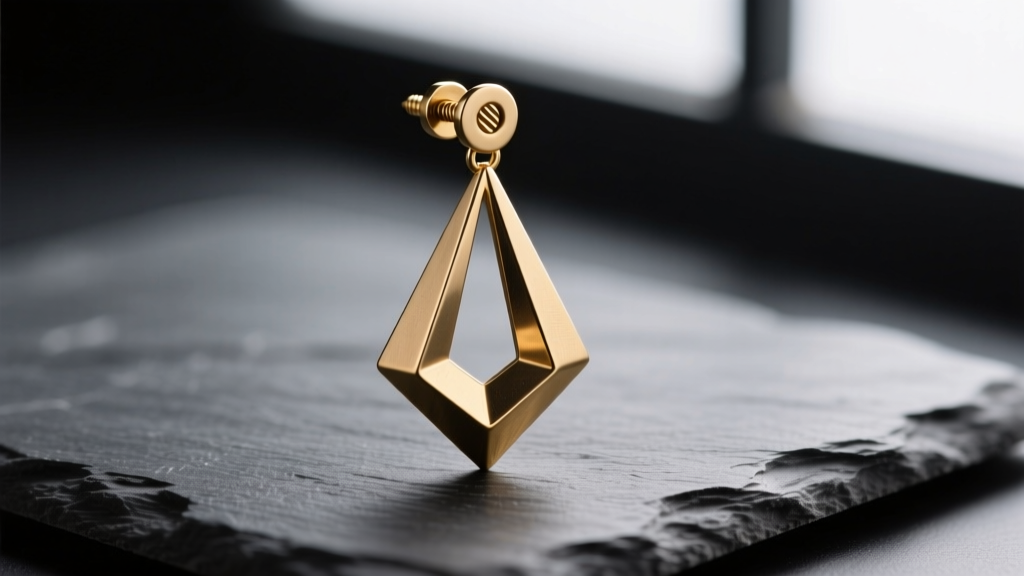
If you are purchasing a heavy drop, shield, or chandelier earring for the right ear, standard 20-gauge butterfly friction backs will fail. The weight of a single heavy piece will cause the post to tilt, stretching the piercing channel and causing the earring to droop awkwardly. According to guidelines from the Association of Professional Piercers (APP), heavier jewelry requires thicker posts and secure backing mechanisms.
- Screw-Backs: Essential for heavy drops. The threaded backing ensures the earring remains flush against the lobe without sagging.
- Flat-Back Labrets: Ideal for cartilage or upper-lobe single pieces. A 14g (1.6mm) or 12g (2.0mm) titanium flat-back provides a wide surface area inside the ear, distributing the weight of a heavy front-facing charm evenly.
- Omega Clips: For non-pierced right-ear options, omega clips provide superior tension and support for heavier single earrings compared to standard paddle clip-ons.
2. Material Grades for Daily Wear
When wearing a single earring daily, the metal is subjected to constant friction, moisture, and environmental exposure. Avoid gold-plated or vermeil pieces for your primary right-ear statement, as the plating will inevitably wear down on the post, leading to contact dermatitis.
- Implant-Grade Titanium (ASTM F136): The gold standard for sensitive ears and heavy daily wearers. It is completely nickel-free and highly resistant to corrosion.
- Solid 14k or 18k Gold: Ensure the alloy is mixed with palladium or silver rather than nickel. As noted by the Gemological Institute of America (GIA), understanding metal alloys is crucial for preventing allergic reactions in body jewelry.
- Niobium: An excellent, affordable alternative to titanium that can be anodized into vibrant colors without using dyes or plating.
Balancing the Look: Left vs. Right Ear Curation
When your right ear features a bold, heavy, or elongated piece, the left ear should act as a subtle anchor. The goal is contrast, not competition. Use the framework below to build a cohesive asymmetrical setup.
| Feature | Right Ear (The Statement) | Left Ear (The Anchor) |
|---|---|---|
| Visual Weight | High (Heavy drops, ear shields, complex cuffs) | Low (Flush studs, micro-huggies, flat-back gems) |
| Hardware Gauge | 14g to 12g (1.6mm - 2.0mm) for structural support | 20g to 18g (0.8mm - 1.0mm) for minimal visibility |
| Material Finish | Textured, oxidized, or high-polish bold metals | Matte, brushed, or subtle gemstone accents |
| Placement | Lobe, conch, or helix chain setups | Standard lobe or simple tragus stud |
Non-Pierced Alternatives for the Right Ear
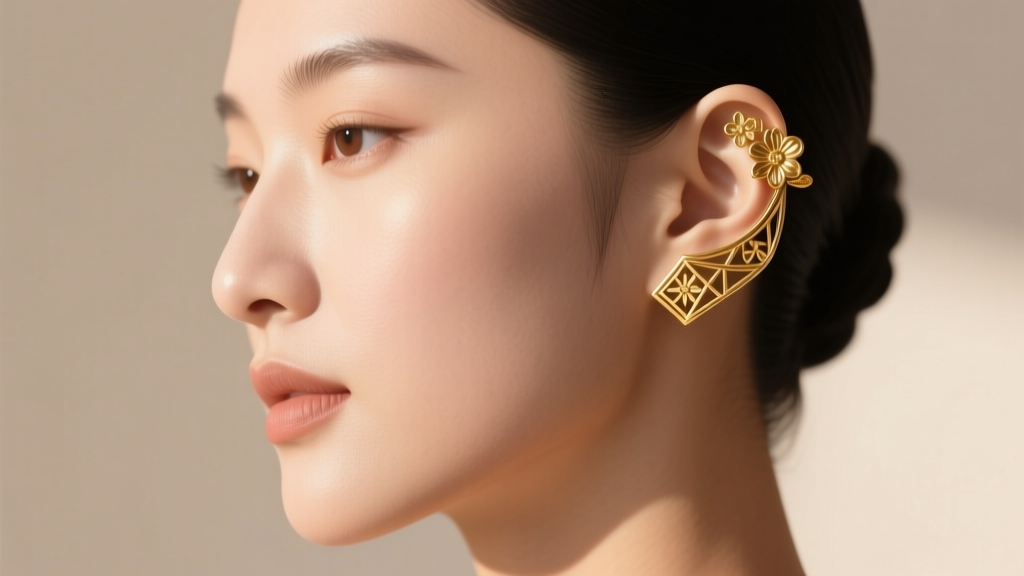
If you want to experiment with the right-ear statement trend without committing to a new piercing, the market for high-tension ear cuffs and clip-ons has advanced significantly. When buying non-pierced jewelry for the right ear, look for C-clips with adjustable tension screws or silicone-padded ear cuffs that grip the helix or conch without causing cartilage fatigue. A 1mm to 1.5mm wire thickness offers the best balance of malleability for adjustment and rigidity to hold the piece in place throughout the day.
Gauge Sizes, Proportions, and Face Shapes
The physical dimensions of your right-ear earring should complement your facial structure, especially since the asymmetry will draw the eye directly to that side of your face.
- Round Faces: Opt for angular, linear, or geometric drops on the right ear. Sharp lines and elongated rectangles create a slimming optical illusion and add structural contrast to soft jawlines.
- Square Faces: Choose fluid, curved, or organic shapes. Teardrops, hoops, or serpentine ear cuffs soften strong angular features and balance the width of the jaw.
- Heart-Shaped Faces: Chandelier or wider-bottomed drop earrings work beautifully on the right ear, adding visual weight to the lower half of the face to balance a narrower chin.
Final Buying Checklist
Before checking out with a single statement earring for your right ear, verify the following:
- Is the post gauge thick enough to support the weight of the charm without bending? (Aim for 16g or thicker for heavy pieces).
- Does the backing mechanism secure the earring flush to the ear? (Prioritize screw-backs or flat-backs over friction push-backs).
- Is the metal solid or implant-grade? (Avoid plated posts for daily asymmetrical wear).
- Does the shape contrast appropriately with the subtle anchor pieces on your left ear?
By discarding outdated myths about the earring in right ear meaning and focusing instead on material integrity, weight distribution, and asymmetrical balance, you can curate a highly intentional, modern look that stands out in 2026 and beyond.


