Royston Turquoise Earrings vs. Sleeping Beauty: A Material Guide
Discover the unique properties of Royston turquoise earrings. Compare matrix patterns, stabilization methods, and durability against other top gems.

The Geological Signature of Royston Turquoise
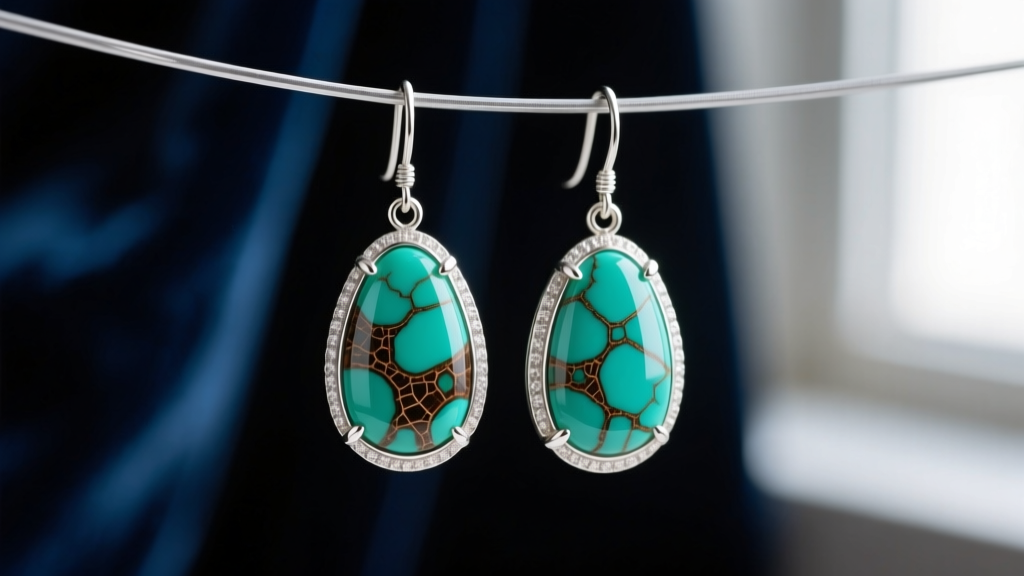
When selecting gemstone jewelry, understanding the mineralogical origins of your stones is paramount for both aesthetic appreciation and long-term wearability. Royston turquoise earrings occupy a highly coveted space in the Southwestern and contemporary jewelry markets, primarily due to their striking visual contrast. Mined in the Royston district near Tonopah, Nevada, this specific variety of hydrous copper aluminum phosphate is celebrated for its deep, rich greens transitioning into soft, pale blues.
Unlike uniform stones, Royston is defined by its heavy matrix—the host rock that remains intertwined with the turquoise. This matrix is typically composed of brown or golden limonite, creating a dramatic, spider-webbed pattern across the cabochon. For earring designers, this high-contrast webbing means no two pairs of Royston turquoise earrings are ever identical. The geological presence of iron (which creates the green hue) and limonite (which creates the brown matrix) dictates not only the stone's appearance but also its structural integrity, which we must evaluate when designing for the ear.
Material Hardness and the Necessity of Stabilization
On the Mohs scale of mineral hardness, natural turquoise generally falls between 5 and 6. However, the porous nature of the stone, combined with the varying densities of the limonite matrix in Royston specimens, presents unique challenges for jewelry that is worn close to the skin and hair. Earrings are subjected to constant environmental hazards: sebum from the skin, aerosolized hairsprays, lotions, and the mechanical friction of brushing hair.
Because natural, untreated Royston turquoise is highly porous, it will readily absorb oils and chemicals, leading to a permanent darkening or dulling of the vibrant green and blue colors. Furthermore, the boundary where the soft turquoise meets the harder limonite matrix is a natural fault line. In an earring that experiences frequent micro-impacts, these fault lines can propagate into visible cracks.
To mitigate these failure modes, over 90% of the Royston turquoise used in high-quality earrings undergoes stabilization. This is not a deceptive practice; it is a vital gemological enhancement. The stones are placed in a vacuum chamber and infused with a clear epoxy resin or polymer. This process permanently hardens the stone to a Mohs 6.5 or higher, seals the pores against chemical absorption, and binds the matrix fault lines together, ensuring the cabochon survives the rigors of daily wear.
Royston vs. Sleeping Beauty vs. Kingman: A Gemological Comparison
To truly understand the material properties of Royston turquoise earrings, it is highly beneficial to compare them against other dominant varieties in the market. Each stone possesses distinct structural traits that dictate how it must be cut, set, and maintained.
| Property | Royston (Nevada) | Sleeping Beauty (Arizona) | Kingman (Arizona) | Persian (Neyshabur) |
|---|---|---|---|---|
| Primary Color | Deep green to light blue | Uniform sky blue | Blue to blue-green | Robin-egg blue |
| Matrix Presence | Heavy brown/gold limonite | None to minimal | Black/brown pyrite | None |
| Avg. Hardness (Natural) | 5.0 - 5.5 | 5.5 - 6.0 | 5.0 - 6.0 | 5.5 - 6.0 |
| Best Earring Setting | Full bezel | Prong or bezel | Wire-wrapped or bezel | Prong or bezel |
| Est. Price (Stabilized) | $15 - $45 per carat | $20 - $60 per carat | $10 - $35 per carat | $30 - $80+ per carat |
As the data illustrates, Royston's heavy matrix makes it slightly more fragile in its natural state than the pristine, matrix-free Sleeping Beauty turquoise. Consequently, while Sleeping Beauty can safely be set in delicate prong settings that expose the edges of the stone, Royston demands more protective metalwork.
Optimal Earring Settings for Royston Cabochons
The Mechanics of the Bezel Setting
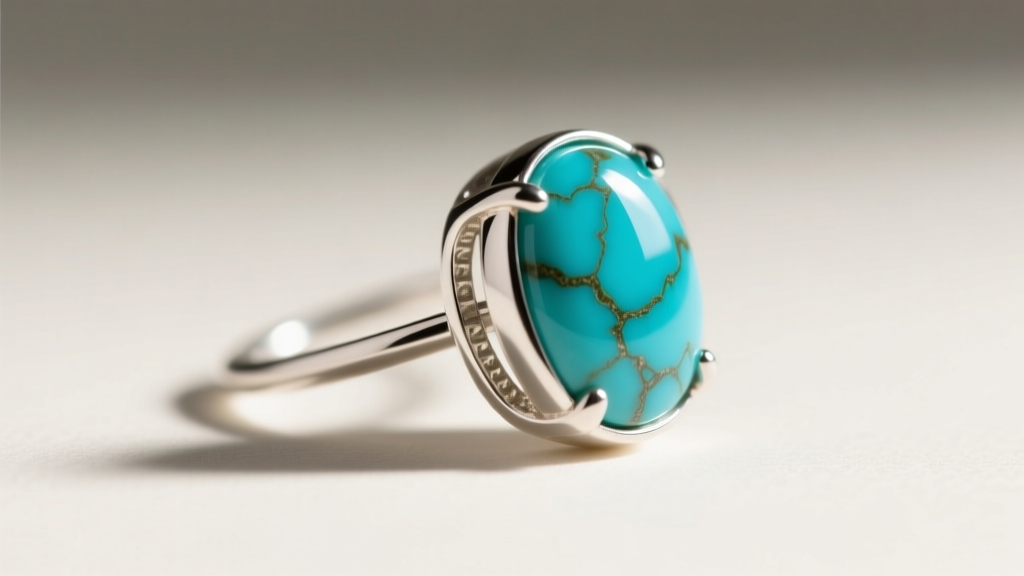
Due to the aforementioned fault lines between the copper phosphate and the iron-rich matrix, prong settings are strongly discouraged for Royston turquoise earrings. Prongs exert concentrated point-pressure on the stone. If a prong rests directly over a patch of brown limonite matrix, the pressure can easily chip or fracture the webbing. A full bezel setting—where a continuous ribbon of metal (usually sterling silver or 14k gold) wraps entirely around the perimeter of the cabochon—distributes pressure evenly and protects the vulnerable edges from lateral impacts.
Weight Distribution and Gauge Sizing
Royston turquoise is frequently cut into larger, statement-sized cabochons (such as 12x16mm ovals or 15mm rounds) to properly showcase the intricate matrix patterns. A stone of this size, combined with a heavy silver bezel, can easily weigh between 4 and 7 grams per earring. To prevent the earring from drooping forward and stretching the earlobe piercing, the ear wire or post must be constructed from a thicker gauge. While standard lightweight studs use 22-gauge or 20-gauge wire, statement Royston drops should utilize 18-gauge or even 16-gauge sterling silver ear wires to maintain structural rigidity and keep the stone facing forward.
Authentication: Spotting Imitations and Dyed Howlite
The high demand and premium pricing of genuine Royston turquoise earrings have unfortunately spawned a market of sophisticated imitations. The most common counterfeit involves howlite or magnesite—naturally white, highly porous stones that are dyed blue or green and artificially painted with brown veining to mimic the Royston matrix.
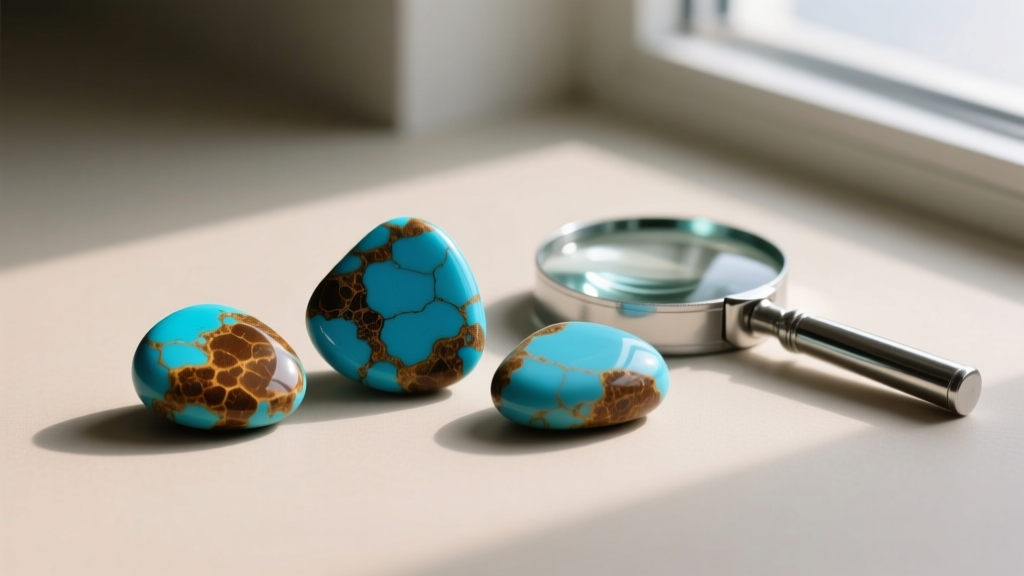
When evaluating a potential purchase, utilize a jeweler's loupe (10x magnification) to inspect the brown matrix lines. In genuine Royston turquoise, the matrix is a physical rock inclusion; it will have a distinct, often metallic or earthy luster, and it will sit flush with the turquoise, showing natural micro-pitting. In dyed howlite, the brown 'matrix' is merely surface-level dye or paint. Under magnification, you will often see the brown dye pooling and concentrating in the microscopic cracks of the host stone, a phenomenon known as 'spiderwebbing' in the dye itself, which looks distinctly different from natural geological inclusions.
- The Acetone Test: While a drop of acetone on a cotton swab can dissolve artificial dyes on howlite, this is a destructive test that should never be performed on a finished piece of jewelry without the owner's explicit consent.
- Thermal Conductivity: Genuine turquoise feels noticeably cooler to the touch than plastic or resin imitations, though this is subjective and less reliable than magnification.
Expert Insight: Always ask the jeweler for the specific stabilization method used. The Zachery treatment is a premium, non-polymer stabilization method that enhances turquoise without adding plastics, making it highly desirable for high-end Royston pieces. For more on gemological treatments, consult the Gemological Institute of America (GIA).
Long-Term Care and Maintenance Protocols
Even when properly stabilized, Royston turquoise earrings require specific care protocols to maintain their polish and structural integrity. The metal bezel will naturally tarnish over time, especially if the earrings are worn in humid environments. However, standard silver polishing dips and ultrasonic cleaners are strictly forbidden.
Ultrasonic cleaners utilize high-frequency sound waves in a liquid bath. These microscopic cavitation bubbles can easily fracture the limonite matrix inside the turquoise, causing the stone to crumble from the inside out. Furthermore, chemical silver dips will strip the polish off the turquoise cabochon, leaving it looking chalky and dull.
Instead, clean your Royston earrings using a dry, ultra-soft microfiber cloth to gently buff the metal. If the stone accumulates skin oils or lotion residue, wipe it gently with a barely damp cloth and immediately dry it. Store the earrings in an anti-tarnish pouch, separate from harder gemstones like diamonds or sapphires, which can easily scratch the surface of the turquoise even after stabilization. By respecting the unique material properties of this Nevada gemstone, your Royston turquoise earrings will retain their striking geological beauty for decades.


