Safest Materials for Earrings in Ear Cartilage Piercings
Discover the safest metals for earrings in ear cartilage. Compare titanium, gold, and steel grades to prevent irritation and promote fast healing.

The Unique Biology of Cartilage Piercings
When selecting earrings in ear cartilage, the biological reality of the tissue dictates your material choices. Unlike the fleshy, highly vascular earlobe, cartilage is avascular, meaning it lacks a direct blood supply. It relies on the perichondrium (the connective tissue surrounding it) for oxygen and nutrients. Because of this, cartilage piercings—such as the helix, tragus, conch, and daith—take significantly longer to heal, typically ranging from 6 to 12 months, and sometimes up to 18 months for complex placements.
This slow healing process means the jewelry will remain in an open, weeping wound for an extended period. The risk of perichondritis (a severe infection of the cartilage tissue) is notably higher than in lobe piercings. According to the Cleveland Clinic, cartilage infections can lead to permanent structural deformity if not managed properly. Therefore, the biocompatibility, surface finish, and structural integrity of your jewelry are not just aesthetic choices; they are critical medical considerations.
The Implant-Grade Standard: What It Actually Means
The term 'surgical steel' is largely a marketing fabrication. To ensure safety, you must look for specific ASTM (American Society for Testing and Materials) or ISO designations that prove the metal is certified for long-term internal human contact.
Expert Rule of Thumb: If a jeweler or piercer cannot provide the specific ASTM or ISO grade of the metal they are selling, do not put it in an unhealed cartilage piercing. True implant-grade manufacturers provide mill certificates verifying their alloy composition.
The gold standard for initial cartilage piercings is ASTM F136 Titanium (Ti-6Al-4V ELI). This specific alloy is completely nickel-free, highly corrosion-resistant, and lightweight. It is the exact same material used in orthopedic joint replacements and pacemaker casings, making it virtually impervious to the body's immune responses.
Material Showdown: Titanium vs. Gold vs. Steel
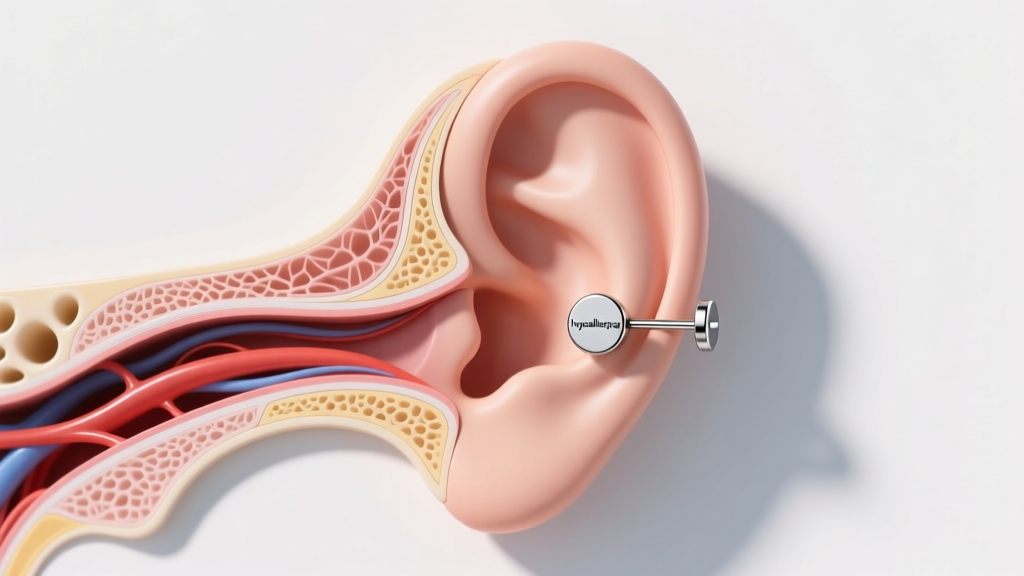
Choosing the right metal involves balancing biocompatibility, weight, budget, and aesthetic preference. Below is a comprehensive comparison of the top materials used by professional piercers for cartilage placements.
| Material | Alloy Standard | Nickel Content | Weight | Avg. Price Range (16G) | Best Use Case |
|---|---|---|---|---|---|
| Implant-Grade Titanium | ASTM F136 | 0% (Nickel-Free) | Ultra-Light | $35 - $80 | Initial piercings, sensitive skin, heavy sleepers |
| 14k / 18k Solid Gold | N/A (Must be alloyed) | Varies (Ask for Ni-free) | Heavy | $120 - $400+ | Healed piercings, high-end aesthetics, downsizing |
| Implant-Grade Steel | ASTM F138 | ~10-14% (Bound) | Heavy | $25 - $60 | Healed piercings, budget-friendly options (if no Ni allergy) |
| Niobium | Ungraded (Pure elemental) | 0% (Nickel-Free) | Medium | $40 - $90 | Initial piercings, custom anodized colors |
Deep Dive: The Gold Caveat
While 14k and 18k gold are beautiful, they are alloys. Pure 24k gold is too soft for body jewelry; it scratches easily, and those microscopic scratches harbor bacteria. Furthermore, many gold alloys use nickel or cadmium to increase hardness. When buying gold earrings in ear cartilage, you must verify with the manufacturer that the alloy is specifically formulated for body jewelry and is completely free of nickel and cadmium. Brands like BVLA and Maria Tasha are renowned for their biocompatible gold formulations.
Metals to Strictly Avoid in Fresh Cartilage
The market is flooded with cheap, mass-produced jewelry that can wreak havoc on a healing fistula. Avoid the following materials at all costs during the first year of your piercing:
- Sterling Silver (925): Silver contains copper and tarnishes when exposed to oxygen and moisture. This tarnish can permanently stain the skin inside the piercing channel (a condition called localized argyria) and cause severe contact dermatitis.
- Gold-Plated or Gold-Filled: The plating is microscopic and will inevitably wear away due to friction and body chemistry, exposing the base metal (often brass or nickel) directly to the open wound.
- Bioplast / PTFE: While flexible, these plastics are inherently porous. They harbor bacteria, degrade under UV light, and can become brittle, making them a massive infection risk for long-term cartilage healing.
- 'Mystery' Surgical Steel: If it lacks the ASTM F138 designation, it is likely 304 or 316L stainless steel, which has a higher nickel release rate and a rougher surface finish that will irritate the delicate cartilage tissue.
Gauge, Threading, and Finish: Beyond the Alloy
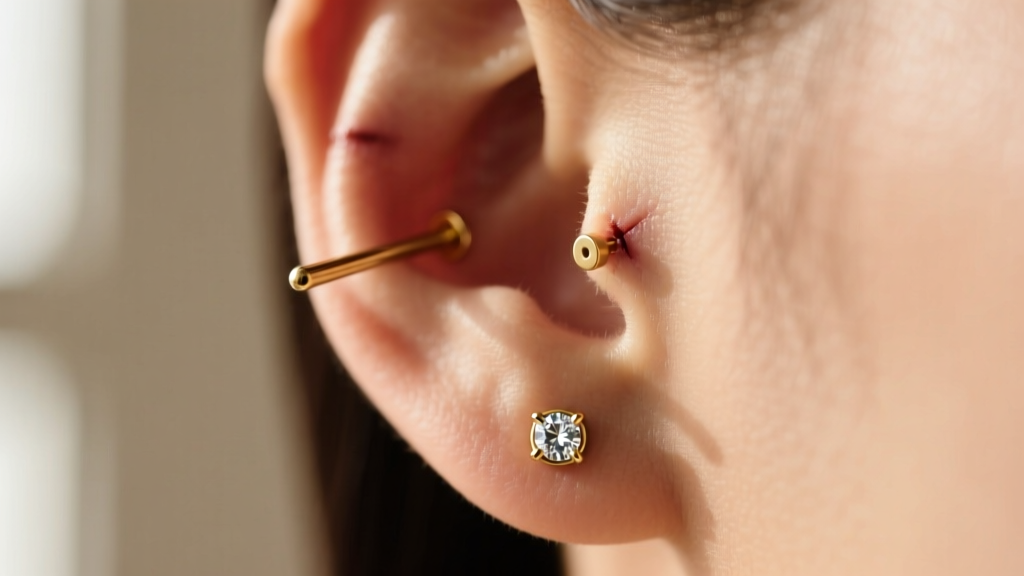
Even if you choose perfect ASTM F136 titanium, poor manufacturing will ruin your healing process. The physical construction of the jewelry is just as critical as its chemical composition.
The Threading Imperative
Never use externally threaded jewelry (where the screw is on the post) in cartilage. Forcing sharp, jagged external threads through the fistula tears the fragile healing tissue. You must use internally threaded (where the screw is on the decorative end) or threadless (push-pin) jewelry. Threadless jewelry, which relies on the tension of a slightly bent pin inside a hollow post, is currently the industry favorite for cartilage because it eliminates the risk of the decorative end unscrewing and falling out in your hair or while sleeping.
Surface Finish (Ra Value)
The Association of Professional Piercers (APP) mandates that implant-grade jewelry must have a mirror finish with a surface roughness (Ra) of less than 0.8 micrometers. A rough surface acts like a microscopic cheese grater on the healing fistula and provides a breeding ground for biofilm. High-end body jewelry brands invest heavily in hand-polishing and electropolishing to achieve this glass-like finish.
Standard Gauges for Cartilage
Most standard cartilage piercings (helix, forward helix, tragus) are performed at 16-gauge (1.2mm) or 18-gauge (1.0mm). Thicker jewelry (14G or 12G) is generally reserved for industrial bars or conches to prevent the 'cheese-cutter effect,' where thin wire slowly migrates through the tissue under pressure.
Real-World Troubleshooting: Irritation Bumps and Material Failure
If you develop an irritation bump (hypertrophic scarring) on your cartilage piercing, your first instinct might be to blame the piercer's angle. However, material and mechanical irritation are the primary culprits.
If you are wearing a heavy 14k gold hoop in a fresh helix, the constant swinging and pressure create mechanical trauma. Similarly, if you are wearing an alloy with trace nickel, the bump is a localized allergic response. The solution is almost always to downsize to a lightweight, internally threaded or threadless titanium flat-back labret stud. The flat back sits flush against the inner ear, eliminating pressure points and preventing the post from moving and agitating the fistula.
Expert Sourcing: Where to Buy Verified Implant-Grade Jewelry
To guarantee you are getting legitimate, safe materials, bypass mall kiosks and fast-fashion jewelry brands. Source your earrings in ear cartilage directly from manufacturers and retailers that cater to professional piercers. Look for brands such as Anatometal, Industrial Strength, BVLA, and NeoMetal. These companies machine their jewelry from certified implant-grade billets, utilize advanced threadless or internal threading mechanisms, and provide the exact metallurgical data required to ensure your cartilage heals safely and beautifully.


