Gold Rabbit Earrings: A Technical Guide to Purity & Fit
Discover the metallurgy, gauge requirements, and casting techniques behind high-quality solid gold rabbit earrings in this expert technical guide.

The Metallurgy of Motif Jewelry: 14k vs. 18k Gold
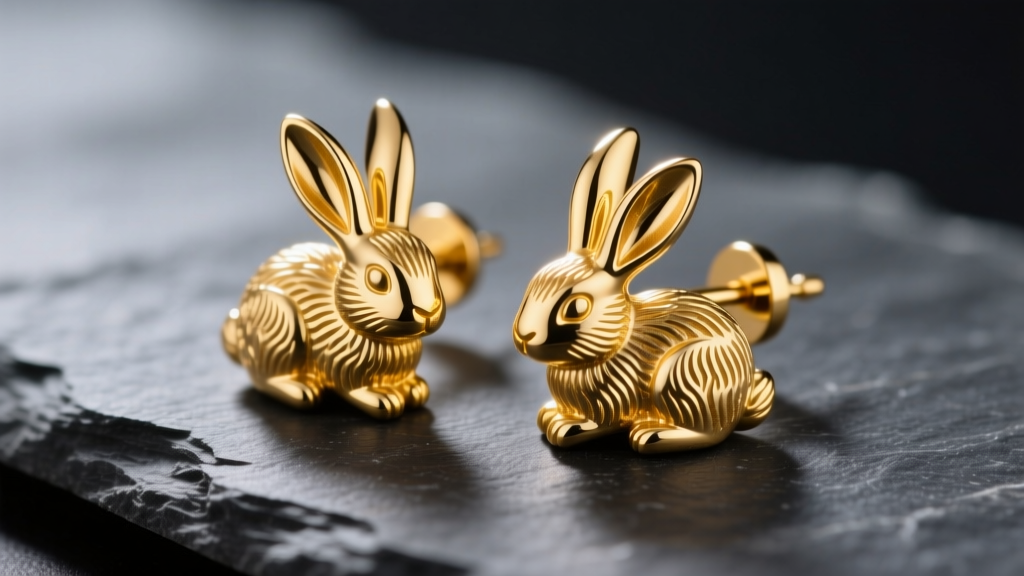
When evaluating animal-motif jewelry, specifically gold rabbit earrings, consumers often prioritize the aesthetic silhouette over structural metallurgy. However, the gold purity directly dictates the piece's tensile strength, which is critical for elongated features like rabbit ears. Pure 24k gold (99.9% Au) is far too malleable for intricate motifs; a 24k rabbit ear would permanently bend under minimal lateral stress or snagging.
According to the Gemological Institute of America (GIA), alloying gold with metals like copper, silver, and zinc is necessary to achieve durability. For motif earrings, the industry standard oscillates between 14k and 18k gold, each presenting distinct mechanical properties.
| Gold Purity | Au Content | Tensile Strength | Best Application for Rabbit Motifs |
|---|---|---|---|
| 14k Gold | 58.5% | High | Thin, elongated ears; micro-pave diamond eyes; everyday wear studs. |
| 18k Gold | 75.0% | Moderate | Chunky, solid silhouettes; rich yellow hue; requires thicker casting (min 1.2mm). |
| 22k Gold | 91.6% | Low | Not recommended for protruding animal ears due to high warp risk. |
If you are purchasing 18k gold rabbit earrings, ensure the base of the ears is at least 1.2mm thick to prevent warping. For 14k gold, the higher copper and zinc content allows for thinner, more delicate ear structures (down to 0.8mm) without sacrificing structural integrity.
Anatomical Fit: Gauge Thickness and Lobe Biomechanics
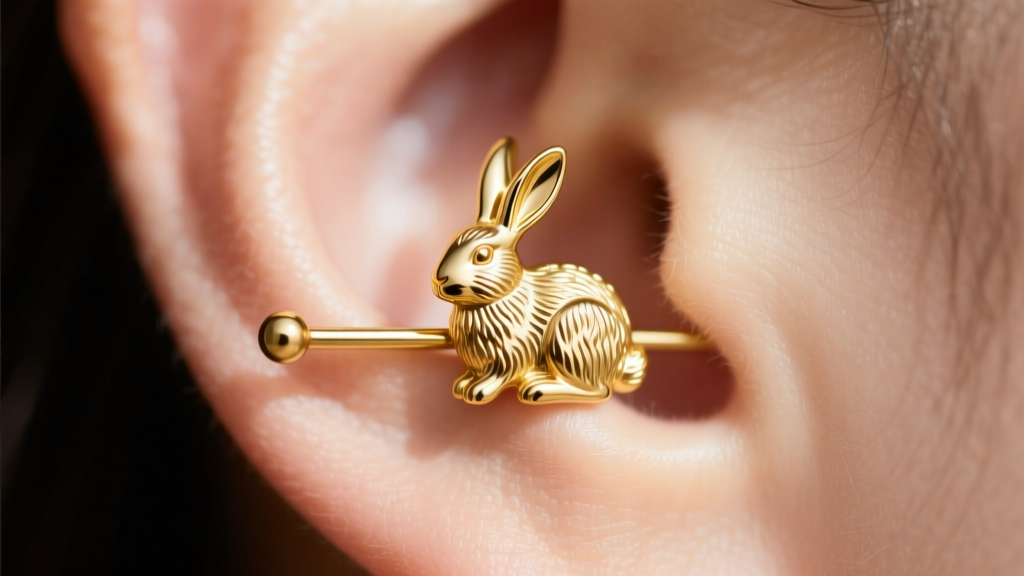
The "cheese-cutter" effect is a common failure mode in heavy motif earrings. Solid gold is exceptionally dense (approximately 13 to 15 g/cm³ depending on the alloy). A standard 10mm x 8mm solid gold rabbit head weighs roughly 1.8 to 2.5 grams per earring. While this sounds light, the center of gravity in a rabbit motif is heavily biased toward the front (the snout and ears), creating a fulcrum effect on the earlobe.
Standard fashion earrings utilize 20-gauge (0.81mm) or 22-gauge (0.64mm) posts. When a top-heavy gold rabbit head is mounted on a 20g post, the post acts as a blade, slowly migrating downward through the piercing fistula and causing the earring to tilt forward. This results in the rabbit appearing to "dive" rather than sit upright.
The Association of Professional Piercers (APP) recommends thicker posts for heavier jewelry to distribute pressure evenly across the tissue. For solid gold rabbit earrings, an 18-gauge (1.02mm) post is the biomechanical sweet spot. It provides sufficient shear strength to support the motif's weight while remaining compatible with standard healed lobe piercings. If the design exceeds 3 grams, a 16-gauge (1.29mm) post is mandatory to preserve lobe health and maintain the correct silhouette angle.
Casting Techniques for Micro-Details (Fur and Whiskers)
Achieving high-resolution micro-details—such as individual fur strands, whiskers, and the inner ear ridges—requires precision lost-wax casting. The process begins with a high-resolution 3D-printed wax model or a hand-carved master. The wax is encased in a specialized investment powder. For micro-details, the investment must be exceptionally fine (often a phosphate-bonded gypsum mixture) to capture textures as shallow as 0.1mm.
During the burnout phase, the wax is melted away in a kiln. If the temperature ramps up too quickly, the investment can crack, leading to gold flashing (thin fins of metal) on the rabbit's whiskers. Molten gold is then injected into the flask via centrifugal or vacuum casting.
Sprue placement is critical in motif casting. The sprue (the channel through which molten gold enters the mold) must be attached to the flat back or the base of the neck of the rabbit head. Attaching it to the ears or snout leaves a visible scar that requires aggressive filing, which destroys the delicate micro-textures of the face.
Surface Finishing and Patina Considerations
The surface finish of gold rabbit earrings drastically alters both their visual impact and long-term maintenance. High-polish finishes reflect light beautifully but act as a magnet for micro-scratches and skin oils, which can quickly dull the intricate fur textures. Conversely, a matte or sandblasted finish is highly recommended for animal motifs. Sandblasting uses fine glass beads under high pressure to create a uniform, low-luster texture that mimics the soft appearance of animal fur while hiding daily wear and tear.
Some advanced jewelers employ a two-tone finishing technique: sandblasting the fur areas for a matte texture, while applying a high-polish rhodium or gold finish to the inner ears and eyes. This creates optical depth and makes the motif pop without requiring gemstone accents.
Securing the Silhouette: Backing Mechanisms
The earring backing is the unsung hero of motif jewelry. A standard friction back (butterfly clutch) relies on the tension of folded metal tabs. Over time, these tabs loosen, and the weight of the gold rabbit head will cause the earring to droop forward.
To maintain the upright posture of the rabbit silhouette, you must upgrade the backing mechanism. Here are the technical specifications for secure motif backings:
- La Pousette (Locking Clutch): Utilizes an internal spring-loaded mechanism with precision-machined grooves on the post. It locks securely into place and requires a dual-pinching motion to release, making it impossible for the earring to droop or fall off during sleep.
- Screw-Backs: The post is threaded (typically with a 0.9mm or 1.0mm thread pitch), and the backing screws on. This provides a rigid, flush fit against the earlobe, eliminating the forward tilt common with friction backs.
- Jumbo Silicone Discs: If using a standard post, pairing it with a 10mm or 12mm medical-grade silicone disc distributes the 2.5g weight of the gold rabbit across a wider surface area of the posterior earlobe, preventing the "diving" effect.
Pricing Matrix and Quality Red Flags
When shopping for solid gold rabbit earrings, understanding the pricing matrix helps you identify structural compromises. Beware of "hollow casting" or electroforming, where a thin shell of gold is formed over a resin or wax core. While this reduces the price and weight, hollow earrings are highly susceptible to denting and cannot be repaired or polished by a jeweler once damaged.
Here is a realistic pricing framework for solid, cast gold rabbit studs in the current market:
- 14k Solid Gold (Small, 6-8mm, ~1.2g): $120 - $250. Ideal for minimalists and secondary cartilage piercings (if fitted with a flat-back labret post).
- 18k Solid Gold (Medium, 10mm, ~2.2g): $300 - $550. The premium tier, offering a richer color and substantial feel, requiring 18g posts.
- 14k/18k with Micro-Pave Diamonds (Eyes/Accents): $600 - $1,200+. Pricing scales heavily based on the clarity and carat weight of the accent stones.
Always verify the hallmark. A legitimate piece will be stamped with "14K", "18K", or "585"/"750" in an inconspicuous area, usually on the flat back of the rabbit head or the post itself. By prioritizing metallurgical integrity, correct gauge sizing, and secure backing mechanisms, you ensure your gold rabbit earrings remain a structurally sound and anatomically flattering addition to your collection.


