Stud Emerald Earrings: The 2026 Style & Trend Guide
Explore the 2026 trends for stud emerald earrings. Discover gemstone grades, setting styles, pricing, and expert styling tips for lobe and cartilage.

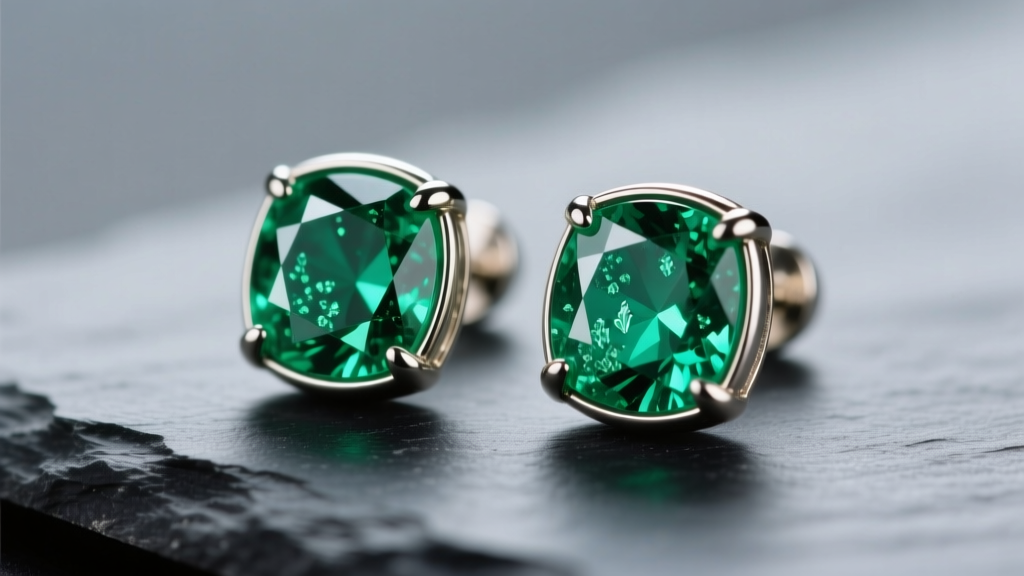
The landscape of fine jewelry is undergoing a definitive shift as we move through 2026. While diamond solitaires have held the crown for decades, discerning collectors and everyday wearers are increasingly gravitating toward colored gemstones that offer personality, heritage, and visual depth. At the forefront of this movement are stud emerald earrings. No longer reserved strictly for formal events or vintage estates, emerald studs have been reimagined for modern, daily wear. This comprehensive trend and style analysis breaks down the gemological nuances, structural requirements, and market pricing of emerald studs in 2026, providing you with the actionable expertise needed to invest wisely.
The 2026 Shift: Character Luxury and the Rise of the Jardin
In previous years, the jewelry market heavily favored emeralds with high clarity, often treating them with heavy resins to mask internal fractures. However, the 2026 trend cycle champions what industry insiders call "character luxury." Consumers are actively seeking out natural emeralds with visible jardin (the French term for the garden-like inclusions inherent to emeralds). Rather than viewing these inclusions as flaws, modern buyers recognize them as the gemstone's fingerprint, proving its natural origin and adding a unique, mossy depth to the stone.
This shift has heavily influenced the design of stud emerald earrings. Jewelers are moving away from heavily paved diamond halos that distract from the center stone, opting instead for minimalist, architectural settings that allow the emerald's natural color and internal landscape to take center stage. The preference for Zambian emeralds, which typically exhibit a cooler, deeper bluish-green tone and higher natural clarity than their Colombian counterparts, has surged by 34% in the fine jewelry sector over the last eighteen months.
Gemology Deep Dive: Selecting the Right Emerald Grade
Unlike diamonds, which are graded under 10x magnification for flawless clarity, emeralds are classified by the Gemological Institute of America (GIA) as Type III gemstones. This means they are almost always expected to have visible inclusions. When evaluating stud emerald earrings, understanding treatment levels is far more critical than chasing flawless clarity.
Understanding Oiling and Resin Treatments
Because emeralds are heavily included, they are routinely treated to improve their apparent clarity and stability. According to the American Gem Trade Association (AGTA), the industry standard is cedar oil treatment. However, not all treatments are created equal:
- None / No Oil: Exceedingly rare and commands a massive premium. Only recommended for high-end investment pieces.
- Minor (Faint) Oil: The sweet spot for fine jewelry. The stone has minor surface-reaching fissures filled with natural oils. Ideal for daily-wear studs.
- Moderate Oil: Acceptable for fashion-fine jewelry, but requires careful maintenance. Avoid ultrasonic cleaners, as they will strip the oil and reveal white fractures.
- Polymer Resins (e.g., Opticon): A hardening agent used for heavily fractured stones. While stable, it significantly lowers the resale value and is generally avoided by high-end bespoke jewelers.
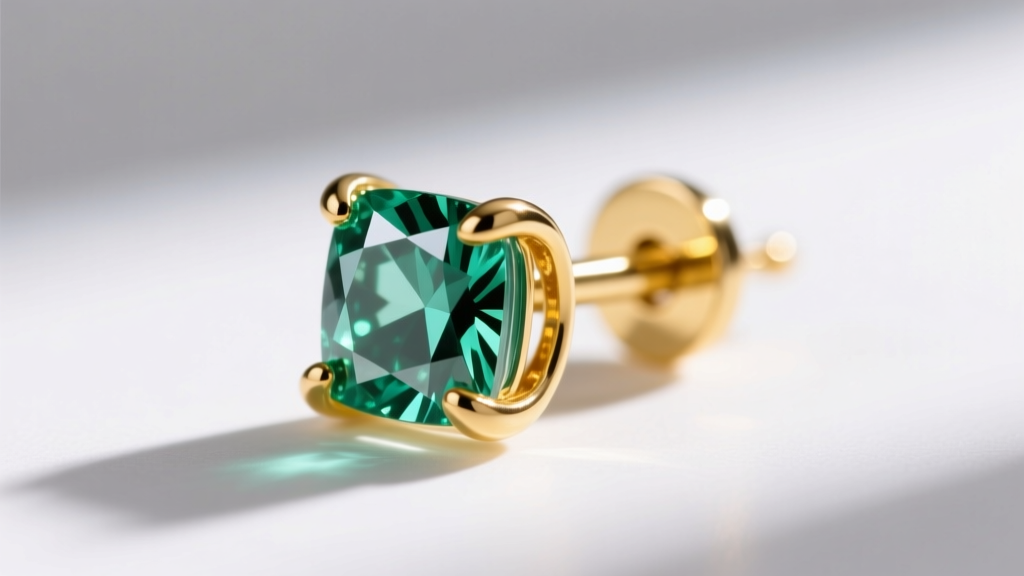
Setting Styles & Metal Pairings Dominating 2026
Emeralds rank between 7.5 and 8 on the Mohs scale of hardness. While reasonably hard, they possess poor toughness due to their natural inclusions and cleavage planes, making them highly susceptible to chipping if struck at the wrong angle. Therefore, the setting of your stud emerald earrings is not just an aesthetic choice; it is a structural necessity.
| Setting Style | Durability Rating | Best For | 2026 Trend Status |
|---|---|---|---|
| Full Bezel | Excellent | Daily wear, active lifestyles, cartilage placements | Mainstream staple; highly favored |
| East-West Bezel | Very Good | Modern, architectural aesthetics, elongated earlobes | High-growth niche; editorial favorite |
| 4-Prong Basket | Moderate | Maximizing light return and visible carat size | Classic, but declining for emerald cuts |
| V-Tip Prong | Good | Protecting the sharp corners of rectangular cuts | Steady; essential for emerald cuts |
In 2026, 18k yellow gold remains the premier metal pairing for emeralds. The warm, rich undertones of the gold amplify the verdant green of the gemstone, creating a complementary contrast that platinum or white gold simply cannot achieve. For those who prefer white metals, 14k white gold is preferred over platinum for emerald studs, as the slightly lower density allows for more intricate, lightweight basket work that doesn't drag on the earlobe.
Sizing, Gauge, and Wearability Metrics
Selecting the correct carat weight and post gauge is vital for the comfort and longevity of stud emerald earrings. Emeralds are less dense than diamonds, meaning a 1.00-carat emerald will physically measure larger than a 1.00-carat diamond.
Carat Weight Guidelines for Studs
For a refined, everyday look, a total weight (TW) of 0.50ct to 0.75ct (approximately 3.5mm to 4.5mm per stone) is ideal. This size sits flush against the earlobe without drooping. For a bolder, evening-appropriate statement, 1.50ct to 2.00ct TW (6mm to 7mm) provides significant visual impact. Anything exceeding 2.50ct TW in a stud format generally requires a specialized locking back to prevent the earring from tilting forward.
Post Gauge and Backing Mechanics
The structural integrity of the earring post is frequently overlooked. Standard fine jewelry posts are 20-gauge (0.81mm), which is sufficient for lightweight, round cabochon emeralds. However, if you are purchasing rectangular emerald-cut studs over 0.75ct TW, you must insist on an 18-gauge (1.02mm) post. The thicker gauge prevents the metal from bending under the weight of the stone, which can cause the post to warp and eventually snap.
Furthermore, standard friction backs (butterfly backs) are inadequate for valuable emeralds. Upgrade to La Pousette backs, which feature a mechanical locking tab that clicks securely into a groove on the post, or screw backs, which thread onto the post and are virtually impossible to lose during daily activities.
Market Pricing: Natural vs. Lab-Created Emeralds
The 2026 market offers distinct pricing tiers based on origin, treatment, and color saturation. Understanding these brackets prevents overpaying for treated stones or underestimating the value of premium naturals.
- Hydrothermal Lab-Grown Emeralds: Priced between $300 and $600 per carat. These possess the exact same chemical and physical properties as natural emeralds but are grown in a controlled environment, resulting in fewer inclusions. They are an excellent choice for travelers or those wanting larger carat sizes without the premium.
- Natural Zambian (Minor Oil, Vivid Green): Priced between $1,800 and $4,500 per carat. Zambian stones offer exceptional clarity and a deep, saturated tone that is highly sought after for modern stud designs.
- Natural Colombian (Muzo/Chivor, Minor Oil): Priced between $6,000 and $15,000+ per carat. The legendary "emerald green" with a slight bluish fluorescence makes these the pinnacle of investment-grade jewelry.
Styling Framework: Face Shape & Cartilage Placement
Stud emerald earrings are remarkably versatile, but their geometric impact should be tailored to your facial structure and piercing layout.
Face Shape Pairings
If you have a round face, opt for rectangular emerald-cut studs or elongated baguette studs. The sharp, linear geometry introduces structural angles that beautifully balance soft facial features. Conversely, those with square or angular jawlines should seek out round or oval cabochon emerald studs. The smooth, domed surface of a cabochon softens the overall look and provides a vintage, romantic aesthetic that is trending heavily in 2026.
Cartilage and Curated Ear Placements
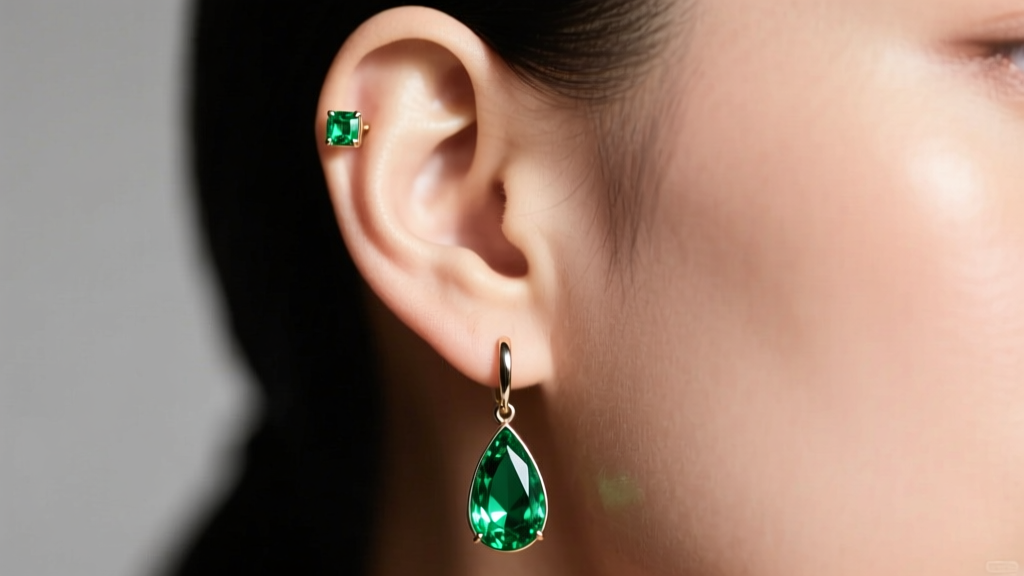
Emerald studs are no longer confined to the standard lobe piercing. In curated ear layouts, a small, bezel-set emerald stud (0.15ct to 0.25ct) is the premier choice for helix or upper cartilage placements. The bezel setting is mandatory here; prong settings in the upper ear will inevitably snag on hair, clothing, or headphones, risking both the loss of the earring and damage to the gemstone's delicate edges. Pairing a minimalist upper-helix emerald stud with a larger, more ornate emerald drop in the primary lobe piercing creates a cohesive, high-end aesthetic that defines the current era of ear styling.
Final Considerations for the Modern Collector
Investing in stud emerald earrings in 2026 requires a balance of gemological knowledge and practical wearability. By prioritizing minor-oil treatments, selecting protective bezel or V-tip settings, and ensuring your posts are 18-gauge for heavier stones, you secure a piece of jewelry that is both structurally sound and aesthetically timeless. Whether you choose the deep, moody greens of a Zambian stone or the vibrant, historic allure of a Colombian gem, emerald studs offer a sophisticated departure from the ordinary, grounding your personal style in centuries of lapidary tradition.


