Styling 3 Earrings in One Ear: The Ultimate Buying Guide
Master the art of stacking with our buying guide for 3 earrings in one ear. Learn about gauge sizes, spacing, metals, and design formulas.


The 'curated ear' trend has undergone a massive evolution. As we navigate the jewelry landscape of 2026, the focus has shifted away from chaotic, ear-party maximalism toward intentional, architectural stacking. Learning how to properly style and buy 3 earrings in one ear is the ultimate sweet spot for jewelry enthusiasts. It provides enough canvas to tell a visual story without overwhelming the side profile or causing physical discomfort. However, buying for a triple-stack requires a deep understanding of spatial geometry, metallurgical grades, and hardware mechanics. This comprehensive buying guide will teach you exactly what to look for when curating your trio.
The Geometry of the Triple Stack: Understanding Spacing
The most common mistake buyers make when purchasing 3 earrings in one ear is ignoring the spatial relationship between the fistulas (the piercing holes). Standard professional piercers typically space consecutive lobe piercings between 6mm and 8mm apart, measured from the center of one hole to the center of the next.
If you purchase three 8mm wide hoop earrings for holes spaced 7mm apart, the jewelry will physically overlap, causing friction, tangling, and eventual irritation bumps. To avoid this, you must apply the Radius Rule: the combined radius of two adjacent earrings must be less than the distance between their respective holes. For a standard 7mm spacing, your earrings should not exceed 6mm in total diameter. When shopping for your trio, always check the millimeter (mm) dimensions in the product specifications, not just the visual scale in the product photos.
Material Grades: What Authoritative Piercers Recommend
When you have multiple pieces of jewelry resting in the same ear, the cumulative metal exposure increases. This makes material biocompatibility non-negotiable. According to the Association of Professional Piercers (APP), only specific grades of metal should be worn in healed or healing piercings to prevent contact dermatitis and nickel sensitization.
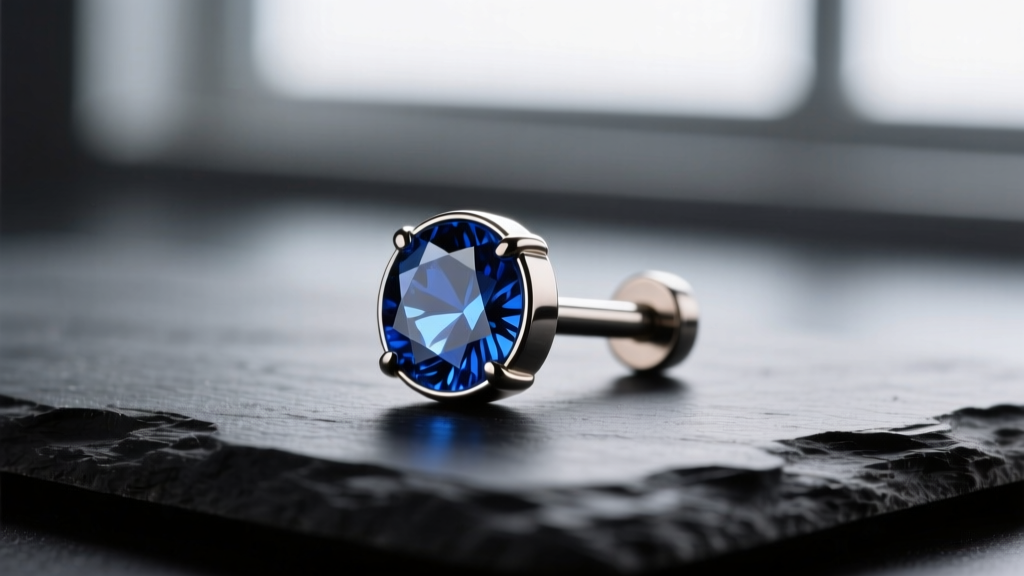
- ASTM F136 Implant-Grade Titanium: The gold standard for sensitive ears and fresh piercings. It is entirely nickel-free, lightweight, and highly polished. Ideal for the base posts of your stack.
- 14k or 18k Solid Gold (Nickel-Free Alloy): Ensure the brand explicitly states their gold is alloyed without nickel. Yellow and rose gold are generally safer than white gold, which often relies on nickel or palladium for its color.
- Niobium: A highly reactive metal that can be safely anodized to various colors without using surface paints or platings that could chip off in the fistula.
Buyer Beware: Avoid 'surgical steel' or 'stainless steel' for your triple stack. These terms are unregulated and often contain high levels of nickel that will cause severe itching and swelling when worn in clusters.
The Hardware: Threadless vs. Threaded Backings
When buying 3 earrings in one ear, the backing mechanism dictates both the security of your jewelry and the ease of changing it. Traditional 'butterfly' friction backs are largely considered obsolete by high-end piercers because they harbor bacteria and pull on hair. Here is a breakdown of what to look for:
| Backing Type | Security Level | Best For | Drawbacks |
|---|---|---|---|
| Threadless (Push-Pin) | Very High | Cartilage, Triple Lobes, Active Lifestyles | Requires bending the pin slightly for tension |
| Internally Threaded | High | Standard Lobes, Heavy Statement Pieces | Can slowly unscrew over time; threads can cross |
| Externally Threaded | Low | Nothing (Avoid entirely) | Sharp threads tear the fistula lining upon insertion |
| Friction (Butterfly) | Low | Temporary, low-cost fashion wear | Traps dead skin, high risk of losing the earring |
3 Blueprint Formulas for Styling Your Trio
Buying the right jewelry is only half the battle; arranging them cohesively is the other. Here are three fail-safe design formulas for styling 3 earrings in one ear, whether they are all in the lower lobe or ascending into the upper cartilage.
Formula 1: The Descending Gradient
This is the most popular configuration for a triple-lobe setup. The visual weight is heaviest at the bottom and tapers upward, mimicking the natural anatomy of the ear.
The Buy:
• Hole 1 (Bottom): 5mm to 6mm cluster stud or small huggie hoop.
• Hole 2 (Middle): 3mm to 4mm simple gemstone or bezel setting.
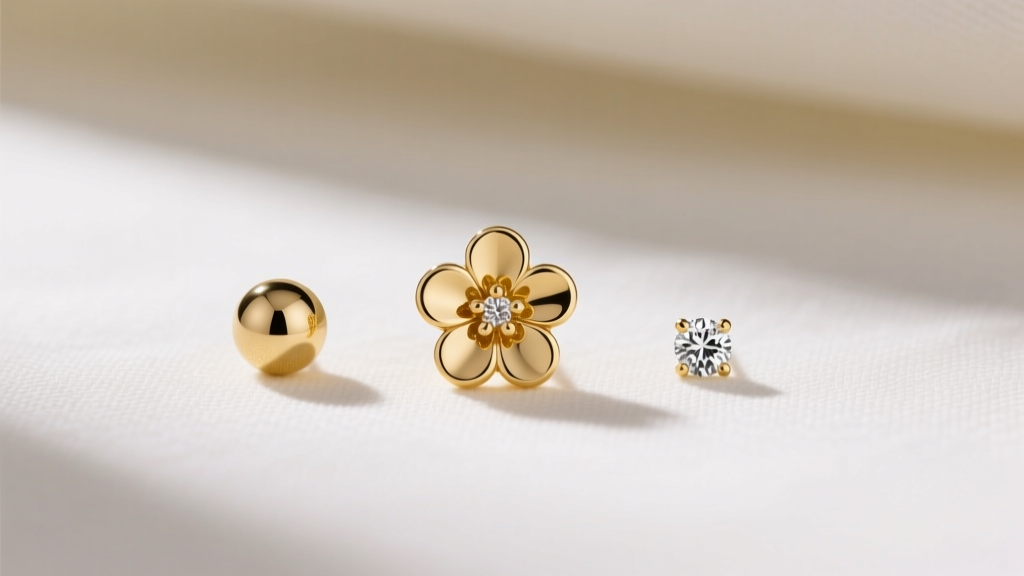
• Hole 3 (Top): 1.5mm to 2mm micro-stud or plain gold ball.
This formula guarantees that no matter how close your piercings are, the decreasing sizes prevent overlapping.
Formula 2: The Anchor and Satellites
If you want to make a statement without cluttering the ear, use one focal point.
The Buy:
• Hole 1 (Bottom): A bold, 8mm-10mm textured hoop, chain drop, or intricate floral cluster.
• Hole 2 & 3: Ultra-minimalist 2mm flush-set diamonds or plain titanium balls.
The minimalist satellites frame the anchor piece, drawing the eye directly to the primary earring while maintaining a cohesive, high-end look.
Formula 3: The Lobe-to-Helix Ascension
For those whose three piercings span from the lower lobe up to the mid-helix (cartilage), you must mix jewelry types to accommodate different tissue thicknesses.
The Buy:
• Lobe: A 10mm lightweight hoop or drop earring.
• Upper Lobe/Flat: A 4mm bezel-set gemstone on a flat-back labret post.
• Helix: A 16g seamless clicker ring or a delicate threadless cuff.
Pro Tip: Cartilage piercings swell more than lobes. Always buy 16g (1.2mm) thickness for helix placements, as 18g jewelry can cause the 'cheese-cutter effect' in thinner cartilage tissue.
Gauge Sizing: Getting the Thickness Right
Gauge refers to the thickness of the post or wire that passes through your ear. Buying the wrong gauge will result in jewelry that either won't fit or will stretch the piercing uncomfortably.
- 20 Gauge (0.8mm): The standard for traditional fashion earrings and friction-back studs. Best for the top hole of a triple-lobe stack if the tissue is thin.
- 18 Gauge (1.0mm): The standard for high-end body jewelry, threadless ends, and most cartilage piercings. If you are buying a matching trio from a premium body jewelry brand like BVLA or Maria Tash, 18g is the most common baseline.
- 16 Gauge (1.2mm): Thicker and more durable. Essential for helix, tragus, or conch piercings to provide structural integrity and prevent migration.
Final Thoughts on Building Your Stack
Curating 3 earrings in one ear is an exercise in precision and personal style. By prioritizing biocompatible materials like ASTM F136 titanium and 14k nickel-free gold, opting for secure threadless hardware, and strictly adhering to the spatial mathematics of your unique anatomy, you can build a stack that is as comfortable as it is stunning. Before you add to cart, grab a digital caliper, measure the distance between your piercings, and shop by exact millimeter dimensions. Your ears will thank you for the intentional, expert-level curation.


