How to Style, Clean, and Protect Holographic Earrings
Learn how to style, clean, and maintain holographic earrings. Discover expert care tips for dichroic glass, anodized titanium, and resin styles.

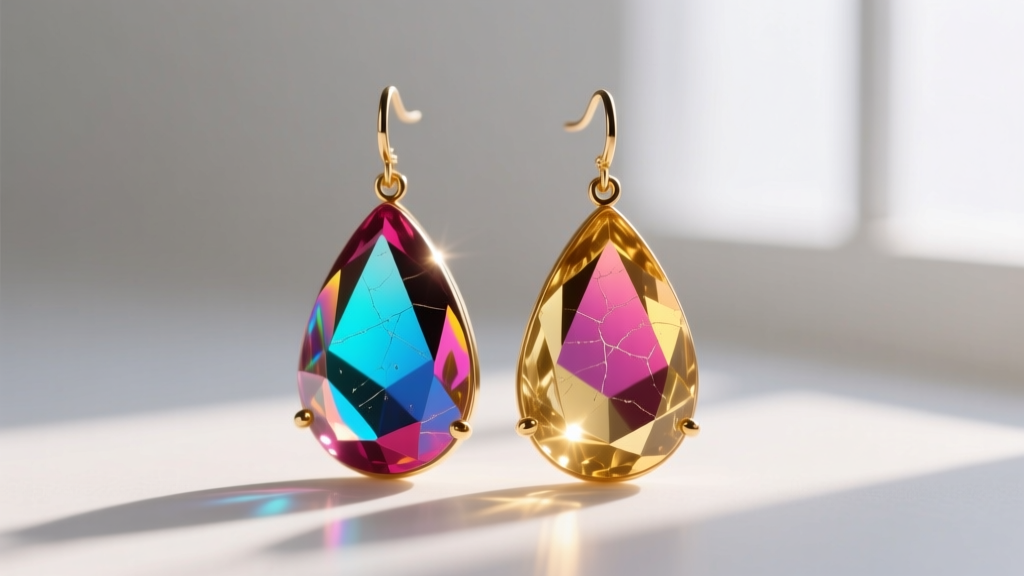
In 2026, the intersection of avant-garde optics and fine jewelry has firmly established holographic earrings as a staple in both high-fashion and everyday body modification. Unlike standard metallic or gemstone jewelry, holographic pieces rely on thin-film interference, micro-layering, and light refraction to produce their signature iridescent color shifts. However, this complex optical engineering requires highly specific care, styling, and maintenance protocols. Whether you are wearing dichroic glass drops, anodized titanium cartilage studs, or holographic resin huggies, treating these pieces like standard gold or silver will lead to rapid degradation.
This comprehensive, step-by-step guide will teach you how to identify your holographic materials, style them for maximum light refraction, and clean them without destroying their delicate optical layers.
The Science and Materials Behind Holographic Earrings
Before you can properly care for holographic earrings, you must identify the manufacturing technique used to create them. The term "holographic" is often used as a catch-all, but in jewelry making, it refers to three distinct material categories, each with unique failure modes and care requirements.
1. Dichroic Glass (Fused Quartz and Metal Oxides)
Dichroic glass is created in a vacuum chamber by stacking micro-layers of quartz crystal and metal oxides (such as titanium, chromium, and aluminum). These layers are measured in nanometers. When light hits the glass, some wavelengths pass through while others reflect, creating a brilliant, shifting holographic effect. Failure Mode: Dichroic glass is highly susceptible to thermal shock and hard impacts. Sudden temperature changes can cause the micro-layers to delaminate or the glass to shatter along the oxide fault lines.
2. Anodized Titanium (ASTM F-136 Implant-Grade)
For body jewelry, holographic effects are often achieved through anodizing. According to the Association of Professional Piercers (APP), implant-grade titanium (ASTM F-136) is submerged in an electrolyte bath and subjected to an electrical current. This grows a titanium dioxide layer on the surface. The exact voltage dictates the thickness of this oxide layer, which in turn dictates the refracted color. A thickness of roughly 110 nanometers yields a stunning magenta-to-gold holographic shift. Failure Mode: While the titanium itself is indestructible, the anodized oxide layer can be scratched off by abrasive polishing cloths or degraded by harsh alkaline chemicals, revealing the dull gray metal beneath.
3. Holographic Resin and PET Films
Fashion earrings often utilize laser-etched PET (polyethylene terephthalate) films encased in UV-cured jeweler's resin. These are lightweight and can be molded into complex geometric shapes. Failure Mode: Resin is porous and highly reactive to alcohol and UV degradation. Prolonged sun exposure will cause the resin to yellow, while alcohol-based cleaners will induce micro-cracking and clouding, permanently ruining the holographic refraction.
Step-by-Step Guide to Styling Holographic Earrings
Styling holographic jewelry is fundamentally about light management. Because these earrings do not possess inherent pigment, their visual impact changes drastically depending on the light source and the wearer's geometry.
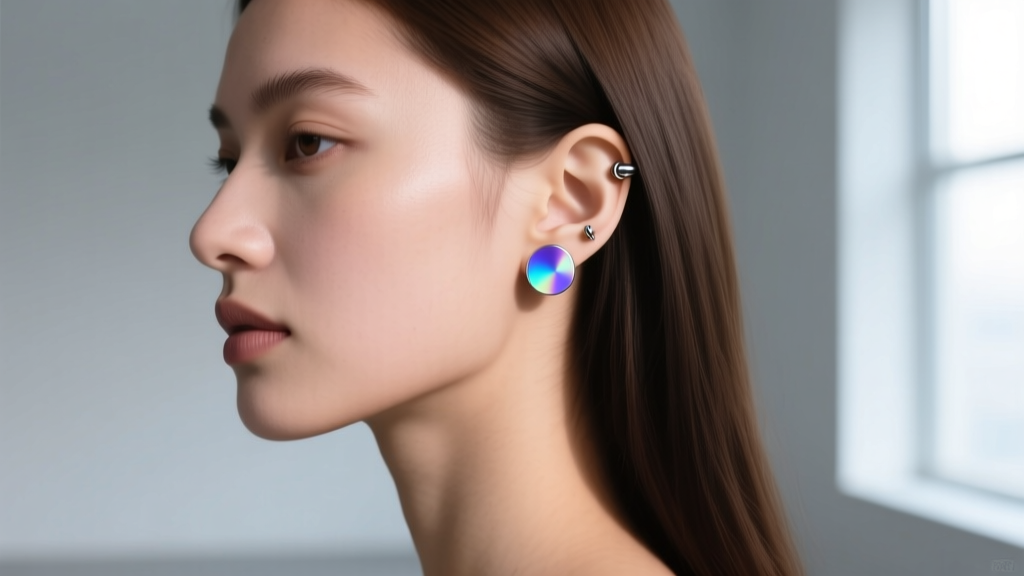
- Lighting Environments: Dichroic glass requires direct, high-kelvin light (like natural sunlight or cool-white LEDs at 5000K+) to activate the full color spectrum. Under warm, dim indoor lighting (2700K), dichroic glass will appear muddy or dark. Conversely, anodized titanium holographic studs catch and scatter diffused ambient light beautifully, making them superior for evening or office wear.
- Face Shape Pairing: Because holographic drops draw intense visual attention, use them to balance facial geometry. Elongated dichroic drop earrings are ideal for round or square face shapes, as the vertical light-trail elongates the jawline. For heart-shaped faces, holographic huggies or short chandelier styles add necessary volume to the lower half of the face without overwhelming the chin.
- Metal Coordination: Never mix anodized titanium with heavy yellow gold. The holographic color shift will clash with the warm, solid tones of gold. Instead, pair holographic pieces with rhodium-plated white gold, platinum, or surgical steel to allow the iridescent colors to remain the focal point.
The Ultimate Cleaning Protocol (What to Do and Avoid)
The most common way collectors ruin holographic earrings is by using standard jewelry dips or ultrasonic cleaners. The high-frequency vibrations of an ultrasonic cleaner will literally shake the microscopic oxide layers off dichroic glass, while chemical dips will strip the anodized coating off titanium. According to the APP Official Aftercare Protocols, less is always more when dealing with specialized surface treatments.
Step-by-Step Cleaning Routine
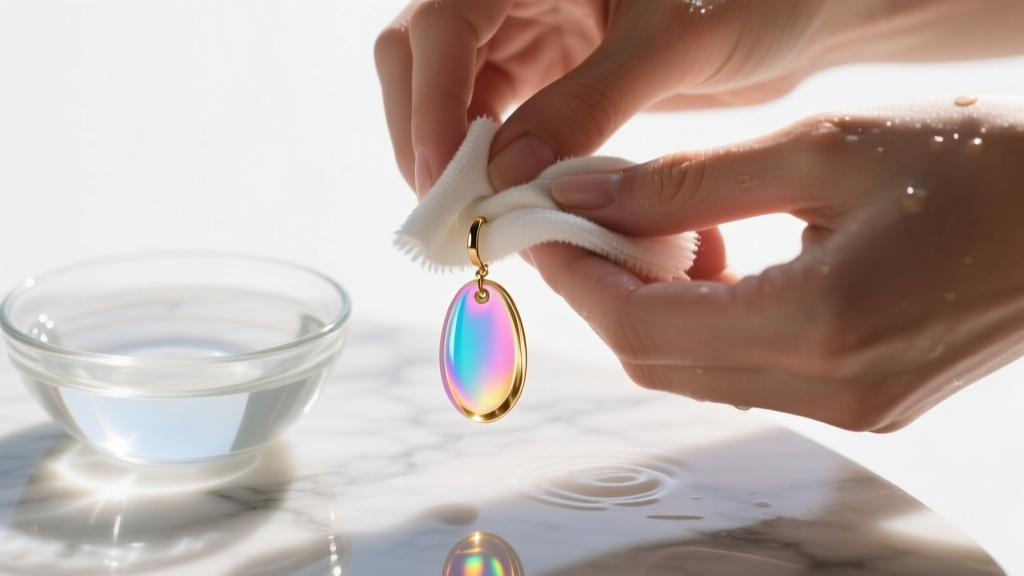
- Preparation: Mix a solution of distilled water and a few drops of pH-neutral, fragrance-free liquid soap (such as baby shampoo) in a glass bowl. Avoid tap water, as hard water minerals will leave microscopic calcium deposits that dull the holographic refraction.
- Agitation: Submerge the earrings for no more than 60 seconds. Do not scrub. Gently swish the bowl to allow the soapy water to lift sebum, dead skin cells, and cosmetic residue.
- Rinsing: Rinse thoroughly under a gentle stream of distilled or filtered water.
- Drying: Never air-dry holographic earrings, as water spots will permanently etch into resin and dull glass. Use a clean, lint-free microfiber cloth to gently pat the pieces dry. For intricate settings or flat-back threads, use a can of compressed air or a cool-setting hair dryer to blow moisture out of the crevices.
Expert Warning: Never use rubbing alcohol, ammonia, bleach, or commercial silver polishing cloths on holographic earrings. Silver polish contains mild abrasives (like calcium carbonate) that will instantly sand away the nanometer-thin anodized layer on titanium and scratch holographic resin.
Material Compatibility Chart
| Cleaning Agent | Dichroic Glass | Anodized Titanium | Holographic Resin |
|---|---|---|---|
| Warm Soapy Water | Safe | Safe | Safe |
| Ultrasonic Cleaner | DESTROYS (Delamination) | Safe (but risky for gems) | DESTROYS (Shattering) |
| Isopropyl Alcohol | Safe | Safe | DESTROYS (Clouding) |
| Silver Polish Cloth | Scratches Surface | STRIPS Color | SCRATCHES Surface |
| Steam Cleaner | DESTROYS (Thermal Shock) | Safe | MELTS / Warps |
Troubleshooting Common Holographic Failures
Even with meticulous care, holographic earrings can lose their luster. Here is how to diagnose and fix the most common issues based on material science.
Issue: The earring looks dull and cloudy, but isn't scratched.
Diagnosis: This is almost always a buildup of hard water minerals, skincare silicones, or natural sebum.
Solution: Soak the piece in a 50/50 mix of distilled white vinegar and distilled water for exactly 3 minutes (do not exceed this, especially for resin). Rinse with distilled water and dry with microfiber. The mild acetic acid will dissolve the mineral and silicone barriers without harming the optical layers.
Issue: The color shift has faded to a single, flat tone.
Diagnosis: UV degradation (for resin) or oxide layer wear (for titanium).
Solution: Resin UV damage is irreversible; the piece must be replaced. If an anodized titanium stud has lost its holographic shift, the oxide layer has been worn away by friction or chemicals. Fortunately, you can send the piece back to a professional piercer or jeweler to be re-anodized, restoring the holographic effect for a fraction of the cost of a new piece.
Gauge and Sizing Guide for Cartilage and Lobe Piercings
When purchasing holographic earrings for body piercings, particularly cartilage, precise sizing is non-negotiable to prevent migration, tearing, and rejection. The Gemological Institute of America (GIA) and body modification experts emphasize that optical jewelry must never compromise structural integrity.
- Standard Lobe Piercings: Typically pierced at 20G (0.81mm) or 18G (1.02mm). Most dichroic glass drops and holographic resin dangles are manufactured with standard 20G or 18G fishhook or lever-back wires. Ensure the wire is made of surgical steel or gold-plated brass to avoid contact dermatitis.
- Helix and Cartilage Piercings: Cartilage requires thicker, more stable jewelry to prevent the "cheese-cutter effect." Holographic anodized titanium flat-back studs should always be purchased in 16G (1.29mm) or 14G (1.63mm).
- Post Lengths: For healed cartilage piercings, a post length of 6mm (1/4 inch) or 8mm (5/16 inch) is standard. If you are wearing a holographic threadless end in a fresh piercing, you must start with a 10mm (3/8 inch) post to accommodate swelling, downsizing only after the 3-to-6-month healing period is complete.
Final Thoughts on Holographic Maintenance
Holographic earrings are a triumph of modern material science, blending the beauty of light physics with wearable art. By understanding whether your pieces rely on dichroic micro-layers, titanium anodization, or PET resin films, you can tailor your styling and cleaning routines to protect their delicate optical properties. Treat them with the specialized care they demand, and your holographic collection will continue to shift, shimmer, and captivate for years to come.


