How to Style and Conceal a Big Earring Hole: The Ultimate Guide
Discover the best jewelry, lobe supports, and styling tricks to conceal or embrace a big earring hole. Expert tips on materials, gauges, and rehab.


Understanding the Anatomy of a Big Earring Hole
Whether caused by years of wearing heavy statement dangles, accidental snags, or intentional stretching, a 'big earring hole' presents a unique set of styling and anatomical challenges. In the professional piercing community, standard earlobe piercings are typically performed at 18-gauge (1.02mm) or 16-gauge (1.29mm). When a fistula (the piercing channel) expands beyond 4-gauge (5.1mm) or becomes elongated due to the 'cheese-cutter effect,' standard jewelry no longer fits securely, and the structural integrity of the lobe is compromised.
The cheese-cutter effect occurs when a heavy earring rests on a thin wire. The localized pressure on the inferior edge of the tissue restricts blood flow (ischemia), causing the tissue to slowly necrose and tear downward. If you are dealing with a blown-out lobe, an elongated tear, or an intentionally stretched fistula, your buying strategy must shift from purely aesthetic choices to structural support and tissue preservation. This comprehensive buying guide will walk you through the exact jewelry, concealers, and materials you need to manage a big earring hole safely and stylishly in 2026.
Strategic Jewelry Solutions: What to Buy
When shopping for a compromised or enlarged earlobe, you must prioritize weight distribution and structural fill. Here is what to look for when building your jewelry wardrobe.
1. Lobe Support Patches and Concealers
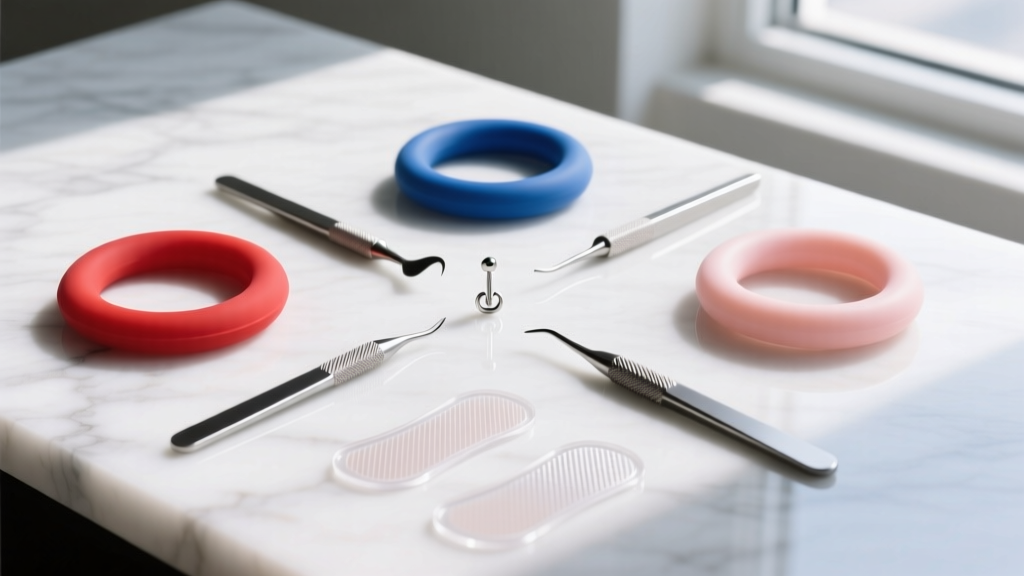
If your goal is to wear standard 20G or 18G drop earrings without them sliding to the bottom of an elongated hole, medical-grade lobe support patches are your best investment. Brands like BlingDots or LobeWonder manufacture 0.2mm thick polyethylene patches with a hypoallergenic adhesive.
- What to look for: Ensure the material is polyethylene or medical-grade silicone, not standard paper tape. Paper tape breaks down rapidly when exposed to natural sebum (skin oils) and sweat.
- How they work: By placing the patch behind the earlobe and inserting the earring post through the patch's pre-punched hole, you increase the surface area bearing the earring's weight by up to 400%. This drops the localized pressure below the tissue damage threshold.
- Pricing: Expect to pay $10 to $18 for a pack of 50 to 100 pairs.
2. Thick-Band Huggies and Sleepers
For a big earring hole that is circular rather than torn, thick continuous hoops or huggies are ideal. The goal is to 'fill the void' so the jewelry does not migrate downward.
- Wire Gauge: Look for huggies with a minimum wire thickness of 1.6mm (14G) to 2.5mm (10G). A thicker wire rests comfortably inside the enlarged fistula, providing internal support.
- Closure Mechanism: Avoid thin fishhook wires. Opt for hinged segment rings or clickers with a secure snap closure to ensure the earring does not slip out of the enlarged opening while sleeping.
- Diameter: Choose a small inner diameter (10mm to 14mm) so the earring hugs the lobe tightly, preventing gravity from pulling it through the hole.
3. Ear Cuffs and Climbers (No-Piercing Options)
If your lobe is completely torn or currently healing from a blowout, bypass the hole entirely. Modern ear cuffs are designed to distribute tension across the helix or the outer edge of the lobe.
- Buying Tip: Look for adjustable cuffs lined with micro-silicone grips on the interior band. This prevents the metal from slipping on the cartilage without requiring excessive clamping force, which can cause cartilage fatigue.
Material Guide: Safe Options for Compromised Tissue
When the tissue surrounding a big earring hole is thin, scarred, or healing, it is highly susceptible to contact dermatitis and bacterial infections. According to the Association of Professional Piercers (APP), only specific, non-porous materials should be worn in compromised fistulas.
| Material | Grade / Type | Pros for Enlarged Holes | Cons / Warnings |
|---|---|---|---|
| Implant-Grade Titanium | ASTM F136 | Biocompatible, lightweight, highly polished. Ideal for custom thick-gauge huggies. | More expensive than surgical steel. |
| Borosilicate Glass | Pyrex / Quartz | Non-porous, can be autoclaved, heavy enough to maintain stretch without tearing. | Can shatter under extreme blunt impact. |
| PTFE (Teflon) | Bioplast / Flexible | Extremely lightweight, flexible, reduces pressure on the inferior edge of the lobe. | Can degrade over years of continuous wear. |
| Silicone | Medical-Grade | Soft and comfortable for temporary wear. | Warning: Porous. Traps anaerobic bacteria. Never wear in a fresh tear or blowout. |
Sizing and Gauge Mechanics: Avoiding Further Damage
If you are intentionally maintaining a stretched big earring hole, understanding flare types is critical to preventing further tissue damage. When shopping for plugs or tunnels, you will encounter three main styles:
- Single Flare: Features a lip on only one side, secured by a silicone or glass O-ring on the back. This is the safest option for compromised or thinning lobes, as it requires no force to insert.
- Double Flare: Features lips on both sides, requiring the jewelry to be pushed through the fistula. Avoid these if your lobe is thin or prone to tearing, as the insertion process can cause micro-tears in the weakened tissue.
- Threadless / Internally Threaded: For heavy stone or metal plugs, always buy internally threaded or threadless (pin-fit) jewelry. Externally threaded jewelry has sharp ridges that will scrape and damage the delicate interior of an enlarged fistula during insertion.
Expert Rule of Thumb: The general consensus among professional piercers is that 0-gauge (8mm) is the 'point of no return' for natural earlobe shrinkage. If your hole is larger than 8mm and you wish to downsize, you will likely require professional intervention.
When to Seek Professional Rehabilitation
Jewelry and patches are excellent for styling and management, but they cannot reverse severe tissue loss. If your big earring hole is accompanied by a complete split (where the lobe is divided into two distinct pieces) or extreme thinning (where the inferior edge is less than 2mm thick), it is time to consult a medical professional.
Dermal Fillers
For lobes that are stretched but not torn, dermatologists can inject hyaluronic acid (HA) fillers into the earlobe. This adds volume, plumps the thinned tissue, and can actually shrink the diameter of the fistula by pushing the surrounding tissue inward. This is a temporary solution, typically lasting 9 to 12 months, and costs between $300 and $600 per session.
Surgical Lobuloplasty
For completely torn lobes, surgical earlobe repair (lobuloplasty) is the gold standard. According to the American Society of Plastic Surgeons, this is a minor in-office procedure performed under local anesthesia. The surgeon excises the scar tissue lining the fistula and sutures the fresh edges together. Pricing generally ranges from $500 to $1,500 per ear, and you can typically expect to wait 6 to 8 weeks before re-piercing the lobe.
Your Final Buying Checklist
Before you checkout with your next jewelry purchase, run through this quick diagnostic checklist to ensure you are protecting your earlobes:
- Weight Check: Does the earring weigh more than 7 grams? If yes, you must pair it with a polyethylene lobe support patch.
- Wire Thickness: Is the wire passing through your hole at least 1.2mm (16G) thick? If not, swap it for a thicker huggie or use a patch to prevent the cheese-cutter effect.
- Material Verification: Is the jewelry made of ASTM F136 Titanium, Borosilicate Glass, or solid 14k/18k Gold? Avoid mystery metals, plated brass, and porous silicone.
- Closure Security: If using a hoop, does it have a secure clicker or hinge? Avoid friction closures on enlarged holes.
Managing a big earring hole does not mean sacrificing style. By understanding the physics of weight distribution, investing in medical-grade concealers, and choosing structurally sound, biocompatible jewelry, you can wear your favorite pieces with total confidence and keep your tissue healthy for years to come.


