How to Style Diamond Shape Earrings for Every Face Shape
Learn how to choose, style, and stack diamond shape earrings based on your face shape, ear anatomy, and metal gauge requirements.


The Geometry of Glamour: Understanding Diamond Shape Earrings
When we talk about diamond shape earrings, we are referring to one of the most striking silhouettes in modern jewelry design: the geometric rhombus. Unlike the soft curves of traditional hoops or the simple symmetry of round studs, the diamond shape offers an architectural edge that frames the face with sharp, deliberate lines. Whether crafted from solid 14k gold, paved with brilliant-cut gemstones, or carved from matte titanium, the rhombus silhouette is a masterclass in visual tension.
However, styling geometric jewelry requires more than just picking a pretty design. The sharp angles and elongated drops of diamond shape earrings interact directly with your facial geometry, jawline, and ear anatomy. According to the Gemological Institute of America (GIA), the perception of geometric shapes in jewelry is heavily influenced by light reflection and proportion. In this step-by-step guide, we will break down exactly how to select, fit, and curate diamond shape earrings for your unique features.
Step 1: Map Your Face Shape to the Right Rhombus Scale
The most common mistake buyers make is ignoring the scale of the earring relative to their facial proportions. A 15mm micro-diamond stud will get lost on a strong, angular jawline, while a 60mm elongated rhombus drop might overwhelm a petite, heart-shaped face. Here is how to match your face shape to the optimal diamond shape earring profile.
| Face Shape | Recommended Diamond Shape Scale | Styling Rationale |
|---|---|---|
| Round | Elongated, sharp-angled drops (40mm - 65mm) | Creates verticality and sharpens soft jawlines by drawing the eye downward. |
| Square | Soft-cornered rhombus hoops or pavé geometric clusters | Offsets a strong mandible with light-reflecting surfaces rather than harsh, competing lines. |
| Heart | Bottom-heavy diamond dangles or inverted rhombus studs | Adds visual weight to the lower half of the face, balancing a narrower chin. |
| Oval | Asymmetrical diamond shapes or wide geometric huggies | Highlights natural facial symmetry while adding a modern, avant-garde edge. |

Step 2: Choose the Right Metal Grade and Gauge
The structural integrity of diamond shape earrings is paramount. Because the rhombus silhouette often features elongated drops or wide geometric frames, the weight distribution can put immense stress on your earlobe. This brings us to a critical concept in jewelry wearability: the cheese-cutter effect.
Understanding the Cheese-Cutter Effect
If you hang a heavy, solid 18k gold diamond shape drop earring (weighing over 8 grams) on a thin 20-gauge or 18-gauge wire, the downward force will slowly slice through your earlobe tissue over time. To prevent this, you must match the earring's weight to the correct post thickness (gauge).
- 20-Gauge (0.81mm): Standard for lightweight micro-studs and delicate wire wraps. Not suitable for heavy geometric drops.
- 18-Gauge (1.02mm): The industry standard for most lobe earrings. Safe for medium-weight diamond shape huggies and standard drops under 5 grams.
- 16-Gauge (1.29mm): Ideal for heavy, elongated rhombus drops and cartilage piercings (helix, forward helix). Provides the necessary structural support to prevent lobe tearing.
- 14-Gauge (1.60mm): Reserved for statement, oversized architectural pieces or stretched lobes.
Material Grades and Skin Sensitivity
Geometric earrings often sit flush against the skin or feature sharp corners that can cause micro-abrasions if the metal is reactive. The American Academy of Dermatology (AAD) warns that nickel contact dermatitis is a leading cause of jewelry-related skin reactions. Always verify your metal grades:
- 14k Gold (58.5% pure): Alloyed with copper, silver, or zinc. Highly durable and resistant to bending, making it the best choice for sharp geometric corners that might catch on clothing.
- 18k Gold (75% pure): Richer in color but softer. Best for pavé diamond shape earrings where the metal is protected by gemstone settings.
- ASTM F136 Titanium: The ultimate hypoallergenic metal. If you are getting a cartilage piercing and want a diamond shape stud, insist on implant-grade titanium to ensure proper healing without rejection.
Step 3: Curate Your Ear Stack (Lobe vs. Cartilage)
Diamond shape earrings are incredibly versatile when it comes to ear curation. The key to a professional-looking ear stack is the Rule of Thirds—balancing heavy geometric shapes with minimalist negative space.
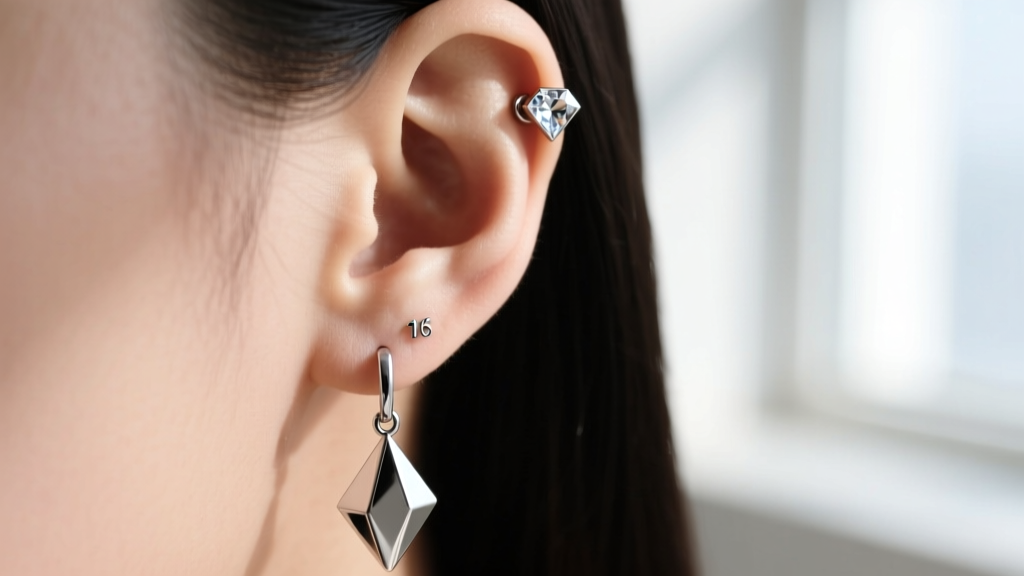
Stylist Tip: Never pair two identical, oversized diamond shape drops in the same ear. Instead, anchor your standard lobe piercing with a 35mm rhombus drop, and place a 10mm geometric diamond shape huggie in your upper lobe or flat piercing to create a cascading visual flow.
For cartilage placements like the forward helix or tragus, opt for bezel-set diamond shape studs. Prong-set geometric stones in the cartilage are prone to snagging on hair and headphones, which can lead to cartilage bumps (hypertrophic scarring). A smooth, bezel-set rhombus offers the same architectural vibe with zero snag risk.
Step 4: Maintenance, Prong Care, and Snag Prevention
The sharp corners of diamond shape earrings are their defining feature, but they are also their biggest vulnerability. The acute angles of a rhombus frame act like tiny hooks, catching on silk blouses, knit sweaters, and loose hair. Over time, these micro-snags can bend the metal frame or loosen gemstone prongs.
The Monthly Prong Check
If your diamond shape earrings feature pavé or channel-set gemstones along the geometric edges, you must perform a monthly prong check. Use a 10x jeweler's loupe to inspect the corners of the rhombus. Corner stones bear the brunt of impact when you set your jewelry down on a hard surface. If you notice any light leaking beneath a stone, or if the metal prongs look flattened, take the piece to a jeweler immediately for laser welding or re-tipping.
Safe Cleaning Protocols
While ultrasonic cleaners are excellent for removing sebum and lotion buildup from solid gold diamond shape frames, they can be disastrous for certain gemstone configurations. If your geometric earrings feature fracture-filled diamonds, emeralds, or opals cut into a rhombus shape, the high-frequency vibrations of an ultrasonic machine will shatter the stones. Instead, use a soft-bristled baby toothbrush and a solution of warm water with a single drop of mild, phosphate-free dish soap. Gently brush the back of the geometric frame where skin oils accumulate, rinse with distilled water, and dry with a lint-free microfiber cloth to maintain the sharp, reflective edges of the metal.
By understanding the interplay between facial geometry, metal gauges, and structural maintenance, you can confidently wear diamond shape earrings as a bold, lifelong signature of your personal style.