The Anatomy of Three Hoop Earrings: Gauges, Tension, and Stacks
Master the biomechanics of three hoop earrings. Explore gauge sizing, spatial geometry, metallurgical standards, and tension mechanics.

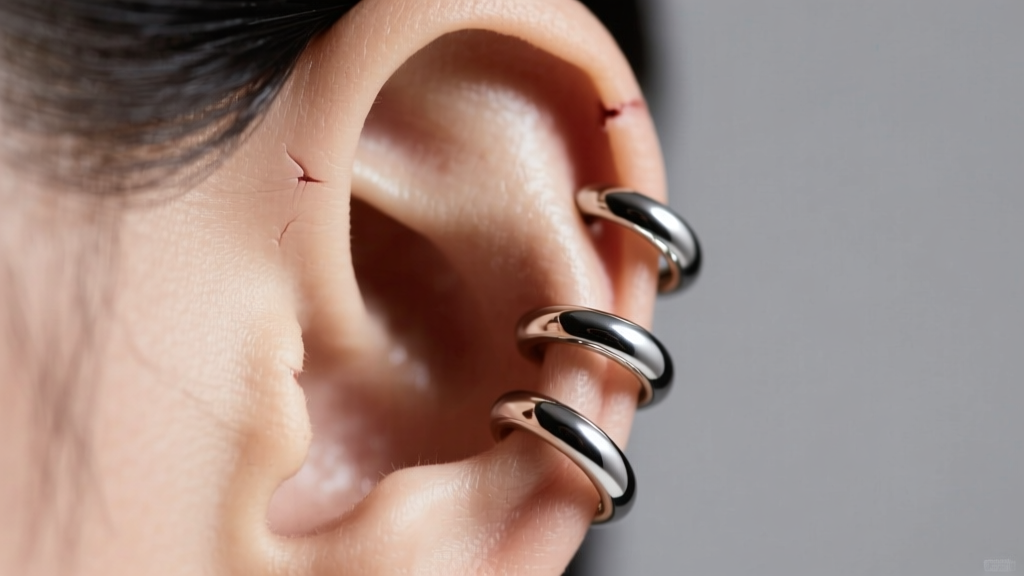
The Biomechanics of a Three Hoop Earrings Stack
When curating a sophisticated ear stack or engineering a single-piece multi-ring design, three hoop earrings present a unique set of biomechanical and metallurgical challenges. Unlike studs, which sit flush and distribute weight directly through the fistula, hoops introduce rotational force, variable tension, and dynamic movement. Understanding the physics of how three distinct hoops interact with the auricular cartilage and earlobe tissue is essential for long-term wearability, comfort, and the prevention of migration.
According to the Association of Professional Piercers (APP), the angle of the initial piercing dictates the success of any hoop jewelry. For a vertical stack of three hoops, each fistula must be pierced at a strict 90-degree perpendicular angle to the tissue plane. If the piercings are angled to accommodate flat-back labrets, inserting hoops will create a torque effect, leading to chronic irritation bumps and potential tissue rejection.
Piercing Alignment and Spatial Geometry
The spatial arrangement of three hoop earrings along the ear requires precise geometric planning. The golden rule of cartilage stacking is maintaining a minimum of 6mm to 8mm of space between the edges of each piercing hole. This spacing is not merely aesthetic; it is a functional necessity. Hoops require physical clearance to rotate freely without the beads or hinges of adjacent rings colliding. When three hoops are placed too closely, the friction between the jewelry components generates micro-abrasions on the skin, creating an entry point for bacterial pathogens.
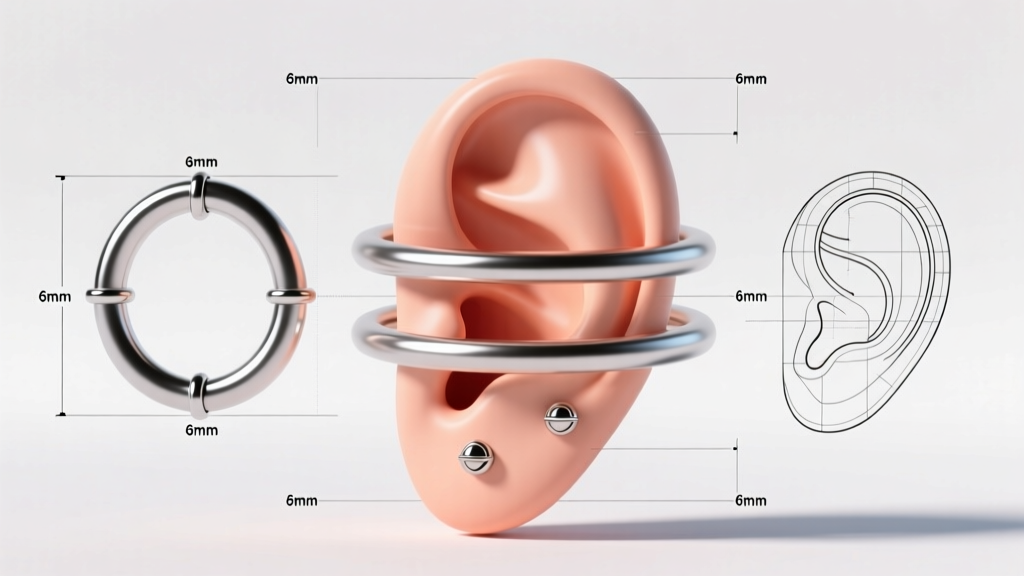
Metallurgical Standards for Multi-Hoop Wear
Because three hoop earrings cover a larger surface area of the skin and cartilage than single studs, the total nickel exposure and galvanic reactivity are multiplied. Utilizing substandard alloys in a triple-stack configuration drastically increases the risk of allergic contact dermatitis. The European Nickel Directive limits nickel release to 0.5 µg/cm²/week, but for multi-hoop cartilage setups, implant-grade materials are the only medically sound choice.
A study published in the National Institutes of Health (NIH) highlights that prolonged exposure to 316L surgical steel in cartilage piercings often results in localized hypersensitivity due to the nickel content trapped within the alloy's crystalline structure. Therefore, selecting the correct material grade is paramount when wearing three hoops simultaneously.
| Material | ASTM Standard | Nickel Content | Best Application |
|---|---|---|---|
| Implant-Grade Titanium | ASTM F136 | 0% (Trace only) | Healing piercings, sensitive cartilage, daily wear |
| Niobium | ASTM B393 | 0% | Anodized color hoops, lightweight stacks |
| 14k/18k Solid Gold | N/A (Alloy dependent) | Varies (Avoid white gold) | Healed lobes, luxury curated stacks |
| 316LVM Steel | ASTM F138 | 10-14% | Healed lobes only (Not recommended for cartilage stacks) |
Engineering the Single-Piece Triple Hoop Earring
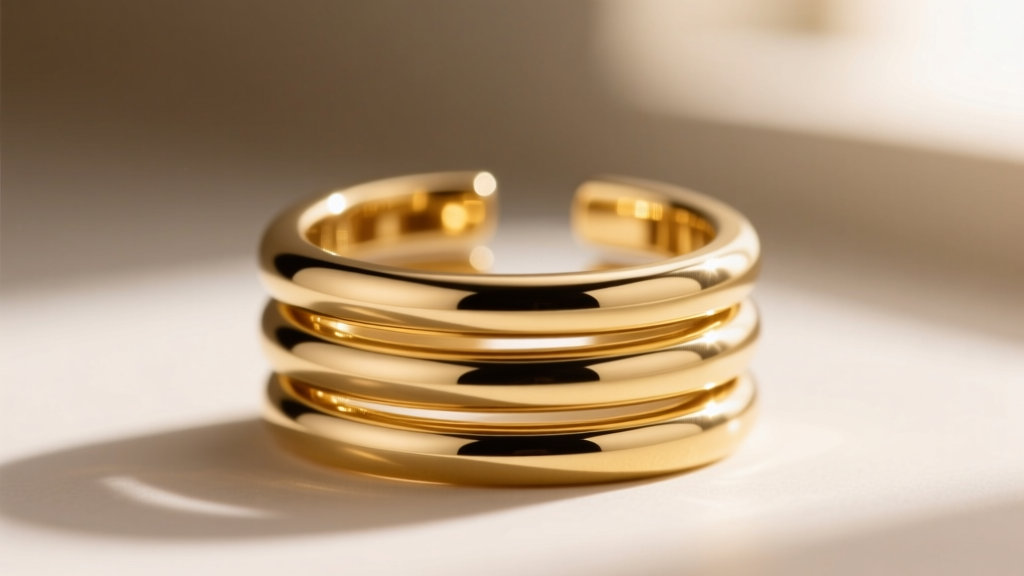
For those without multiple piercings, the single-piece triple hoop earring—often designed as an ear cuff or a chain-linked huggie—relies entirely on mechanical tension rather than fistula support. Engineering a piece that wraps the helix or conch with three interconnected rings requires a deep understanding of metal memory and tensile strength.
Hinge Tension and Clasp Mechanics
A continuous triple-hoop cuff must exert enough radial pressure to remain anchored to the cartilage without restricting blood flow or causing pressure necrosis. Jewelers typically utilize a friction-fit tension gap of exactly 0.2mm to 0.5mm. If the gap is wider, the cuff will slip during sleep or physical activity; if narrower, the metal will fatigue and snap upon repeated opening. High-quality single-piece designs use a hidden micro-clicker hinge on the primary hoop, while the secondary and tertiary hoops are soldered or laser-welded to the main chassis to distribute the clamping force evenly across the ear's ridge.
Sizing Matrix: Inner Diameter vs. Gauge
Selecting the correct Inner Diameter (ID) and wire thickness (gauge) is where most triple-hoop stacks fail. A hoop that is too tight will trap lymphatic fluid, causing the cartilage to swell over the metal (the "cheese-cutter effect"). A hoop that is too large will snag on hair and clothing, applying sudden shear force to the piercing.
- Standard Lobe (Bottom Hoop): 18g or 16g wire | 8mm to 10mm ID. Allows for a full, relaxed circle that frames the face.
- Mid-Helix / Flat (Middle Hoop): 16g wire | 7mm to 8mm ID. Snug enough to hug the cartilage fold without pressing into the conch.
- Upper Helix / Snug (Top Hoop): 16g wire | 6mm to 7mm ID. Requires a tighter radius to follow the sharp curve of the upper auricular rim.
"When stacking three hoops, always taper the inner diameters from largest at the lobe to smallest at the upper helix. This creates a visually pleasing cascade while respecting the anatomical tightening of the ear's outer rim." — Senior Piercing Technician
Troubleshooting Common Triple-Hoop Failure Modes
Even with perfect placement, wearers of three hoop earrings frequently encounter specific mechanical and biological failure modes. Identifying these early prevents permanent tissue damage.
1. Hypertrophic Scarring from Snagging
Hoops act as levers. When the bottom hoop of a three-piece stack catches on a sweater, the rotational force is transferred up the ear, often irritating the top helix piercing. To mitigate this, opt for seamless continuous rings or clickers with flush-fitting hinges rather than Captive Bead Rings (CBRs), which have a protruding bead that acts as a natural snag point.
2. Migration via the Cheese-Cutter Effect
If a heavy 14k gold hoop is worn in a thin 20-gauge piercing, the weight of the metal combined with gravity will slowly slice through the tissue over several months. This is especially dangerous in a three-hoop cartilage stack where the tissue is already under stress. Always match the weight of the gold to the gauge of the fistula; for 18g piercings, stick to lightweight titanium or hollow-core gold designs.
3. Galvanic Corrosion in Mixed-Metal Stacks
Wearing a niobium hoop adjacent to a 14k gold hoop in the same ear can create a micro-galvanic cell when exposed to sweat and humidity. This electrochemical reaction degrades the less noble metal and causes localized skin discoloriation. Always ensure all three hoops in your stack are forged from the exact same base alloy to maintain electrical neutrality across the auricular surface.
Mastering the technical nuances of three hoop earrings transforms a simple jewelry choice into an exercise in anatomical engineering. By respecting spatial geometry, adhering to strict metallurgical standards, and calculating precise tension metrics, you ensure that your curated ear remains both structurally sound and aesthetically flawless for years to come.


