Engineering the Arc: A Technical Guide to Types of Hoop Earrings
Explore the engineering, metallurgy, and closure mechanics behind different types of hoop earrings. An expert guide to gauges, alloys, and structural fit.

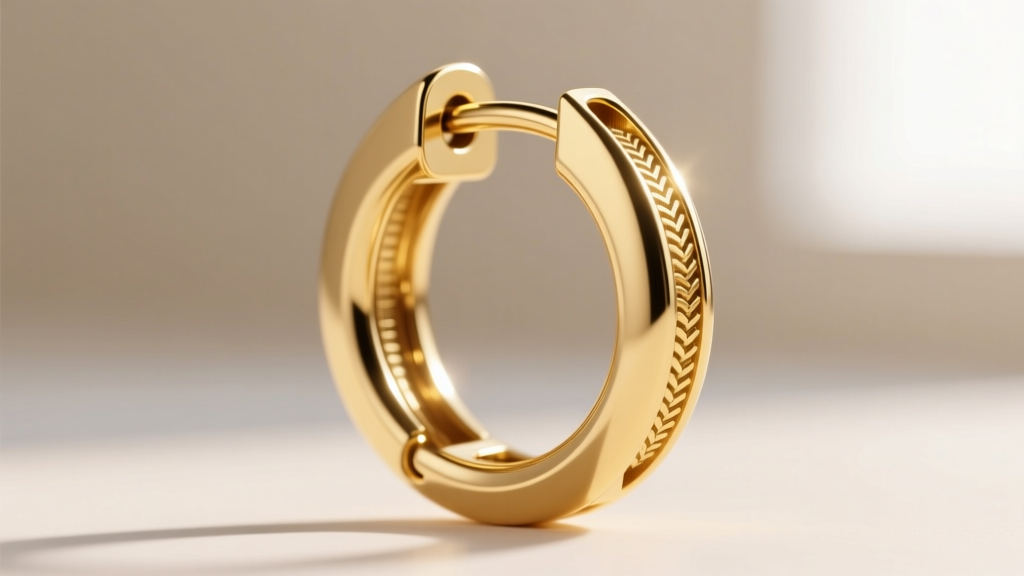
When most consumers evaluate jewelry, they focus primarily on aesthetics: the sparkle of a gemstone or the color of a metal. However, from a metallurgical and structural engineering perspective, the seemingly simple hoop earring is a masterclass in tension, geometry, and material science. Understanding the different types of hoop earrings requires looking past the surface and examining the mechanics of their closures, the physics of their arcs, and the specific alloy compositions that dictate their longevity and biocompatibility.
In this expert deep dive, we deconstruct the anatomy of hoop earrings, analyzing the failure modes, manufacturing tolerances, and tissue interactions that separate mass-produced fashion jewelry from precision-engineered body art.
The Physics of the Arc: Inner vs. Outer Diameter
Before dissecting specific closure mechanisms, we must establish the geometric baseline. A common point of confusion in jewelry procurement is the discrepancy between Inner Diameter (ID) and Outer Diameter (OD). For any hoop earring, the wearable space is strictly defined by the ID. However, the thickness of the wire or tubing (the gauge) inherently reduces this space.
For example, a hoop with an OD of 12mm crafted from 14-gauge wire (1.6mm thick) does not offer 12mm of clearance. The math dictates that the wire consumes 1.6mm on both the left and right sides of the circle. Therefore, the true wearable ID is 8.8mm. In tight cartilage placements like the daith or rook, failing to account for this geometric subtraction results in excessive pressure on the fistula, leading to hypertrophic scarring or migration.
Continuous Wire Hoops (Endless Hoops)
Continuous wire hoops, often referred to as endless hoops or sleeper hoops, rely entirely on the metal memory and structural tension of the alloy. These designs feature a straight pin that inserts into a hollow receiving tube on the opposite end of the arc.
Manufacturing and Annealing
To create the arc, straight wire is drawn through a series of progressively smaller dies, a process that induces work hardening. The wire is then coiled and subjected to precise annealing—heating the metal to a specific recrystallization temperature and cooling it to relieve internal stresses. If the annealing process is rushed or improperly calibrated, the hoop will suffer from uneven tension, causing the pin to misalign with the receiving tube.
Failure Modes and Tissue Interaction
- Metal Fatigue: Repeated bending of the pin to insert and remove the earring causes localized work hardening at the bend point, eventually leading to a shear fracture.
- Tube Flaring: Over time, the friction of the pin entering the receiving tube can cause the softer metal of the tube to flare, compromising the friction-fit and increasing the risk of the earring falling out during sleep.
Hinged Sleepers and Clicker Huggies
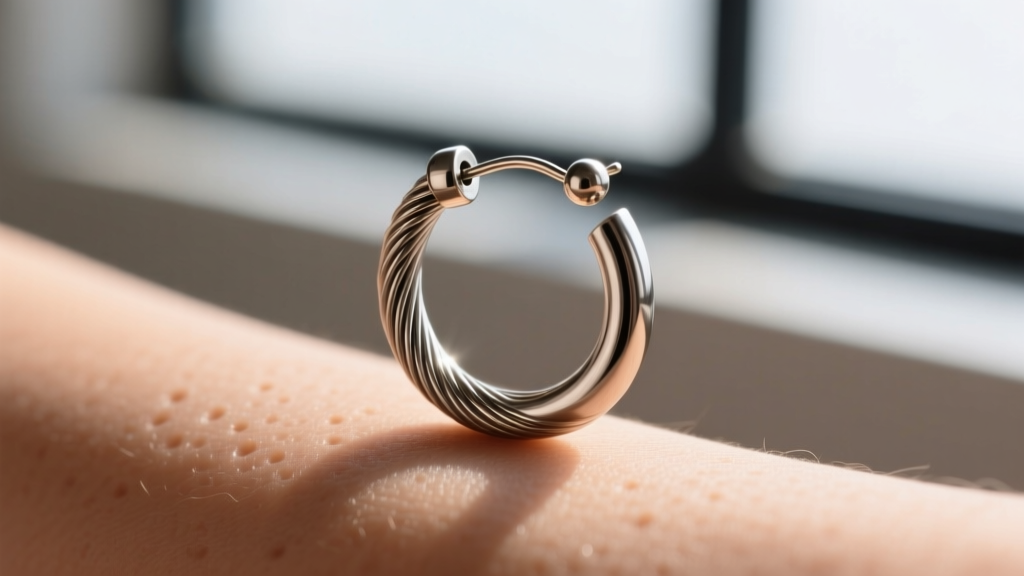
Among the most technically complex types of hoop earrings are hinged sleepers and clicker huggies. Unlike continuous hoops, these feature a mechanical hinge on one side and a snap-locking interference fit on the other. They are the gold standard for cartilage piercings due to their structural rigidity and ease of insertion.
The Mechanics of the 'Click'
The satisfying 'click' of a high-quality huggie or segment ring is the result of precision CNC (Computer Numerical Control) machining. The locking mechanism typically consists of a male prong with a micro-groove that snaps into a corresponding female recess. The tolerances for these components are measured in microns (often <0.05mm). If the gap is too wide, the closure will rattle and fail under lateral stress; if too tight, the user will struggle to close it, potentially bending the hinge pin.
Expert Insight: When evaluating a clicker hoop, perform the 'fingernail test.' Run your fingernail across the seam. A premium, CNC-machined clicker will feel virtually seamless. If you feel a distinct ridge or catch, the manufacturing tolerances are too loose, which can harbor bacteria and irritate the piercing channel.
Captive Bead Rings (CBRs) and Segment Rings
Captive Bead Rings utilize the inherent tensile strength of the metal arc to hold a spherical bead or solid segment in place. The gap in the ring is manufactured to be slightly smaller than the diameter of the bead. To insert the bead, the ring must be expanded using specialized ring-opening pliers, and the resulting vector forces push the ends of the ring firmly into the dimples on either side of the bead.
The primary engineering challenge with CBRs is the balance of tension. If the alloy is too soft (like pure 24k gold or fine silver), the ring will permanently deform upon opening and fail to grip the bead. Therefore, CBRs require alloys with high yield strength, such as 316L surgical steel or implant-grade titanium, to maintain the necessary compressive force over years of wear.
Metallurgical Deep Dive: Alloys and Hardness
The performance of any hoop earring is fundamentally dictated by its metallurgy. The Vickers Hardness (HV) scale and yield strength determine how well a hoop resists deformation, while the alloy composition dictates its biocompatibility. According to guidelines established by the Association of Professional Piercers (APP), only specific, highly regulated alloys should be used for long-term wear, particularly in fresh or sensitive piercings.
| Material / Alloy | Vickers Hardness (HV) | Yield Strength | Best Application & Notes |
|---|---|---|---|
| Implant-Grade Titanium (ASTM F136) | ~350 HV | ~827 MPa | Initial piercings, highly sensitive cartilage. Exceptional strength-to-weight ratio; completely nickel-free. |
| 14k Yellow Gold (Nickel-Free) | ~140-160 HV | ~350 MPa | Healed lobes and cartilage. Softer than titanium; prone to scratching. Must be alloyed with silver/copper, not nickel. |
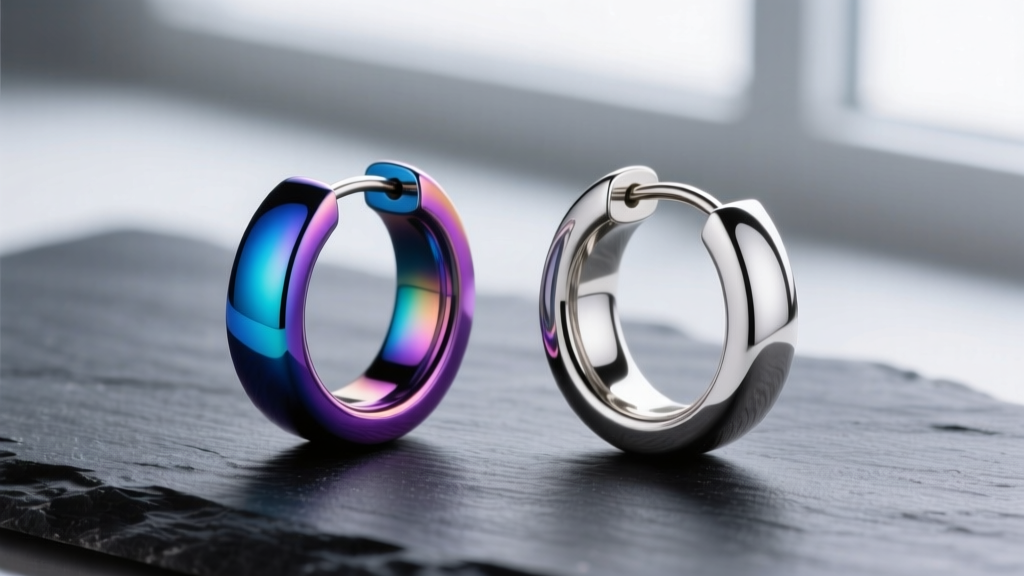
| Niobium (Pure) | ~60-100 HV | ~105 MPa | Hypoallergenic alternative to titanium. Very soft; easily bent. Excellent for anodizing into vibrant colors. |
| 316L Surgical Steel | ~150-190 HV | ~170 MPa | Healed piercings only. Contains trace nickel, which can cause contact dermatitis in sensitive individuals. |
For a comprehensive understanding of how gold alloys affect jewelry durability and skin reactions, the Gemological Institute of America (GIA) provides extensive documentation on the metallurgical properties of karat gold, emphasizing the necessity of nickel-free formulations for body jewelry.
Gauge Thickness and the 'Cheese-Cutter' Effect
The gauge (thickness) of the hoop wire is not merely an aesthetic choice; it is a critical factor in tissue health. In the body modification industry, gauge sizes are standardized, with 20g (0.81mm), 18g (1.02mm), 16g (1.29mm), and 14g (1.63mm) being the most common for hoop earrings. For a precise breakdown of these measurements, refer to the APP Body Jewelry Sizing Chart.
Understanding Tissue Migration
When a hoop earring is too thin (e.g., 22g or 20g) and worn in a high-mobility area like the earlobe or helix, the weight of the jewelry combined with kinetic movement concentrates force onto a microscopic surface area of the fistula (the piercing channel). Over time, this continuous pressure causes the tissue to necrose and recede, a phenomenon known in the industry as the 'cheese-cutter effect.'
To mitigate this, structural best practices dictate a minimum of 18g for standard lobe hoops, and 16g or 14g for any cartilage placement. The thicker wire distributes the kinetic load across a wider surface area of the tissue, preventing migration and ensuring the long-term stability of the piercing.
Threader and Chain Hoops: Tensile Limits
Threader hoops and chain-based hoops represent a departure from rigid geometry, relying instead on gravity and friction. A threader earring consists of a fine chain attached to a rigid post that is pulled entirely through the fistula. The retention mechanism is purely the friction of the chain links against the tissue and the weight distribution on either side of the ear.
The engineering vulnerability here lies in the tensile strength of the chain links. Because threaders are typically manufactured in very fine gauges (often 22g or 20g) to allow the chain to pass comfortably through the ear, the individual links are highly susceptible to snapping if subjected to sudden lateral force, such as catching on a sweater or towel. Consequently, these types of hoop earrings are strictly recommended for fully healed, low-traffic lobe piercings and should be removed during sleep or physical activity.
Conclusion: Selecting by Anatomy and Engineering
Choosing the right hoop earring is not simply about matching metals to skin tones; it is about matching structural engineering to human anatomy. Continuous wire hoops offer a seamless aesthetic but require careful handling to avoid metal fatigue. Hinged clickers provide superior security and ease of use for complex cartilage placements, provided they are manufactured to strict CNC tolerances. Meanwhile, captive bead rings offer unparalleled structural integrity for larger gauge piercings, relying on the raw tensile strength of the alloy.
By prioritizing implant-grade materials, respecting the mathematics of inner diameters, and selecting appropriate gauge thicknesses, you ensure that your jewelry not only looks exceptional but functions flawlessly within the biomechanics of the human ear.


