Flat Gold Stud Earrings: A Technical Guide to Alloys & Backs
Discover the metallurgy, gauge specs, and backing mechanics of flat gold stud earrings. An expert guide to 14k vs 18k alloys and threadless posts.

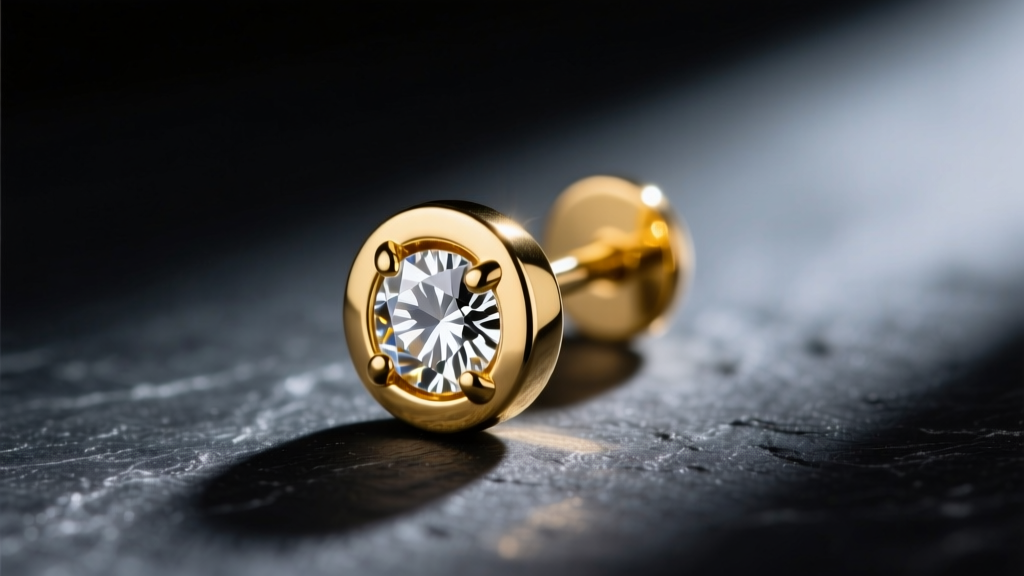
When evaluating fine jewelry for daily wear, particularly for healing or sensitive piercings, the structural integrity and biocompatibility of the materials are paramount. Flat gold stud earrings—often referred to in professional piercing circles as labret studs or flat-backs—represent the gold standard for both lobe and cartilage placements. Unlike traditional butterfly-back earrings, which rely on friction and concentrate pressure on a microscopic point, flat-backed studs distribute force evenly across the dermal layer. This technical deep dive explores the metallurgy, mechanical engineering, and ergonomic frameworks that define high-quality flat gold stud earrings in the modern jewelry market.
The Metallurgy of Gold: Karat Alloys and Hardness
Gold in its pure, 24-karat form is a remarkably dense and malleable metal, scoring roughly 25 on the Vickers Hardness (HV) scale. While chemically inert and highly biocompatible, 24k gold is entirely unsuitable for the posts of flat gold stud earrings; a 1.0mm post made of pure gold would bend under the slightest lateral pressure, leading to fistula trauma and jewelry failure. Therefore, gold must be alloyed with other metals to increase its tensile strength and hardness.
14k vs. 18k Gold: The Durability Matrix
The most common alloys for fine body jewelry are 14k (58.5% gold) and 18k (75% gold). According to the Gemological Institute of America (GIA), the remaining percentage consists of metals like copper, silver, zinc, and sometimes palladium. 14k gold typically achieves a Vickers hardness of 130-150 HV, making it exceptionally resilient for thin posts and intricate prong settings. 18k gold, while richer in color and slightly more hypoallergenic due to a lower alloy content, sits at a softer 100-120 HV. For flat gold stud earrings intended for cartilage placements like the helix or conch—where snagging is a frequent hazard—14k gold offers superior structural resistance to bending.
Crucially, buyers must verify that the alloy is strictly nickel-free. Under the EU REACH regulations (EN 1811:2011), nickel migration from post assemblies must not exceed 0.2 µg/cm²/week. Reputable manufacturers use palladium or silver to create white gold alloys, entirely bypassing nickel sensitization risks.
Post Architecture: Gauge, Length, and Threading
The post is the structural spine of flat gold stud earrings. Understanding gauge thickness and threading mechanics is essential for minimizing tissue irritation and ensuring the longevity of the jewelry.
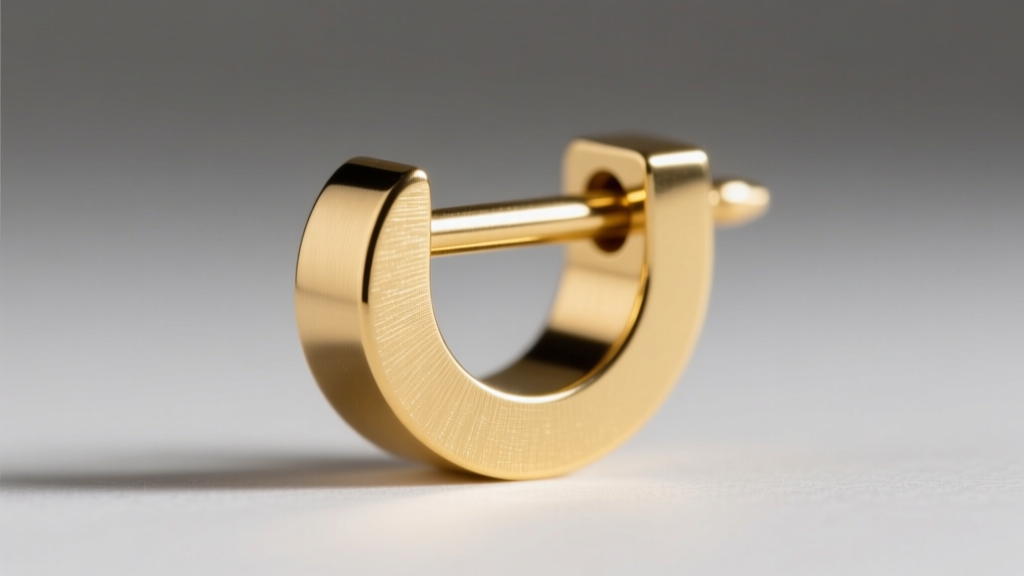
Standard Gauge Dimensions
- 18-Gauge (1.02mm): The standard for traditional earlobe piercings. It provides a delicate profile while maintaining enough tensile strength in 14k gold to resist casual bending.
- 16-Gauge (1.29mm): The universal standard for cartilage piercings (helix, tragus, conch). The increased thickness prevents the 'cheese-cutter effect,' where thin jewelry migrates through the tissue under tension.
- 14-Gauge (1.63mm): Reserved for larger cartilage placements or industrial scaffolding, offering maximum rigidity.
Threading Mechanics: Threadless vs. Internally Threaded
The Association of Professional Piercers (APP) strictly advises against externally threaded jewelry, as the coarse threads act like a file, tearing the delicate epithelial lining of the fistula upon insertion. High-end flat gold stud earrings utilize one of two superior mechanisms:
- Internally Threaded: The threads are cut into the inside of the decorative end, while the post remains perfectly smooth. This requires precise CNC machining but ensures a flawless insertion.
- Threadless (Press-Fit): Pioneered by brands like NeoMetal, this system uses a smooth post and a decorative end with a slightly bent insertion pin. The tension created by the spring-steel or gold pin pressing against the inner wall of the post creates a mechanical lock that is often more secure than threading and completely eliminates cross-threading risks.
The Ergonomics of the Flat Back Design
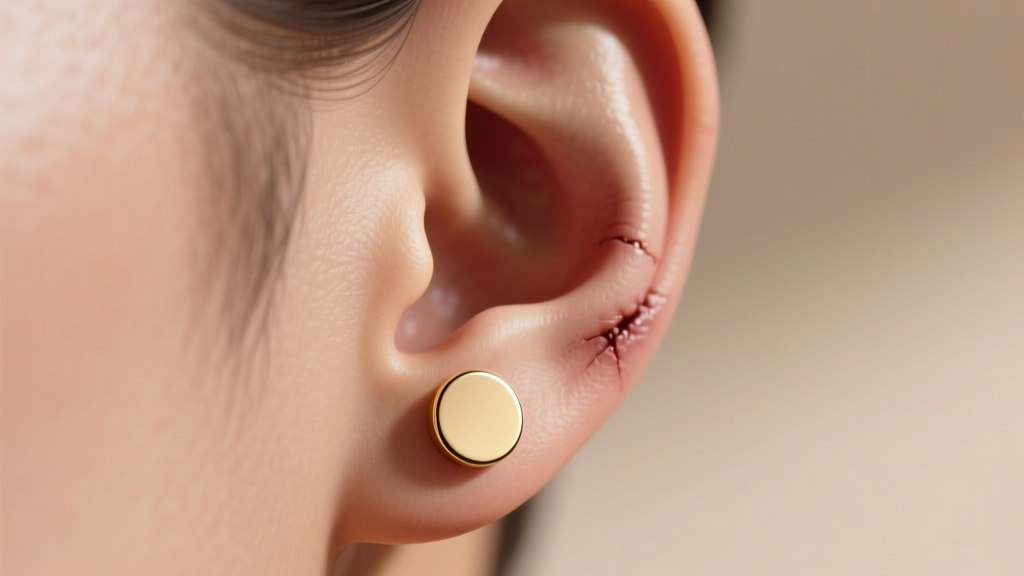
The defining feature of these earrings is the flat disc backing, typically ranging from 3mm to 5mm in diameter. This design solves the inherent biomechanical flaws of the traditional friction-backed 'butterfly' clutch.
| Feature | Flat Back (Labret) Studs | Traditional Butterfly Backs |
|---|---|---|
| Pressure Distribution | Evenly dispersed across a 3-5mm disc | Concentrated on dual microscopic prongs |
| Sleep Comfort | Flush profile; no mastoid digging | Prongs embed into the neck/skull base |
| Hygiene & Biofilm | Smooth surface; easy to flush with saline | Complex crevices trap sebum and bacteria |
| Security Mechanism | Threaded or tension-fit (high security) | Friction-based (prone to falling off) |
When a patient sleeps on a traditional earring, the dual prongs of the butterfly back concentrate the weight of the head into a high-pressure focal point, frequently causing pressure necrosis or contact dermatitis. Flat gold stud earrings eliminate this vector entirely, allowing the jewelry to sit flush against the mastoid or lobe without impeding blood flow to the localized tissue.
Troubleshooting Common Failure Modes
Even premium flat gold stud earrings can experience mechanical or chemical failures if improperly specified or maintained. Recognizing these failure modes allows for proactive mitigation.
Galvanic Corrosion and Alloy Breakdown
While gold itself does not tarnish, the alloying metals (particularly copper and silver in yellow and rose gold) can undergo galvanic reactions when exposed to high-salinity environments, chlorinated water, or acidic skincare products (like glycolic acid). This manifests as a darkening of the post or a metallic odor. To prevent this, jewelry must be removed before swimming or applying active chemical exfoliants, and cleaned regularly with a mild, non-abrasive surfactant.
Gemstone Loss: Prong vs. Bezel Settings
The decorative end of a flat back stud frequently features a gemstone. Prong settings, while maximizing light return and brilliance, are highly susceptible to snagging on hair and textiles, which can lift the prongs and result in stone loss. For active individuals or those wearing the earrings in helix placements prone to friction, a bezel setting—where a continuous rim of gold encircles the gemstone's girdle—is the technically superior choice, offering near-total protection against impact and snagging.
Sourcing and Pricing Framework
The market for flat gold stud earrings is heavily stratified. Mass-market commercial jewelry often utilizes hollow-cast posts, nickel-laden white gold alloys, and poorly calibrated friction backs disguised as 'flat backs.' True professional-grade jewelry requires investment in precision machining and verified metallurgy.
Expert Sourcing Tip: Always request the mill certificate or alloy breakdown from the jeweler. Brands that adhere to ASTM F138 standards for their steel components typically apply the same rigorous material tracking to their 14k and 18k gold lines, ensuring complete traceability and nickel-free compliance.
Expect to pay between $120 and $350 for a single, high-end threadless or internally threaded 14k gold flat back stud from reputable manufacturers such as BVLA, Anatometal, or Maria Tash. This price reflects not just the raw commodity value of the gold, but the CNC-machining precision required to ensure a flawless, tissue-safe post and a secure, long-lasting threading or tension mechanism. Investing in technically sound flat gold stud earrings ultimately reduces the long-term costs associated with tissue irritation, lost gemstones, and jewelry replacement.


