The Engineering Behind Uali Earrings: A Technical Deep Dive
Explore the metallurgy, weight distribution, and ergonomic engineering of Uali earrings. A technical guide for collectors and piercers.

The Architectural Allure: What Defines Uali Earrings?
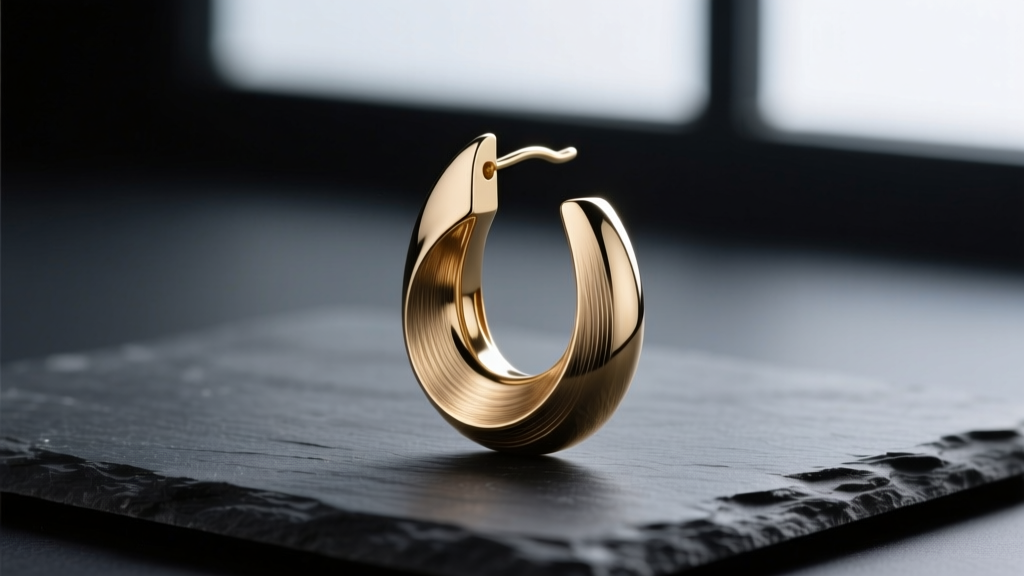
When discussing contemporary statement jewelry, Uali earrings represent a distinct intersection of brutalist architecture and fluid metallurgy. Unlike traditional filigree or delicate drop earrings that rely on two-dimensional symmetry, Uali designs are characterized by their bold, U-shaped spatial volumes, negative space utilization, and sculptural weight. From an engineering perspective, these earrings are not merely decorative; they are cantilevered structures that must withstand continuous kinetic stress while maintaining structural integrity and wearer comfort.
The transition from standard jewelry to architectural earwear introduces complex mechanical challenges. A typical Uali earring features a continuous, sweeping curve that acts as a lever arm, transferring torque directly to the earlobe piercing. To execute this design without causing tissue damage or metal fatigue, manufacturers must employ advanced metallurgical techniques, precise gauge calculations, and specialized surface treatments. This deep dive examines the material science and ergonomic engineering that make high-quality Uali earrings viable for long-term wear.
Metallurgy and Material Grades: Beyond Standard Brass
The structural foundation of any sculptural earring dictates its longevity and skin compatibility. While mass-market fashion jewelry often relies on cheap, porous zinc alloys or low-grade brass with high lead content, premium Uali earrings utilize specific copper-based alloys engineered for both ductility and tensile strength. The Copper Development Association classifies these alloys based on their exact elemental composition, which directly impacts the Vickers hardness (HV) and the alloy's resistance to stress corrosion cracking.
For the sweeping U-shaped bodies of these earrings, silicon bronze (C65500) is frequently preferred over standard cartridge brass. Silicon bronze offers superior fluidity during the investment casting process, allowing for the seamless, porosity-free curves required in architectural designs. Furthermore, it exhibits a higher yield strength, meaning the earring will not permanently deform if accidentally squeezed or dropped.
| Alloy Designation | Composition | Vickers Hardness (HV) | Best Application |
|---|---|---|---|
| C26000 (Cartridge Brass) | 70% Cu, 30% Zn | 100-150 | High-ductility wire and posts |
| C36000 (Free-Machining) | 61.5% Cu, 35.5% Zn, 3% Pb | 130-160 | CNC machined structural components |
| C65500 (Silicon Bronze) | 97% Cu, 3% Si, 1% Mn | 180-220 | Cast sculptural bodies and U-curves |
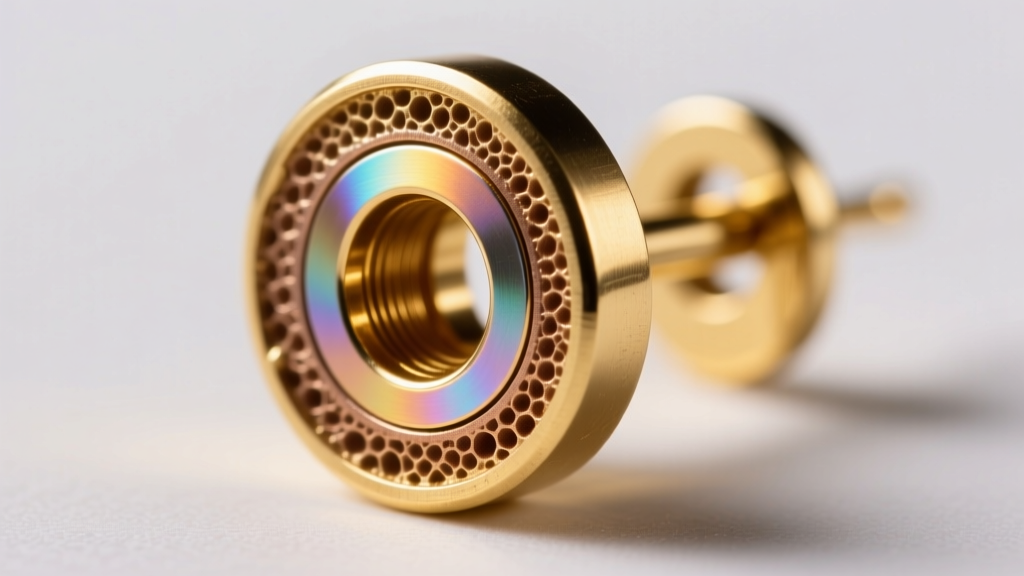
However, the post—the component that actually penetrates the skin—requires a different metallurgical approach. Casting alloys are too brittle for the thin diameters required for ear posts. Therefore, high-end Uali earrings utilize drawn C26000 cartridge brass or, ideally, implant-grade 316L stainless steel for the post, which is then laser-welded or silver-soldered to the cast sculptural body. This bi-metal construction ensures the post will not snap under shear stress while the body maintains its architectural rigidity.
Ergonomics and Weight Distribution on the Earlobe
A critical failure point in heavy architectural earrings is the interaction between the post and the earlobe tissue. The human earlobe is composed of fibrofatty tissue with no cartilage support, making it highly susceptible to mechanical creep and the 'cheese-cutter effect' when subjected to prolonged localized pressure. According to guidelines from the Association of Professional Piercers (APP), standard lobe piercings are typically performed at 20-gauge (0.81mm) or 18-gauge (1.02mm).
Calculating Lobe Tolerance and Gauge Stress
When a sculptural Uali earring weighing 14 grams is suspended from a standard 20-gauge post, the shear stress concentrated on the inferior wall of the piercing channel is immense. The U-shaped design inherently creates an offset center of gravity, generating a moment of force (torque) that pulls the bottom of the post forward and the top of the post backward against the tissue. Over time, this continuous torque causes the piercing channel to elongate, resulting in irreversible earlobe drooping.
To mitigate this, expert jewelers engineer Uali earrings with specific ergonomic countermeasures:
- Upgraded Post Gauges: Heavy architectural pieces require a minimum of 16-gauge (1.29mm) or 14-gauge (1.63mm) posts to increase the surface area distributing the load, thereby reducing the pounds-per-square-inch (PSI) exerted on the tissue.
- Wide-Footprint Backings: Standard butterfly clutch backs concentrate the counter-pressure onto a 2mm point. Uali designs are best paired with wide silicone o-rings or jumbo flat disc backs (10mm+ diameter) that disperse the clamping force across a broader area of the posterior earlobe.
- Hollowed Casting Techniques: By utilizing hollow-form casting or CNC milling to remove internal mass, manufacturers can maintain the massive visual volume of the U-curve while reducing the physical weight by up to 40%, keeping the total earring weight under the critical 10-gram threshold for comfortable all-day wear.
Plating Technologies: PVD vs. Traditional Electroplating
Because base metals like brass and bronze will oxidize and cause galvanic corrosion when exposed to the slightly acidic pH of human sweat, surface finishing is non-negotiable. Historically, jewelry was electroplated with thin layers of gold or rhodium. However, traditional electroplating (typically 0.5 to 1.0 microns thick) is inadequate for the high-friction areas of architectural earrings, where the metal constantly rubs against the jawline, hair, and clothing.
Premium Uali earrings now utilize Physical Vapor Deposition (PVD) in a vacuum chamber. PVD coatings, such as Titanium Nitride (TiN) or Zirconium Nitride (ZrN), bond to the base metal at a molecular level. A PVD gold finish achieves a surface hardness of over 2,000 HV, making it virtually impervious to the micro-scratches that cause traditional electroplated gold to wear away and expose the reactive brass underneath. Furthermore, PVD coatings are entirely hypoallergenic and do not contain nickel, eliminating the risk of contact dermatitis for sensitive wearers.
Maintenance and Failure Modes in Sculptural Earwear
Even with advanced PVD coatings and precision engineering, sculptural earwear requires specific maintenance protocols to prevent mechanical and chemical failure. The most common failure mode in U-shaped earrings is the accumulation of sebum, dead skin cells, and cosmetic residues in the interior apex of the curve. This biological buildup creates a localized acidic environment that can eventually penetrate microscopic pores in the casting, leading to sub-surface verdigris (copper carbonate formation).
To maintain the structural and aesthetic integrity of Uali earrings, owners should adhere to the following technical maintenance guidelines:
- Ultrasonic Cleaning Risks: While ultrasonic cleaners are effective for diamond jewelry, they should never be used on PVD-coated brass or bronze. The cavitation bubbles can create micro-fractures in the plating if the base metal has any hidden casting porosity.
- Chemical Compatibility: Avoid commercial silver dips or ammonia-based cleaners. Ammonia reacts aggressively with copper alloys, causing stress corrosion cracking (season cracking) in the drawn wire posts.
- Proper Storage: Store the earrings in a low-humidity environment with anti-tarnish silica packets. Because the U-shape acts as a spring, storing them under heavy objects can cause plastic deformation, permanently altering the calibrated tension of the curve.
By understanding the metallurgy, physics, and surface engineering behind these pieces, collectors and piercers can better appreciate the technical mastery required to transform raw alloys into the striking, gravity-defying forms characteristic of Uali earrings.


