Titanium Earrings Buying Guide: Grades, Gauges & What to Look For
Discover what to look for when buying titanium earrings. Learn about ASTM F136 grades, gauge sizes, and how to avoid allergic reactions.

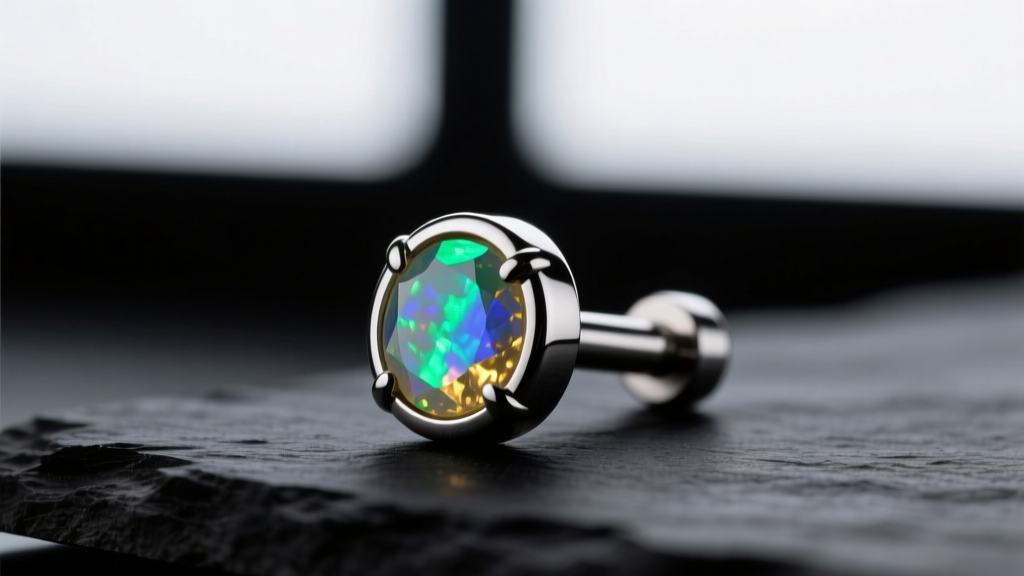
The Biocompatibility Baseline: Why Titanium Dominates
When shopping for titanium earrings, the sheer volume of options can be overwhelming. For those with sensitive skin, metal allergies, or fresh piercings, titanium is not just an alternative to gold or silver—it is the undisputed gold standard. According to the American Academy of Dermatology, nickel allergy is the most common contact allergy, affecting up to 20% of the population. Unlike 'surgical steel' or white gold, which often contain nickel or copper alloys that leach into the skin and cause contact dermatitis, high-quality titanium is entirely biocompatible.
Titanium forms a passive, microscopic oxide layer when exposed to oxygen. This layer acts as an impenetrable shield, preventing the metal from reacting with bodily fluids or tissue. However, not all titanium jewelry is created equal. The market is currently saturated with misleading labels, sub-par alloys, and poorly machined posts that can damage your fistula (the piercing channel). This guide will teach you exactly how to decode metallurgical grades, threading mechanics, and anodization processes to ensure you are buying genuine, body-safe titanium earrings.
Decoding Titanium Grades: ASTM F136 vs. F67
The most critical factor in your purchase is the specific alloy grade. Reputable body jewelers and professional piercers adhere to standards set by the Association of Professional Piercers (APP), which recognizes two primary grades of titanium for body jewelry:
ASTM F136 (Ti-6Al-4V ELI): The Implant Standard
This is an alloy containing titanium, aluminum, and vanadium, processed to Extra Low Interstitial (ELI) standards. Do not let the word 'alloy' alarm you; the aluminum and vanadium are tightly bound within the titanium's crystalline matrix and do not leach. ASTM F136 is the exact same material used in aerospace engineering and human joint replacements. It is incredibly strong, highly resistant to scratching, and can be machined to a flawless mirror finish. This strength makes it the absolute best choice for internally threaded or threadless jewelry, as the delicate threads will not strip or warp under pressure.
ASTM F67 (Commercially Pure Titanium)
Often labeled as 'CP Titanium', this grade is unalloyed and comes in four sub-grades (1 through 4). While highly biocompatible, CP titanium is significantly softer than F136. Because it is softer, it is prone to 'galling'—a form of wear where the metal essentially cold-welds to itself under friction. Therefore, F67 is rarely used for threaded posts. Instead, you will typically find it used in seamless segment rings, bendable nose hoops, or unthreaded captive bead rings where structural rigidity is less critical.
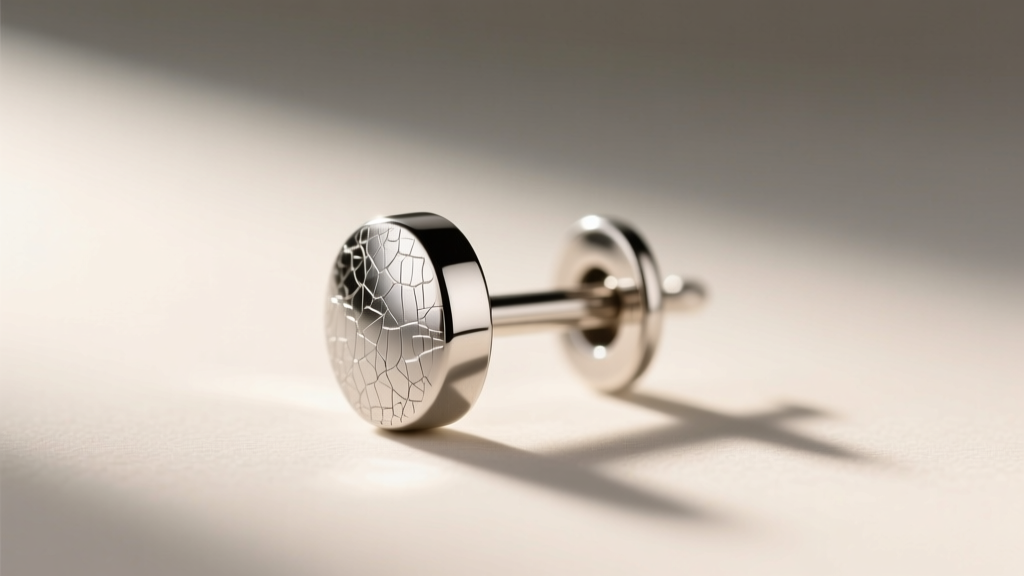
Threading Mechanics: Where Cheap Jewelry Fails
If you are buying threaded titanium earrings (such as labret studs or barbells), the threading style dictates both your comfort and the longevity of your piercing. Cheap manufacturers often use external threading to save on machining costs, but this is a massive red flag for body jewelry.
| Threading Type | Mechanism | Tissue Safety | Best Use Case |
|---|---|---|---|
| External | Threads are on the post (screws into the gem) | Poor (acts like a cheese grater on the fistula) | Avoid entirely |
| Internal | Threads are inside the post (gem screws into post) | Excellent (smooth post glides through tissue) | Standard studs, cartilage, lobes |
| Threadless (Push-Pin) | Tension-fit; a slightly bent pin slides into a hollow post | Superior (no threads, secure tension lock) | All piercings, especially hard-to-reach areas |
Threadless (or push-pin) titanium earrings have become the industry favorite as of 2026. By slightly bending the pin on the decorative end, you create a spring-like tension that locks the jewelry securely inside the hollow post. This eliminates the risk of the gem unscrewing and getting lost in your hair or bedsheets, while providing a perfectly smooth surface for insertion.
Gauge Sizing and Post Lengths: The Precision Game
Titanium earrings are not one-size-fits-all. Purchasing the correct gauge (thickness) and post length is vital for avoiding the 'cheese-cutter effect,' where a heavy gem on a thin post slowly migrates through the tissue.
- 20G (0.81mm): The standard for traditional earlobe piercings done with a needle. Rarely used in professional body jewelry due to its thinness.
- 18G (1.02mm): A versatile size for standard lobe piercings, delicate helix studs, and nostril screws.
- 16G (1.29mm): The workhorse of cartilage jewelry. Ideal for tragus, conch, forward helix, and flat piercings. Provides enough structural integrity to support heavier gemstone ends.
- 14G (1.63mm): Used for industrial barbells, larger conch piercings, and daith clicks.
Post length is equally critical. A standard healed lobe usually requires a 1/4-inch (6mm) or 5/16-inch (8mm) post. However, if you are buying titanium earrings for a fresh or irritated cartilage piercing, you must account for swelling. Professional piercers typically use a 5/16-inch (8mm) or 3/8-inch (10mm) post for initial healing, downsizing to a shorter post only after the swelling has completely subsided.
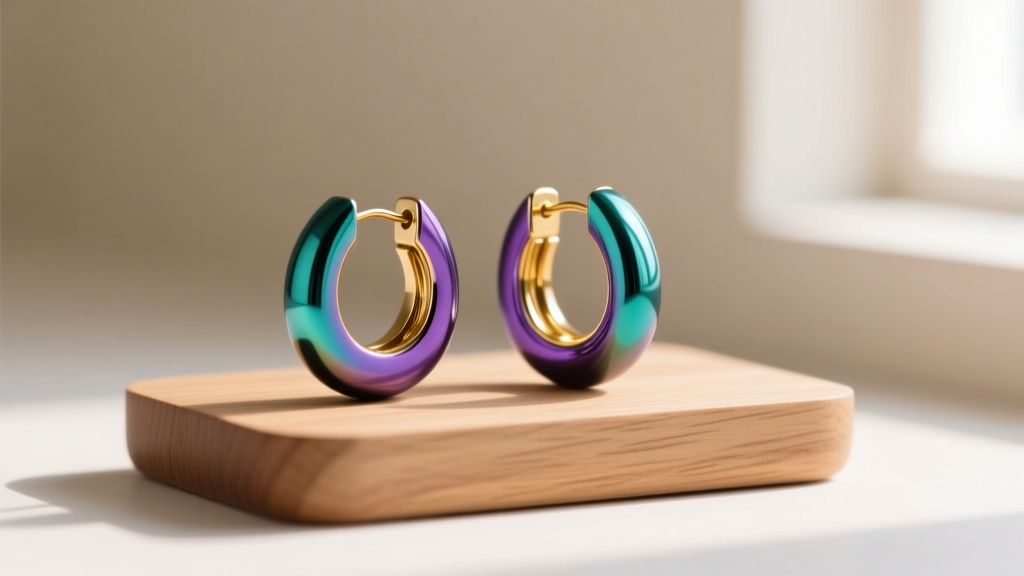
Anodization vs. Plating: The Color Conundrum
One of the most remarkable properties of titanium is its ability to be anodized. If you see vibrant, jewel-toned titanium earrings, they should be anodized, not plated. Anodization is an electrochemical process that alters the thickness of the titanium's natural oxide layer. By running a specific voltage through the metal in an electrolytic bath, the oxide layer thickens, refracting light to produce vivid colors without the use of dyes, paints, or foreign metals.
For example, running 15 volts through F136 titanium yields a vibrant magenta, while 39 volts produces a rich gold, and 90 volts creates a deep teal. Because the color is a structural property of the oxide layer itself, it will never flake, peel, or expose a nickel under-layer. Conversely, 'PVD coated' or 'electroplated' titanium often hides a base metal of surgical steel or brass. Once the microscopic plating wears off from friction or sweat, the underlying allergens are exposed directly to your skin.
Pricing Tiers and Market Red Flags
Understanding the true cost of machining implant-grade titanium helps you spot counterfeit or low-quality listings. Genuine ASTM F136 titanium requires specialized CNC lathes and diamond-polishing tools, which drives up manufacturing costs.
What You Should Expect to Pay
- Basic F136 Internally Threaded Studs (No Gem): $15 - $25 per piece.
- CZ (Cubic Zirconia) Set Ends in F136: $25 - $50. Ensure the CZ is prong-set or bezel-set, not glued.
- Genuine Gemstone Ends (Opal, Sapphire, Aquamarine): $80 - $250+. High-end brands use genuine stones set in solid gold or platinum heads that are laser-welded to the titanium post.
The 'Titanium-Plated' Trap
If you see a listing for 'titanium-plated' earrings, close the tab immediately. Titanium cannot be electroplated onto other metals using standard jewelry techniques. This term is a marketing fabrication used to sell cheap brass or steel earrings coated in a titanium-colored paint or PVD layer. Similarly, be wary of 'surgical steel' masquerading as hypoallergenic; the term 'surgical' is unregulated in the jewelry industry and often just means 316L stainless steel, which contains 8-12% nickel.
Final Pre-Purchase Checklist
Before you add those titanium earrings to your cart, run them through this quick E-E-A-T verification checklist:
- Grade Verification: Does the listing explicitly state ASTM F136 or Implant-Grade? (Avoid vague terms like 'medical grade' or 'hypoallergenic titanium').
- Threading Check: Is it internally threaded or threadless? (Reject anything externally threaded).
- Finish Quality: Look for macro photos showing a mirror finish. A dull, matte, or scratched post indicates poor polishing, which can harbor bacteria and irritate the fistula.
- Mill Certificates: Top-tier jewelry brands (like NeoMetal, BVLA, or Maria Tash) can provide mill certificates proving the metallurgical composition of their titanium upon request.
By prioritizing verified grades, precise threading, and proper gauge sizing, you ensure your titanium earrings are not just beautiful, but fundamentally safe for lifelong wear.


