Troubleshooting Gold Square Hoop Earrings: Fixes & Care Guide
Fix common issues with gold square hoop earrings. Learn how to prevent corner snagging, clasp failure, and lobe drooping with expert troubleshooting tips.

The Geometry Problem: Why Square Hoops Fail
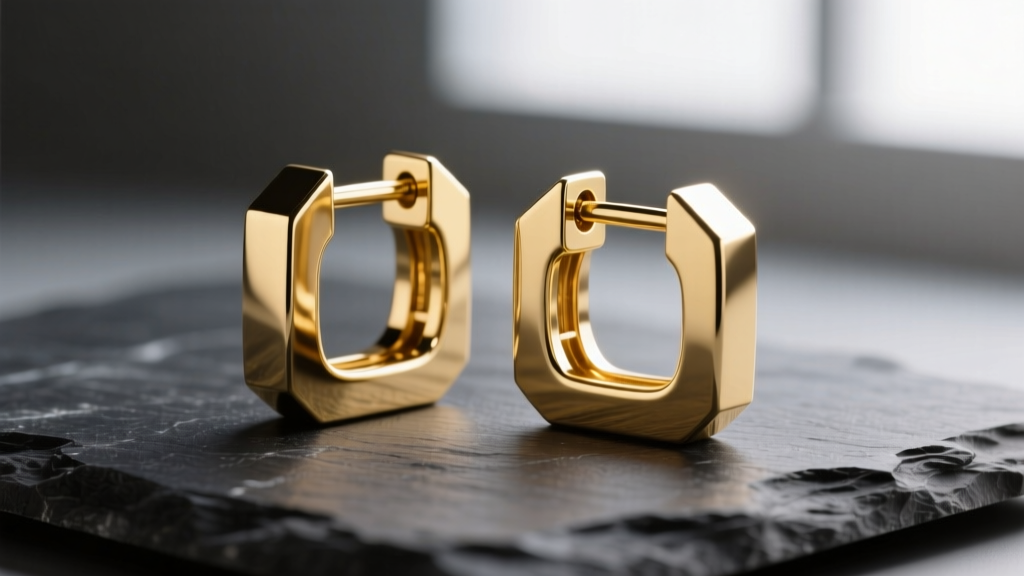
Geometric jewelry has dominated the market for years, but few shapes present as many structural challenges as the square hoop. While a traditional circular hoop distributes kinetic energy and physical tension evenly across its continuous curve, gold square hoop earrings introduce four distinct 90-degree stress concentrators. In metallurgy, sharp internal and external angles act as stress risers. When the earring is bumped, pulled, or even subjected to the repetitive motion of walking, the kinetic energy travels down the metal wire and concentrates entirely at the corners.
If the gold alloy lacks sufficient yield strength, or if the manufacturing process failed to properly anneal the metal after bending, micro-fissures develop. Over time, these microscopic cracks propagate into visible fractures, leading to the dreaded 'snapped corner' failure mode. Furthermore, the rigid bottom bar of a square hoop creates a pendulum effect. Unlike a round hoop that swings freely, the flat bottom bar catches air resistance and physical impacts, transferring lateral torque directly to the hinge clasp and the top corner joints. Understanding these mechanical vulnerabilities is the first step in troubleshooting and preserving your geometric jewelry.
Stress Fractures at the Corners
The most catastrophic failure mode for gold square hoop earrings is metal fatigue at the bends. When a jeweler bends a straight wire into a square, the outer crystals of the metal stretch while the inner crystals compress. This process, known as work hardening, makes the corner brittle. According to jewelry fabrication resources like Ganoksin, if the metal is not carefully annealed (heated and cooled to relieve internal stresses) immediately after forming, the corner remains highly susceptible to snapping under minor pressure. When shopping for or troubleshooting square hoops, inspecting the corners for microscopic stress lines is critical.
Clasp Misalignment from Angular Tension
Because square hoops do not flex, any pressure applied to the bottom bar twists the entire frame. This twisting force frequently causes hinge clasps to pop open or misalign. A standard round hoop can absorb a snag by bending slightly out of shape; a square hoop will instead transfer that exact force to the clasp mechanism, often bending the tiny internal latch or warping the hinge pin.
Troubleshooting Guide: Snagging, Drooping, and Tarnish
Below is a diagnostic matrix for the most frequent complaints associated with square geometric hoops. Use this table to identify your specific hardware issue and apply the correct metallurgical or mechanical fix.
| Symptom | Root Cause | Material/Gauge Factor | Expert Fix |
|---|---|---|---|
| Corners snagging on hair or silk | Factory left outer edges sharp and unpolished | N/A (Profile issue) | Request a 'comfort edge' or 'knife edge' profile polish from a bench jeweler. |
| Clasp popping open randomly | Lateral torque warping the hinge pin | Hinge pin too thin for the frame weight | Upgrade to a locking latch-back clasp or add a silicone locking earring back. |
| Metal fatigue or corner snapping | Work-hardened gold without annealing | 18k gold too soft; 18G wire too thin | Laser weld the fracture; upgrade future purchases to 14k gold, 14G minimum. |
| Front-heavy lobe drooping | Bottom bar is thicker/heavier than the post | Poor weight distribution in casting | Use a lifting earring jacket or switch to a tapered square design. |
| Rapid tarnishing at corners | Friction wearing away gold plating | Vermeil or gold-plated brass base | Polish away tarnish; avoid wearing vermeil square hoops for daily use. |
Material & Gauge Specifications for Longevity
Not all gold is created equal, and the karat weight you choose drastically impacts the structural integrity of a square hoop. The Gemological Institute of America (GIA) notes that pure 24k gold is far too malleable for jewelry. To create durable alloys, gold is mixed with copper, silver, and zinc. However, the ratio of these alloys dictates the metal's Vickers Hardness (HV) and yield strength.
- 18k Gold (75% Pure): With a Vickers Hardness of roughly 110 HV, 18k gold is luxurious and deeply colored, but it is relatively soft. For a square hoop, 18k gold is a liability unless the wire gauge is exceptionally thick. The 90-degree corners will easily dent, warp, or develop stress fractures if subjected to daily wear.
- 14k Gold (58.5% Pure): With a Vickers Hardness of approximately 130 HV to 140 HV (depending on the specific alloy mix), 14k gold offers significantly higher tensile strength. This 20-to-30-point increase in hardness is the vital margin between a durable corner and a snapped earring. For gold square hoop earrings, 14k is the metallurgical sweet spot for longevity.
The Critical Importance of Wire Gauge
The thickness of the metal wire, measured in gauges, is just as important as the karat. Many mass-market jewelers cut costs by using 18-gauge (1.02mm) or 20-gauge (0.81mm) wire for hoops. While this is perfectly acceptable for lightweight circular huggies, it is a structural failure waiting to happen in a square hoop. The rigid geometry demands a minimum of 14-gauge (1.63mm) wire to withstand the pendulum torque of the bottom bar. If you are troubleshooting a pair of square hoops that feel flimsy or bend easily when you open the clasp, they are likely under-gauged and should be reserved for occasional, low-activity wear.
The Vermeil and Plating Trap
Consumers often purchase gold vermeil (a thick layer of gold over sterling silver) or gold-plated brass square hoops as an affordable alternative to solid gold. However, the geometric shape accelerates the degradation of plated jewelry. In a round hoop, friction is distributed. In a square hoop, the corners act as high-friction contact points. Every time you put the earrings on, take them off, or brush your hair, the corners experience concentrated abrasion.
Standard gold plating is often less than 0.5 microns thick, while vermeil is legally required to be at least 2.5 microns. Even at 2.5 microns, the concentrated friction at the 90-degree bends will wear through the gold layer down to the base metal within months of daily wear. Once the silver or brass core is exposed, it reacts with the sulfur and moisture in the air, leading to rapid, localized tarnishing that is impossible to polish away without removing even more of the surrounding gold. If you want square hoops for daily rotation, solid 14k gold is a non-negotiable requirement.
DIY Fixes vs. Professional Jeweler Interventions
When your gold square hoop earrings develop issues, knowing what you can safely fix at home versus what requires a professional bench jeweler will save you from ruining the piece.
Safe DIY Troubleshooting
If your hinged clasp feels loose or fails to 'click' shut, the issue is often a slightly bent latch lever. Using nylon-jaw pliers (never metal-on-metal, which will mar the gold), you can gently apply micro-pressure to the internal latch to restore the tension. If the earring post is slightly bent from a snag, you can carefully roll it on a flat steel block and apply gentle pressure with a rawhide mallet to straighten it. However, if the post is bent at the solder joint where it meets the hoop, do not attempt to bend it back; you will snap the solder.
When to See a Bench Jeweler
If you spot a dark line or a visible fissure at any of the four corners, stop wearing the earring immediately. This is a stress fracture. Traditional torch soldering is often too risky for square hoops, as the heat can easily warp the thin geometric lines or damage the temper of the surrounding metal.
'For structural fractures on geometric hoops, we exclusively use laser welding. A laser welder allows us to fuse the micro-crack at the corner with pinpoint accuracy, adding a microscopic bead of matching 14k gold wire without heating the rest of the earring. This preserves the sharp 90-degree angle and prevents the warping associated with torch soldering.' - Master Bench Jeweler
Preventative Maintenance and Cleaning Protocols
The inner 90-degree corners of square hoops are notorious traps for sebum, dead skin cells, hairspray, and cosmetic powders. Because the angles are so sharp, a standard jewelry cloth cannot reach into the crevices, leading to a dull, caked-on buildup that mimics tarnish.
Ultrasonic Cleaning for Geometric Crevice
The most effective way to maintain gold square hoop earrings is through ultrasonic cleaning. The high-frequency sound waves create microscopic cavitation bubbles in the cleaning solution that implode against the metal, blasting dirt out of the sharp inner corners that brushes cannot reach. Use a mild, ammonia-free jewelry solution and run the ultrasonic cleaner for exactly three minutes. Warning: If your square hoops feature tension-set gemstones at the corners, or if they are hollow-tube construction rather than solid wire, avoid ultrasonic cleaners entirely, as the vibrations can shatter the stones or crack the hollow seams.
Storage to Prevent Warping
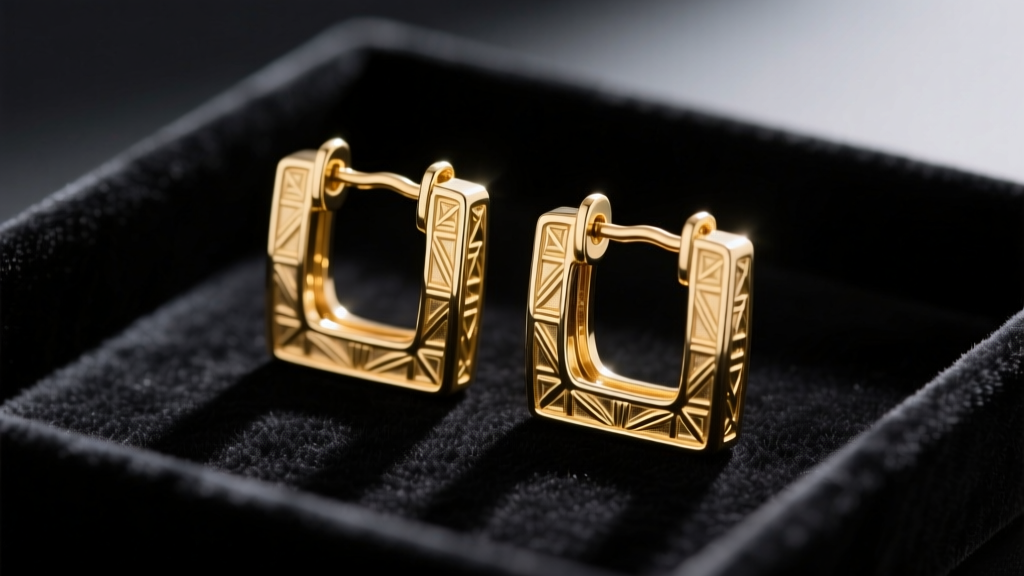
Never toss square hoops loosely into a jewelry box where they can be crushed under heavier items. The rigid geometry means they will not bend to absorb pressure; they will simply snap or warp the clasp. Store them vertically in a slotted earring organizer or lay them completely flat in a dedicated velvet-lined compartment to ensure the frame remains perfectly square and the hinge mechanism remains free of lateral stress.