Turquoise Earrings Vintage: Stone Grades & Metal Properties
Discover how to authenticate vintage turquoise earrings. Compare stone grades, metal properties, and stabilization methods in our expert material guide.

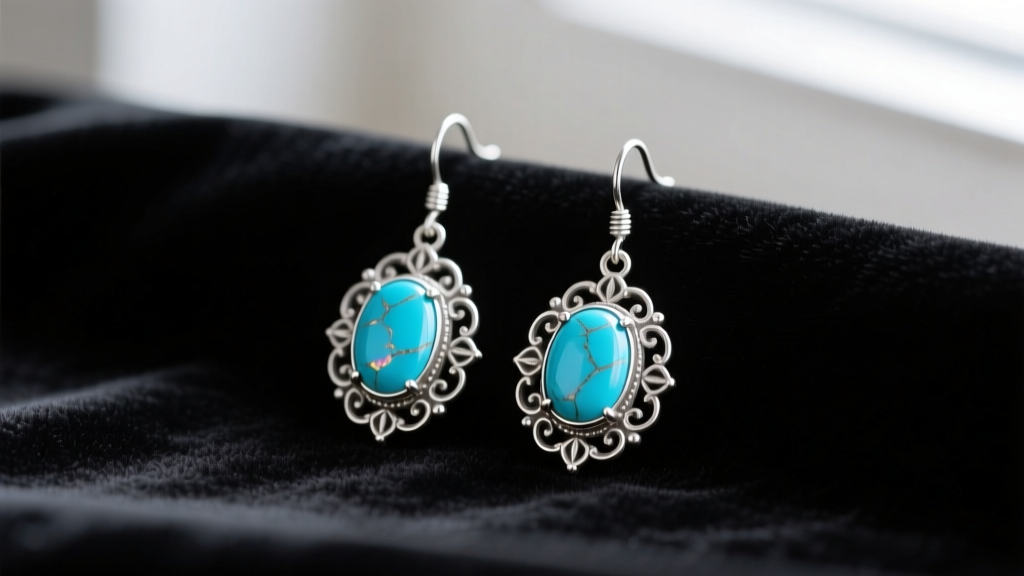
The Mineralogy of Vintage Turquoise Earrings
When evaluating turquoise earrings vintage collectors seek, one must first understand the geological reality of the stone. Turquoise is a hydrous phosphate of copper and aluminum (CuAl6(PO4)4(OH)8·4H2O). Its signature blue-to-green coloration is directly dictated by its heavy metal content: higher copper concentrations yield the prized robin-egg blue, while elevated iron or zinc levels shift the hue toward green or yellowish-brown. According to the Mindat.org Mineral Database, turquoise ranks between 5 and 6 on the Mohs hardness scale, making it relatively soft and highly porous compared to quartz or sapphire.
This inherent porosity is the defining material property that affects vintage turquoise jewelry. Over decades of wear, natural, untreated turquoise acts as a microscopic sponge, absorbing lipids, sebum, cosmetics, and environmental moisture. This absorption fundamentally alters the stone's optical properties, often causing a gradual color shift from sky blue to a deeper, mottled green. While some collectors view this 'patina' as a badge of authenticity and age, it represents a permanent chemical and physical alteration of the gemstone's surface layer.
Geological Material Comparison: Natural vs. Treated vs. Imitation
The vintage market is flooded with misidentified stones. To accurately appraise vintage turquoise earrings, you must differentiate between natural, stabilized, and imitation materials. The Gemological Institute of America (GIA) notes that stabilization became widespread in the mid-20th century to salvage chalky, low-grade turquoise that would otherwise crumble during the lapidary process.
| Material Type | Origin / Era | Mohs Hardness | Porosity & Stability | Vintage Market Value |
|---|---|---|---|---|
| Natural Persian | Neyshabur, Iran (Pre-1970s) | 5.5 - 6.0 | Low porosity, highly stable, no matrix | Premium ($300 - $2,000+) |
| Sleeping Beauty | Arizona, USA (1950s - 2012) | 5.0 - 5.5 | Moderate porosity, uniform sky blue | High ($150 - $800) |
| Epoxy-Stabilized | Global (1960s - Present) | 6.0 - 7.0 | Non-porous, color-locked, plasticized | Low to Moderate ($40 - $150) |
| Dyed Howlite | Global Imitation | 3.5 - 4.5 | Highly porous, dye concentrates in veins | Negligible ($10 - $30) |
| Zachery Treated | High-grade US (1990s+) | 5.5 - 6.0 | Potassium silicate infused, no polymer | High (Comparable to Natural) |
A critical failure mode in vintage stabilized earrings is the degradation of early epoxy resins. Earrings from the 1970s and 1980s often utilized inferior polymers that yellow and become brittle when exposed to prolonged UV light, leading to micro-fractures along the bezel setting.
Metal Pairings: Sterling, Coin Silver, and Alloys
The metalwork holding vintage turquoise is just as critical to the piece's material integrity and value. In Native American and Southwestern vintage earrings, the silver composition provides vital clues to the piece's age and authenticity.
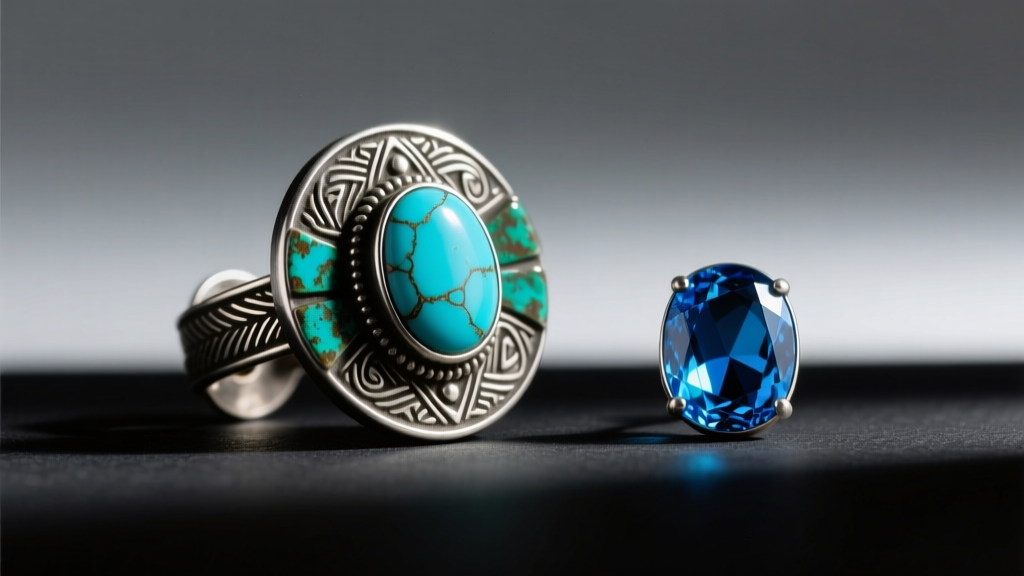
Coin Silver (900) vs. Sterling Silver (925)
Pre-1930s vintage earrings were frequently crafted from 'coin silver,' an alloy created by melting down circulating silver coins. This results in a silver content of approximately 90% (with 10% copper), compared to the 92.5% standard of sterling silver. Coin silver is harder, less malleable, and develops a distinct, darker sulfide patina over time. If you are examining vintage turquoise stud earrings with heavy, dark tarnish that resists standard polishing, you are likely looking at early coin silver, which commands a significant premium among collectors.
The Galvanic Tarnish Transfer
A common material failure in vintage turquoise earrings is 'tarnish transfer.' Because turquoise is porous, the copper sulfides and silver sulfides that form on the oxidizing metal bezel can leach into the adjacent stone. This creates a permanent dark halo around the edge of the cabochon. While this proves the age and continuous assembly of the piece, it is technically a form of material contamination that lowers the gemological grade of the stone, even as it increases the historical provenance of the jewelry.
Authentication Protocols and Material Testing
Identifying authentic vintage turquoise requires moving beyond visual inspection. Professional gemologists and seasoned collectors rely on specific, non-destructive material tests to separate natural vintage stones from mid-century imitations.
- 10x Loupe Matrix Analysis: Examine the brown or black 'spiderweb' matrix. In natural Kingman or Persian turquoise, the matrix consists of limonite, iron pyrite, or sandstone inclusions that sit flush with the surface. In dyed howlite or magnesite, the dark veins are actually fissures where liquid dye has pooled, appearing as concentrated, unnatural lines under magnification.
- Long-Wave UV Fluorescence: Under a 365nm UV light, natural turquoise is typically inert or shows weak, patchy fluorescence. Conversely, the epoxy resins used in mid-century stabilization often emit a bright, uniform yellowish-green or milky blue glow, instantly revealing the presence of polymers.
- The Acetone Swab Test: Dabbing a cotton swab with pure acetone and rubbing an inconspicuous area of the stone will dissolve surface dyes on howlite or dyed chalk turquoise. Natural, untreated turquoise will not release color onto the swab.
Preservation and Material Degradation
Caring for vintage turquoise earrings requires an understanding of their chemical vulnerabilities. Unlike diamonds or sapphires, turquoise cannot be cleaned in ultrasonic machines or exposed to harsh chemical dips.
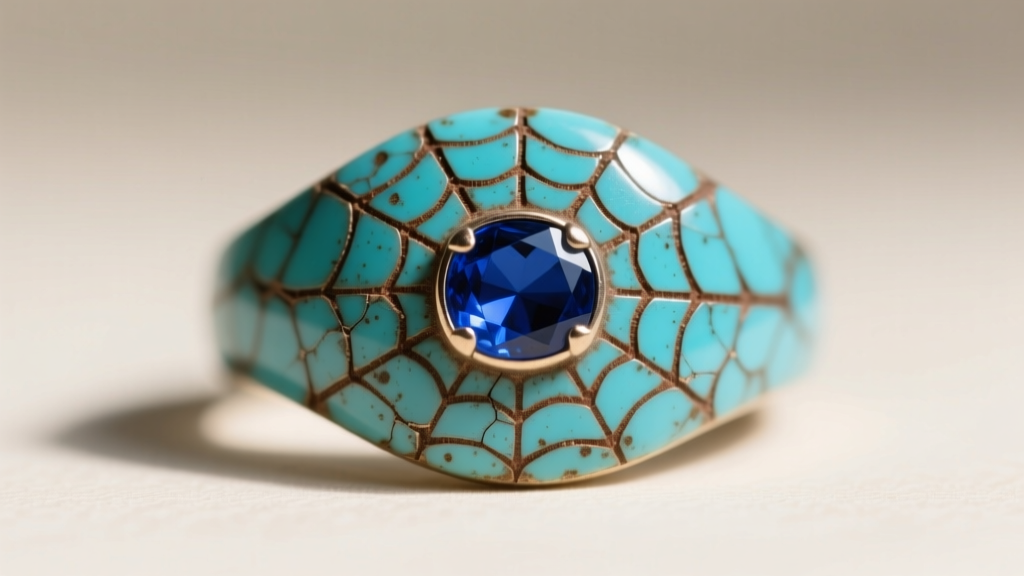
Expert Preservation Rule: Never use commercial silver polish liquids on vintage turquoise settings. The thiourea and ammonia compounds in these solutions will rapidly strip the natural waxes from the turquoise surface, leaving it chalky, dehydrated, and prone to catastrophic cracking. Always use a dry, untreated microfiber cloth for the stone, and a dedicated polishing cloth for the metal.
Furthermore, the Smithsonian Institution highlights that extreme thermal shock is a primary cause of cabochon fracturing in vintage pieces. Leaving turquoise earrings in a hot car or exposing them to sudden temperature drops can cause the moisture trapped within the stone's crystalline structure to expand or contract rapidly, resulting in internal cleaving.
Market Pricing and Collector Grades
The valuation of vintage turquoise earrings is inextricably linked to the mine of origin and the condition of the material. 'Dead mines' such as the Sleeping Beauty mine in Arizona (closed in 2012) or the Lander Blue mine in Nevada command exponential premiums. A pair of 1970s sterling silver dangle earrings featuring verified, untreated Lander Blue turquoise with tight, black spiderweb matrix can easily exceed $3,000 at auction. Conversely, identical settings featuring stabilized Hubei turquoise from the same era will rarely surpass $150. Understanding these material distinctions is the cornerstone of intelligent vintage jewelry acquisition.


