Wall Mounted Earring Organizer Materials: Tarnish & Care Guide
Compare wall mounted earring organizer materials like wood, acrylic, and metal to prevent tarnish and protect your fine jewelry collection.

The Hidden Chemistry of Jewelry Storage
Most jewelry enthusiasts obsess over the metallurgy of their earrings—debating the merits of implant-grade titanium versus 316L surgical steel, or the micron-thickness of 18k gold vermeil. Yet, the microclimate where these pieces reside is often an afterthought. When you invest in a wall mounted earring organizer, you are not just buying a storage solution; you are selecting a chemical environment. The material properties of your organizer directly dictate the tarnish rate, structural safety, and surface integrity of your earrings.
As of 2026, advancements in material science have given us better polymers and anti-corrosive coatings, but the fundamental chemistry of jewelry degradation remains unchanged. Storing porous gemstones, reactive alloys, and delicate mechanical clasps on the wrong surface can undo years of careful maintenance. This guide breaks down the exact material properties of popular organizer surfaces and how they interact with your favorite ear aesthetics.
Material Breakdown: How Organizer Surfaces Impact Earring Alloys
Solid Wood & MDF: The Moisture and Acid Trap
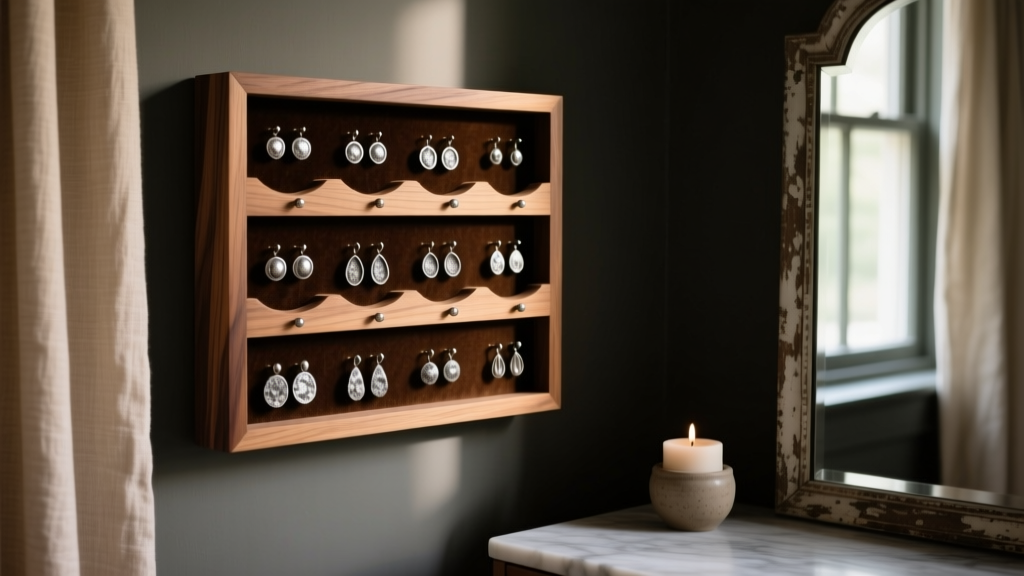
Wood is a classic, aesthetically pleasing choice for a wall mounted earring organizer, but it is a chemical minefield for fine jewelry. Unsealed or improperly sealed woods—particularly oak, walnut, and composite MDF (Medium-Density Fiberboard)—emit volatile organic compounds (VOCs). The most problematic of these is acetic acid. According to conservation guidelines tested via the Oddy test (a standard museum procedure for evaluating material safety), wood off-gassing creates a highly corrosive micro-environment.
For sterling silver earrings (92.5% silver, 7.5% copper), this acidic vapor accelerates the oxidation of the copper alloy. When combined with ambient humidity trapped by the wood's porous surface, it catalyzes the formation of silver sulfide and copper sulfate, manifesting as rapid, stubborn black tarnish. If you must use a wooden organizer, ensure it is sealed with a water-based polyurethane and lined with Pacific Silvercloth to neutralize sulfur compounds.
Cast Acrylic & Polycarbonate: The Static Threat
Acrylic (Polymethyl methacrylate or PMMA) is chemically inert, meaning it will not off-gas acids or sulfur compounds that tarnish metals. However, it presents a completely different physical threat: triboelectric charging, commonly known as static electricity.
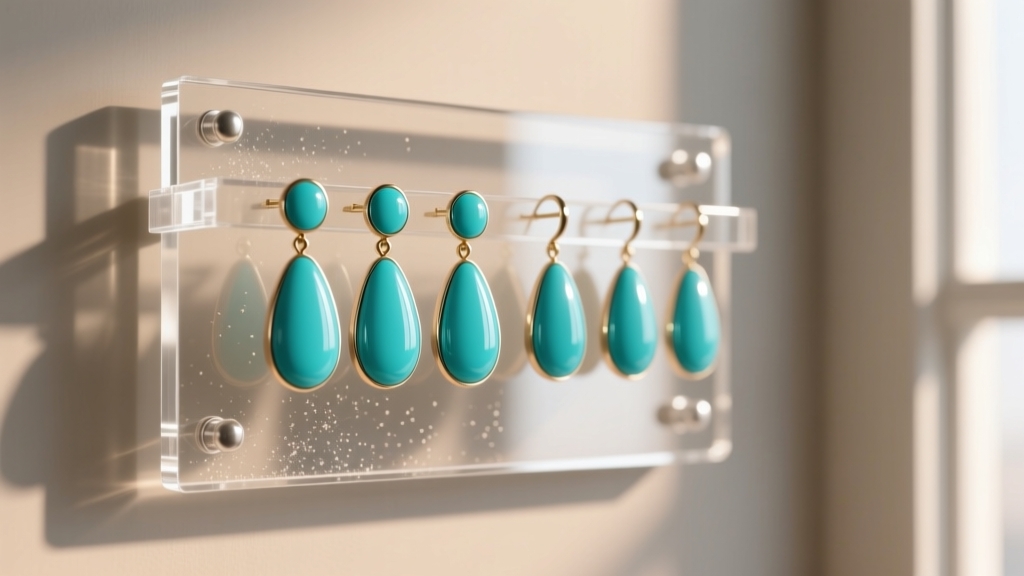
When you repeatedly slide hard metal earring posts (like tungsten, titanium, or stainless steel) through acrylic holes, the friction generates a static charge. This electrostatic field attracts microscopic airborne silica dust. Silica ranks at a 7 on the Mohs hardness scale. When you later wipe your softer gemstone earrings—such as turquoise (Mohs 5-6), opal (Mohs 5.5-6.5), or pearls (Mohs 2.5-4.5)—you are inadvertently grinding this attracted silica into the stone, causing micro-scratches and dulling the polish over time. To mitigate this, acrylic organizers should be treated with an anti-static polymer spray monthly.
Powder-Coated Steel & Aluminum: The Structural Safeguard
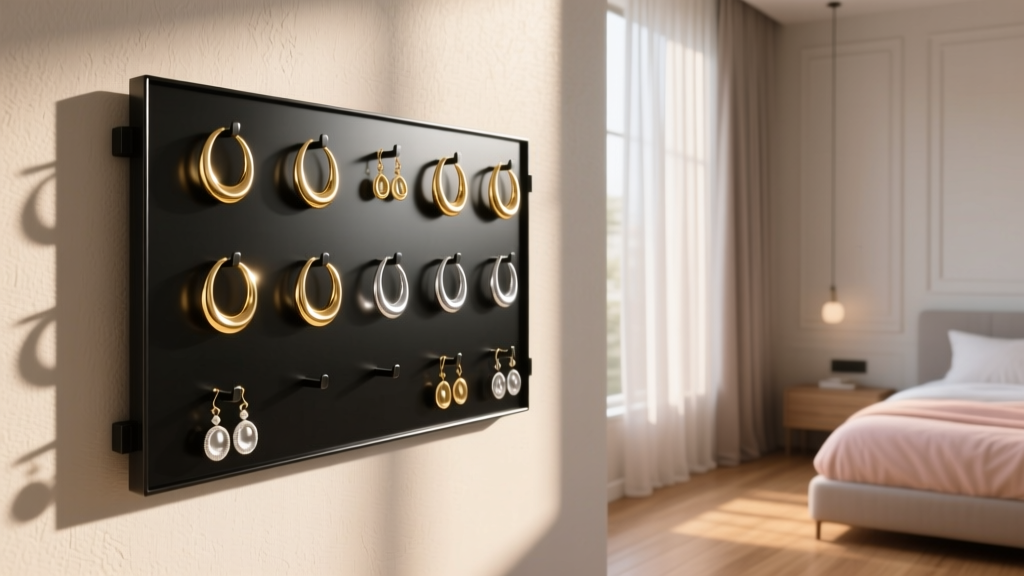
From a structural and chemical standpoint, a metal wall mounted earring organizer is generally the superior choice for heavy and valuable pieces. Powder-coated carbon steel or anodized aluminum offers zero chemical off-gassing and minimal static retention. More importantly, metal organizers possess a high Young’s modulus (stiffness).
Heavy chandelier dangles, oversized brass hoops, and gemstone-encrusted drop earrings can weigh upwards of 30 to 50 grams per pair. Over time, the constant shear stress will cause acrylic sheets to undergo 'creep deformation' (permanent sagging) and thin wood to splinter. A 2mm thick steel grid maintains its structural integrity indefinitely, ensuring that heavy 14k gold ear cuffs and elaborate dangles remain perfectly spaced without warping the display.
Cork & Foam Backings: Acidic Degradation
Many budget-friendly metal grid organizers utilize cork or polyurethane foam backings to secure earring posts. While convenient, standard polyurethane foams can degrade over time, especially when exposed to UV light from nearby windows, releasing sulfur compounds that rapidly tarnish silver and copper. Cork, while natural, contains tannins and trace acids that can corrode the delicate plating on gold vermeil or gold-filled earrings if the posts are left inserted for months at a time.
The Tarnish Matrix: Organizer Material vs. Earring Metal
Understanding the interaction between your organizer's material and your earring's alloy is critical for long-term preservation. The Silver Institute notes that sulfur and chlorides are the primary enemies of silver, while the Gemological Institute of America (GIA) warns against ultrasonic vibrations and abrasive dust for treated gemstones. Below is a decision matrix to help you pair your collection with the right display.
| Organizer Material | Off-Gassing Risk | Static / Abrasion Risk | Load Bearing | Best Earring Pairing |
|---|---|---|---|---|
| Unsealed Oak Wood | High (Acetic Acid) | Low | Medium | Stainless steel, Platinum, Niobium |
| Cast Acrylic (PMMA) | None | High (Silica Dust) | Low (Prone to Creep) | Diamond, Sapphire, Ruby, Solid 14k Gold |
| Powder-Coated Steel | None | Very Low | Very High | Heavy Dangles, Sterling Silver, Vermeil |
| Cork-Backed Metal | Medium (Tannins) | Low | High | Titanium studs, Surgical Steel hoops |
Environmental Factors: Humidity, UV, and Off-Gassing
The material of your wall mounted earring organizer does not exist in a vacuum; it interacts with your room's ambient environment. Bathrooms, for example, experience massive humidity spikes. Wood and cork act as hygroscopic sponges, absorbing this moisture and holding it directly against your earring posts. This localized humidity pocket is a breeding ground for galvanic corrosion, especially on mixed-metal earrings or those with copper cores.
"Museum conservation standards dictate that reactive metals must be isolated from organic acids and fluctuating relative humidity. Applying these standards to home jewelry storage is the difference between a lifelong heirloom and a degraded trinket."
Furthermore, if your organizer is mounted on a wall receiving direct afternoon sunlight, UV radiation will degrade certain materials. Acrylic can yellow and become brittle over a decade, while dyed velvet linings on wooden boards will fade and lose their structural grip, causing heavy studs to slip and fall.
Actionable Framework: Choosing Your Wall Mounted Earring Organizer
To select the ideal organizer for your specific collection, follow this three-step material assessment framework:
- Audit Your Dominant Metals: If your collection is 70% sterling silver or copper-heavy brass, you must absolutely avoid unsealed wood, MDF, and cork. Opt for a powder-coated steel wall mounted earring organizer with silicone-tipped grips to hold posts without scratching the plating.
- Evaluate Gemstone Porosity: If you collect organic gems (pearls, coral, amber) or porous stones (turquoise, lapis lazuli), avoid acrylic. The static-induced dust attraction will ruin the polish. Choose a sealed, lacquered wood with individual velvet-lined compartments that do not require the stones to rub against the backing.
- Calculate Shear Load: Weigh your heaviest pair of earrings. If they exceed 25 grams, acrylic and thin wire meshes will eventually fail. You require a rigid metal framework with a minimum thickness of 1.5mm to prevent permanent deformation.
Conclusion
The intersection of jewelry care and interior organization requires a nuanced understanding of material science. A wall mounted earring organizer is more than a decorative convenience; it is the primary defense system for your jewelry's longevity. By matching the chemical and physical properties of the organizer—whether it be the inert stiffness of powder-coated steel, the static risks of acrylic, or the acidic dangers of raw wood—to the specific alloys and gemstones in your collection, you ensure that your earrings remain as pristine as the day they were pierced. Treat your storage materials with the same scrutiny you apply to your jewelry, and your collection will withstand the test of time.


