How to Style and Maintain Small Rose Gold Hoop Earrings
Learn how to choose, style, and maintain small rose gold hoop earrings. Step-by-step guide on gauge sizes, metal grades, and daily care routines.


The Metallurgy of Rose Gold: What You Are Actually Wearing
Small rose gold hoop earrings are a staple in modern jewelry curation, offering a warm, vintage-inspired alternative to traditional yellow or white gold. However, understanding the metallurgy behind this blush-toned metal is critical for both longevity and skin health. Pure gold is naturally yellow; the signature pinkish-red hue of rose gold is achieved by alloying gold with copper, and occasionally small amounts of silver or zinc.
According to the Gemological Institute of America (GIA), the karat weight dictates not only the gold content but the exact shade of the final piece. 18k rose gold (75% gold) yields a softer, paler champagne-pink tone but is more prone to scratching due to its higher pure gold content. 14k rose gold (58.5% gold) contains a higher copper ratio, resulting in a deeper, more vibrant pink hue and significantly greater structural durability, making it the superior choice for everyday hoop earrings that endure frequent handling.
If you are purchasing plated options rather than solid gold, you must verify the plating thickness and base metal. The Federal Trade Commission (FTC) mandates that 'gold vermeil' must feature a minimum of 2.5 microns of gold plating over a sterling silver base. Anything less is considered standard flash plating, which will quickly wear away on high-friction areas like the earring post and clasp, potentially exposing base metals like brass or nickel that can trigger contact dermatitis.
Step 1: Selecting the Correct Gauge and Diameter
The most common mistake consumers make when buying small rose gold hoop earrings is ignoring the wire gauge and inner diameter relative to their specific piercing placement. A hoop that is too tight will cause migration and irritation bumps, while a wire that is too thin can act like a cheese wire, slicing through delicate fistula tissue.
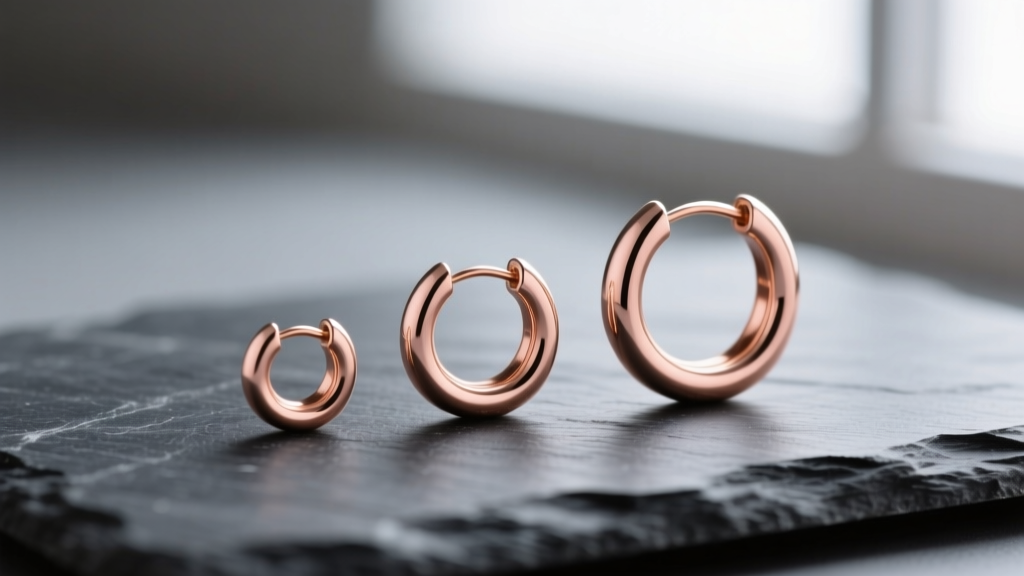
The Association of Professional Piercers (APP) emphasizes that matching the jewelry gauge to the original piercing needle size is vital for tissue health. Below is a structural framework for selecting the correct dimensions based on anatomy:
| Piercing Location | Recommended Gauge | Ideal Hoop Diameter | Best Closure Type |
|---|---|---|---|
| Standard Lobe | 20G (0.8mm) or 18G (1.0mm) | 10mm - 15mm | Hinged or Continuous |
| Upper Lobe / Flat | 18G (1.0mm) or 16G (1.2mm) | 8mm - 10mm | Clicker or Hinged |
| Helix (Cartilage) | 16G (1.2mm) | 8mm - 12mm | Seamless Continuous |
| Tragus | 16G (1.2mm) | 6mm - 8mm | Mini Hinged Clicker |
| Daith | 16G (1.2mm) | 10mm (Standard) | Clicker with Segment |
For a snug 'huggie' fit on a standard lobe, an 8mm to 10mm inner diameter is ideal. If you prefer the hoop to dangle slightly and move freely without pulling on the piercing channel, opt for a 12mm diameter.
Step 2: Mastering the Insertion of Continuous and Hinged Hoops
Small hoops generally feature one of three closure mechanisms: continuous (endless) hoops, hinged snap closures, or clicker rings. Improper insertion is the leading cause of warped jewelry and damaged piercing channels.
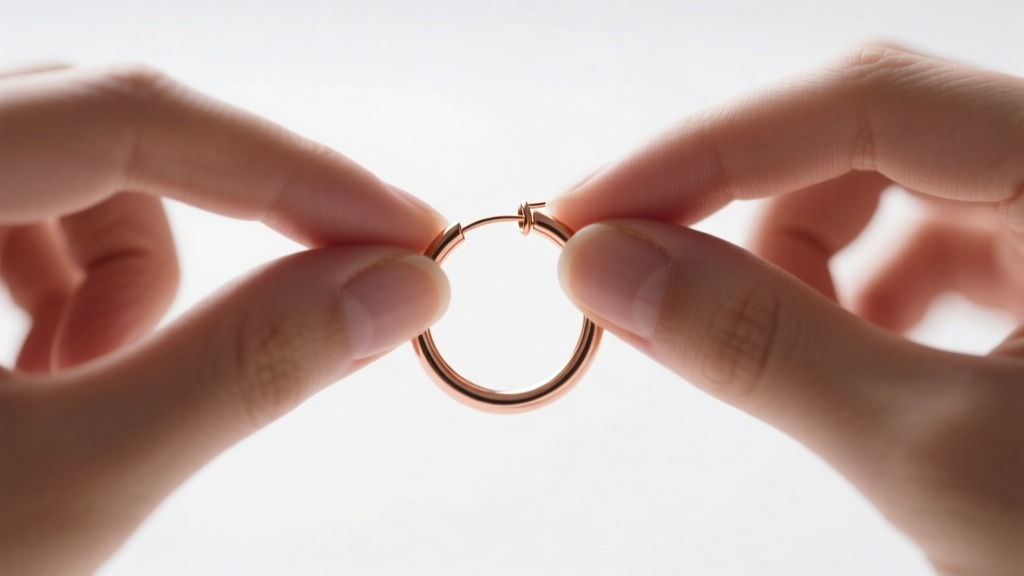
How to Open and Close Continuous (Endless) Hoops
Continuous hoops do not pull apart; they twist. Pulling the ends outward in opposite directions will permanently warp the circle, making it impossible to close flush.
- Grip: Hold the hoop between your thumb and index finger on both hands, positioned on either side of the seam.
- Lateral Torsion: Gently twist one hand toward you and the other hand away from you. This lateral motion opens the hoop sideways, maintaining the perfect circular shape.
- Insertion: Slide the post through the piercing channel. If inserting into a cartilage piercing like a helix, use a slight rotating motion to guide the wire through the fistula without catching.
- Closing: Twist the ends back into alignment. You should feel a subtle 'click' or friction lock as the pin enters the receiving tube. Run your fingernail over the seam; it should feel completely flush with no snagging.
Handling Hinged Clickers
Hinged clickers are vastly easier to manage, especially for tragus or daith piercings where visibility is low. To open, locate the tiny hinge and gently pull the opposite segment away from the closure point. To close, press the segment firmly into the receiving clasp until you hear an audible 'click.' Never force a clicker shut; if it requires excessive pressure, the hinge is likely misaligned or clogged with sebum and debris.
Step 3: Styling Frameworks for Ear Curation
Small rose gold hoop earrings are incredibly versatile, serving as the perfect anchor for a curated ear. Because rose gold has a warm, romantic undertone, it pairs exceptionally well with specific gemstones and mixed-metal layouts.
- The Minimalist Stack: Pair a 10mm solid 14k rose gold hoop in the primary lobe with a 3mm bezel-set moonstone or labradorite stud in the upper lobe. The flash of the gemstone complements the copper tones of the rose gold.
- The Mixed-Metal Bridge: Rose gold acts as a perfect transitional metal. If you have yellow gold in one ear and white gold or platinum in the other, placing a small rose gold hoop in the secondary lobe piercings bridges the gap between the warm and cool tones seamlessly.
- Cartilage Constellations: For flat or helix piercings, use 8mm rose gold huggies adorned with a single bezel-set diamond or morganite. This creates a subtle sparkle that catches the light without the heavy, swinging motion of a dangle earring, which can snag on hair and clothing.
Step 4: The Proper Cleaning and Maintenance Protocol
Because rose gold relies on copper for its color, it is uniquely susceptible to oxidation and environmental damage. Copper reacts with chlorine, salt water, and harsh cosmetics, which can lead to surface pitting or a dull, brownish patina.
Daily Maintenance Rules
Never wear your small rose gold hoops in swimming pools or hot tubs. Chlorine aggressively attacks the copper and silver alloys in 14k and 18k gold, causing microscopic stress fractures that can eventually snap the earring wire. Additionally, apply hairspray, perfumes, and lotions before putting on your earrings to prevent chemical buildup on the metal surface.
Step-by-Step Deep Cleaning Routine
Perform this cleaning protocol once every two weeks to maintain the luster and hygiene of your earrings:
- Prepare the Solution: Mix a few drops of mild, phosphate-free dish soap into a bowl of warm (not hot) distilled water. Avoid tap water, as the minerals can leave microscopic water spots on the polished metal.
- Soak: Submerge the earrings for 3 to 5 minutes. This softens any accumulated sebum, dead skin cells, or cosmetic residue, particularly around the hinge and closure seams.
- Agitate Gently: Use an extra-soft baby toothbrush to gently sweep the bristles over the wire and clasp. Do not use stiff-bristled brushes, as they can create micro-scratches on the high-polish finish.
- Rinse and Dry: Rinse thoroughly under distilled water. Immediately pat dry with a lint-free microfiber cloth. Allowing rose gold to air-dry can result in stubborn water spots that require professional polishing to remove.
Avoid ultrasonic jewelry cleaners unless your earrings are solid gold with no gemstone inclusions. The high-frequency vibrations can loosen the bezels or prongs holding small accent stones, leading to stone loss. By adhering to these precise metallurgical and mechanical guidelines, your small rose gold hoop earrings will remain a secure, radiant fixture in your jewelry rotation for decades.


