Why Do Pirates Wear Earrings? Historical Myths & Modern Metals
Discover why do pirates wear earrings through historical lore, and explore the best saltwater-resistant metals for modern maritime wear.

The Golden Age of Piracy: Fact vs. Fiction
When exploring the rich, often romanticized history of maritime outlaws, one of the most persistent questions from jewelry enthusiasts and historians alike is: why do pirates wear earrings? Pop culture has cemented the image of the swashbuckling buccaneer with a gleaming gold hoop dangling from their lobe. But beyond the Hollywood aesthetics, the reasons are rooted in a fascinating intersection of nautical superstition, early metallurgy, and practical economics.
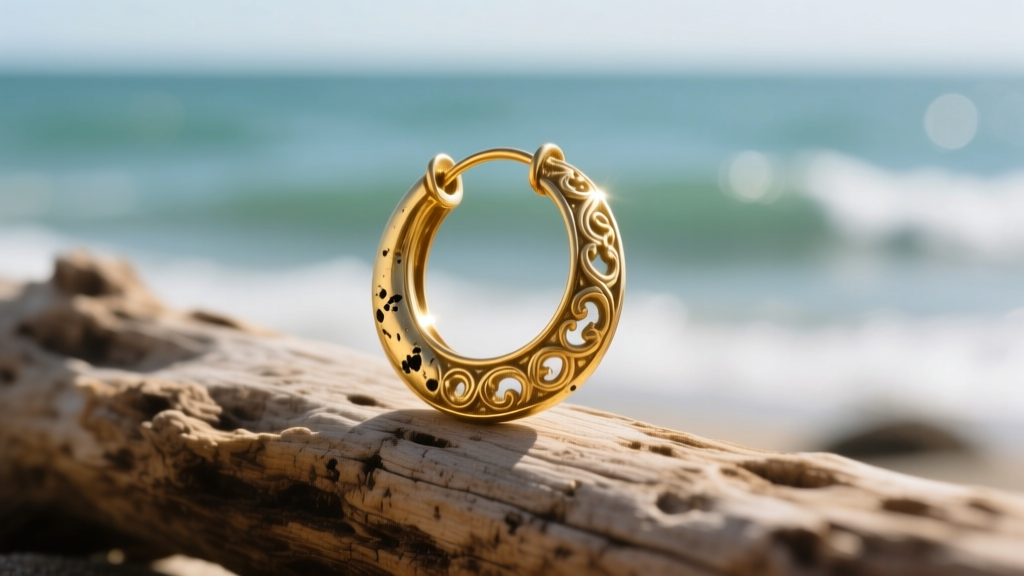
Historically, the most widely accepted theory is that a gold earring served as a portable, un-stealable insurance policy. If a pirate drowned and washed ashore, the gold hoop was meant to pay for a proper Christian burial. According to maritime historians at History.com, while some sailors did wear earrings for this reason, it was far more common for pirates to simply wear their wealth on their bodies because they lacked secure banking on the high seas. Furthermore, Royal Museums Greenwich notes that some sailors believed piercing the earlobe improved long-distance eyesight—a nautical myth tied to early, misunderstood concepts of acupressure.
Gold's status as a 'noble metal' meant it was one of the few materials in the 17th century that could survive the brutal, corrosive environment of the open ocean without degrading or turning the wearer's skin black.
Metallurgy on the High Seas: Historical Materials
To truly understand the material choices of historical pirates, we must look at the chemical properties of the metals available during the Golden Age of Piracy (roughly 1650 to 1730). Saltwater is a highly aggressive electrolyte, rich in sodium chloride, which rapidly accelerates oxidation and corrosion in base metals.
| Material | Historical Use | Saltwater Reaction | Modern Equivalent |
|---|---|---|---|
| 24k / 22k Gold | Captains, wealthy privateers | Highly resistant; noble metal, zero oxidation. | 14k / 18k Solid Gold |
| Sterling Silver | Crew members, looted goods | Rapid tarnishing; forms silver chloride in NaCl. | Rhodium-plated Silver |
| Brass / Bronze | Lower ranks, makeshift gear | Dezincification; turns skin green, causes irritation. | Niobium (Hypoallergenic) |
| Pewter / Lead | Desperate measures | Heavy oxidation, toxic leaching in acidic sweat. | Banned in modern jewelry |
Modern Maritime Metals: What Survives the Salt?
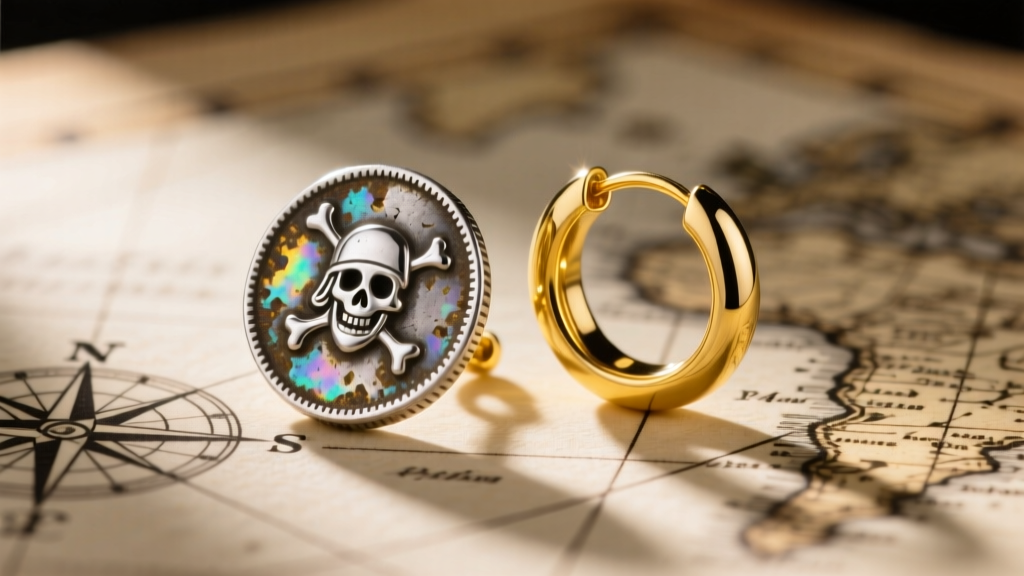
Today, modern 'pirates'—surfers, sailors, marine biologists, and beachgoers—face the exact same metallurgical challenges as their 18th-century predecessors. If you spend your life in and around saltwater, your ear piercings are constantly exposed to a corrosive saline bath. Choosing the wrong material will result in pitting, crevice corrosion, and severe contact dermatitis.
Grade 23 Titanium vs. 316L Surgical Steel
The most critical material debate in modern maritime jewelry is between ASTM F136 (Grade 23 Titanium) and ASTM F138 (316L Surgical Steel). While 316L is often marketed as 'marine grade' steel, it is actually highly susceptible to pitting corrosion when exposed to chlorides over long periods. The passive chromium oxide layer that protects 316L steel can be breached by salt crystallization in the tight crevices of an earring backing or threading.
- Grade 23 Titanium (Ti-6Al-4V ELI): Completely immune to chloride pitting. It forms an impenetrable, self-healing oxide layer. It is the ultimate choice for daily ocean exposure.
- Niobium: An excellent alternative for those who want the anodized colors of a pirate's loot without the nickel content found in white gold or steel.
- Platinum (Pt950): Like gold, it is a noble metal. It will not tarnish in seawater, but its high density makes it heavy for larger hoop or huggie styles.
The Galvanic Corrosion Trap
One of the most common failure modes for modern water-sports enthusiasts is galvanic corrosion. As explained by materials engineers at Corrosionpedia, when two dissimilar metals are in electrical contact in the presence of an electrolyte (like sweat or seawater), a galvanic cell is created. The less noble metal becomes the anode and corrodes rapidly.

If you wear a 14k gold earring but use a cheap stainless steel friction back, the saltwater will act as a bridge, causing the steel back to rust aggressively against your skin, potentially trapping the earring in your lobe due to the buildup of iron oxide and swollen tissue. Always ensure your earring back is made of the exact same metal as the post, or use a biocompatible silicone O-ring for secure, non-metallic retention.
Sourcing Authentic Maritime-Grade Earrings Today
When shopping for saltwater-resistant earrings, structural integrity is just as important as material purity. The ocean is unforgiving of poor mechanics. Here is a practical framework for selecting maritime-ready ear wear:
- Ditch the Friction Backs: Standard 'butterfly' friction backs trap sand and salt crystals, leading to mechanical failure and lost earrings. Opt for threadless (push-pin) or internally threaded closures.
- Respect the Gauge: Standard lobe piercings are usually 20G (0.81mm) or 18G (1.02mm). Cartilage piercings are typically 16G (1.29mm). Forcing a 20G post into a 16G fistula can cause the 'cheese-cutter effect,' where thin metal migrates through the tissue during physical water sports.
- Continuous Hoops vs. Huggies: Large continuous hoops can easily snag on wetsuits, surfboard leashes, or sailing rigging. Snug-fitting huggies or flat-back labret studs offer a much lower profile and reduce the risk of traumatic tearing.
Final Verdict: From Pirate Lore to Modern Lobe Care
So, why do pirates wear earrings? Historically, it was a blend of portable wealth, nautical superstition, and the unique chemical resilience of gold in a saline environment. Today, the spirit of the maritime earring lives on, but the metallurgy has evolved. By understanding the galvanic series, avoiding 316L steel in high-chloride environments, and investing in Grade 23 titanium or solid 14k/18k gold with secure, threadless mechanics, you can conquer the high seas without sacrificing your piercings to the depths.


