Buying Guide: Jump Rings Jewelry for Chainmaille Finger Bands
Discover how to buy jump rings jewelry for finger bands. Learn about chainmaille weaves, aspect ratios, metal grades, and secure closures.

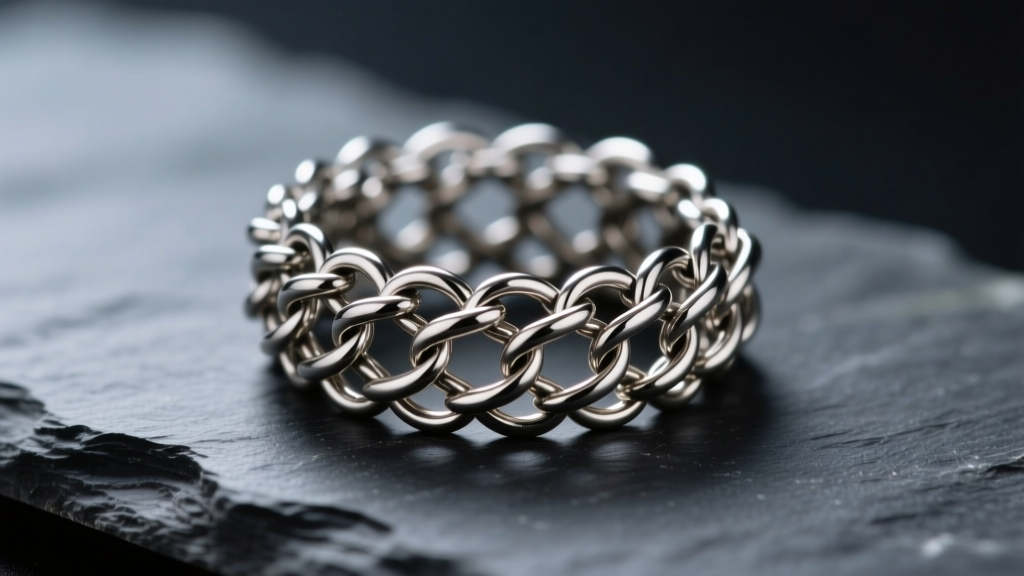
When most jewelers hear the term "findings," they think of hidden components. However, in the niche world of woven metalwork, jump rings jewelry takes center stage as the primary architectural element. For finger rings, this translates to chainmaille bands, woven tension rings, and interconnected mesh designs that offer unparalleled flexibility, breathability, and kinetic movement. Unlike a solid cast shank, a ring constructed entirely from interlocking jump rings behaves like a metallic fabric, conforming to the finger's natural swelling and contracting throughout the day.
Yet, buying a woven metal band requires a completely different knowledge base than purchasing a traditional solitaire or signet ring. You must understand wire temper, aspect ratios, cut types, and specialized closure mechanisms. This comprehensive buying guide will equip you with the exact technical specifications needed to evaluate, select, and wear jump rings jewelry designed specifically for the finger.
The Architecture of Woven Finger Bands
Traditional finger rings rely on a rigid, continuous band (the shank) to maintain their circular shape. Jump rings jewelry designed for fingers abandons the solid shank in favor of geometric weaves. The structural integrity of the ring comes entirely from the friction and tension of the interlocking metal loops. Because there is no solder holding the individual rings together, the band can flex, stretch slightly, and drape over the knuckle with ease.
This flexibility makes chainmaille bands an excellent choice for individuals with arthritis or those who experience significant seasonal finger swelling. However, because the structure relies on precise geometric alignment, a poorly calculated weave will collapse, snag, or pull finger hair. Understanding the mathematics behind the weave is the first step in identifying high-quality jump rings jewelry.
The Mathematics of Weaving: Aspect Ratio and Gauge
The single most critical metric in chainmaille jewelry is the Aspect Ratio (AR). According to the Maille Artisans International League (MAIL), the AR is the mathematical relationship between the Inner Diameter (ID) of the jump ring and the Wire Diameter (WD) of the metal used to make it. The formula is simple: AR = ID / WD.
If a jeweler uses an incorrect AR for a specific weave, the jump rings jewelry will fail. An AR that is too low results in a stiff, locked weave that cannot bend around the curvature of a finger. An AR that is too high creates a sloppy, loose weave that will easily pull apart under the lateral stress of hand movements.
Aspect Ratio Requirements for Popular Ring Weaves
| Weave Pattern | Minimum AR | Ideal AR for Finger Bands | Recommended Wire Gauge (AWG) |
|---|---|---|---|
| European 4-in-1 | 3.5 | 4.2 - 4.5 | 18g - 20g |
| Byzantine | 3.5 | 3.5 - 3.8 | 16g - 18g |
| Full Persian | 5.2 | 5.5 - 6.0 | 20g - 22g |
| Helm Weave | 3.8 (Large) / 2.8 (Small) | 4.0 / 3.0 | 16g (Large) / 20g (Small) |
Note: American Wire Gauge (AWG) is the standard for non-ferrous metals like silver and titanium in the US, while Standard Wire Gauge (SWG) is often used for steel. Always verify which gauge system the artisan is using, as a 20g SWG wire is thicker than a 20g AWG wire.
Material Grades for Daily Wear
Because jump rings jewelry relies on metal-on-metal friction, the hardness and temper of the wire dictate the ring's lifespan. Soft metals will slowly pull open at the seams, while overly brittle metals may snap when forced over a knuckle.
Titanium and Niobium: The Modern Standards
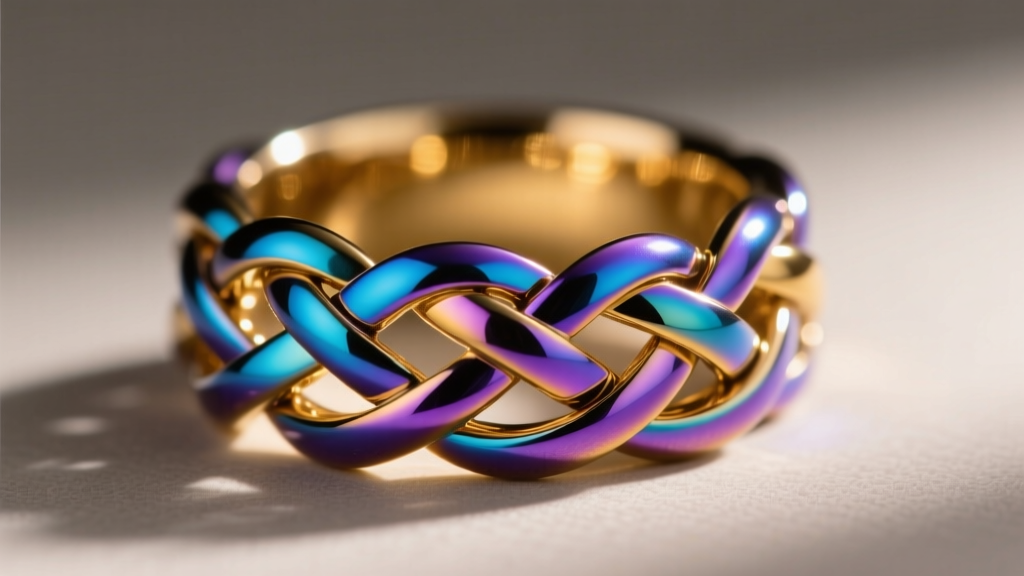
For lightweight, hypoallergenic daily wear, Commercially Pure (CP) Grade 2 or Grade 3 Titanium is the gold standard. Titanium offers an exceptional strength-to-weight ratio, meaning a wide, 10mm Byzantine band will weigh only a fraction of its sterling silver counterpart. Furthermore, titanium can be anodized using electricity to produce vibrant, permanent colors without the use of dyes or platings that can wear off over time.
Niobium is another fantastic reactive metal, favored for its ability to achieve deep, rich anodized colors (like true black and deep copper) that titanium cannot produce. However, niobium is slightly softer than titanium, making it better suited for medium-to-thick gauges (16g or 14g) to prevent the jump rings from pulling open under stress.
Precious Metals: Argentium and Palladium White Gold
If you prefer traditional precious metals, avoid standard sterling silver for complex weaves. Sterling tarnishes quickly, and polishing the deep crevices of a Full Persian weave is nearly impossible. Instead, seek out Argentium Silver, a modern alloy containing germanium that is highly tarnish-resistant and can be fusion-welded. For white gold alternatives, palladium white gold offers a naturally white, hypoallergenic option that does not require rhodium plating, which would quickly wear off the high-friction interior of a chainmaille band.
Structural Closures and Fit
A solid ring is slipped over the finger, but how do you secure a woven band that lacks a continuous shank? High-end jump rings jewelry for fingers utilizes specialized closure mechanisms to ensure the ring stays on during vigorous activity.
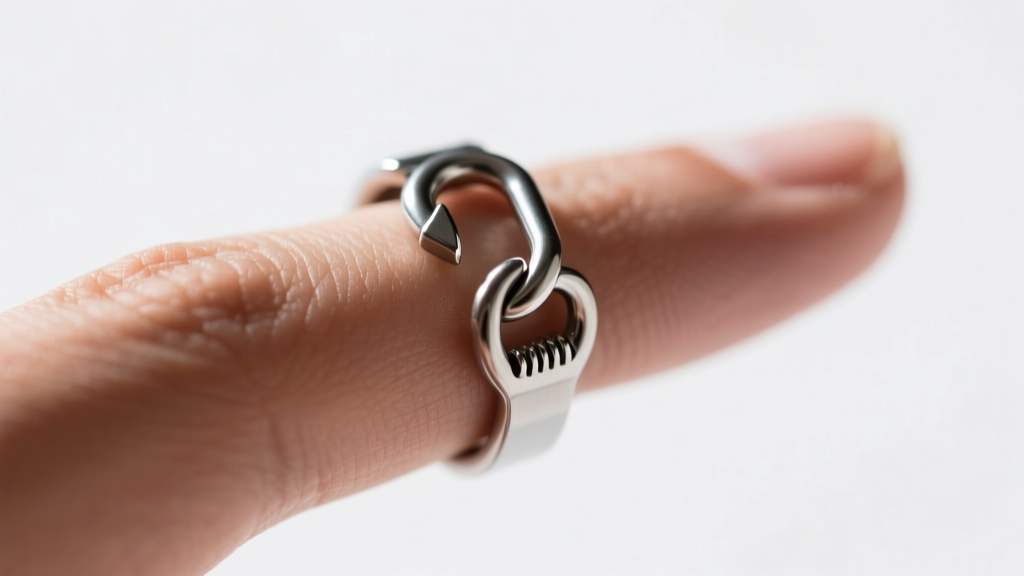
- Tension Hook Closures: The most common method involves a heavy-gauge wire hook on one end that snaps into a corresponding loop on the other. The natural tension of the weave keeps the hook seated. This allows for micro-adjustments in sizing.
- Hidden Magnetic Clasps: For a seamless look, some artisans embed rare-earth neodymium magnets inside hollow, woven tube segments. While elegant, magnetic clasps are not recommended for heavy manual labor, as lateral shearing forces can break the magnetic hold.
- Hinged Segments: Premium bands may feature a solid metal hinge integrated into the weave, secured by a friction pin or a tiny screw. This offers the security of a solid band with the aesthetic of chainmaille.
The Flush-Cut Imperative: What to Inspect
When evaluating the craftsmanship of jump rings jewelry, inspect the cut of the individual rings. Jump rings are created by wrapping wire around a mandrel and then cutting the coil. The method of cutting drastically affects the wearer's comfort.
Expert Tip: Always demand flush-cut or beveled jump rings for finger bands. Flush-cut rings are sliced with specialized parallel cutters that leave the ends perfectly flat and meeting seamlessly. Beveled rings go a step further, slightly angling the cut so the ends overlap, creating a virtually snag-proof closure. Avoid "pinch-cut" rings, which leave sharp, pointed burrs that will scratch your skin and catch on fine fabrics.
To test a ring in person, run the inside of the band across your lower lip or the inside of your wrist. If you feel any scratching or catching, the rings were poorly cut or improperly closed, and the piece should be rejected.
Pricing Tiers and Market Value
Because chainmaille is intensely labor-intensive, you are primarily paying for the artisan's time rather than the raw material cost. A single wide finger band can contain over 300 individually woven jump rings. According to jewelry fabrication benchmarks from suppliers like Rio Grande, the material cost is often less than 15% of the final retail price.
What to Expect to Pay
- $45 - $90 (Entry Level): Anodized aluminum or surgical stainless steel. Aluminum is incredibly lightweight but soft; it will dent and pull open if caught on clothing. Steel is durable but heavy and can cause nickel allergies in sensitive wearers.
- $120 - $280 (Mid-Tier / Artisan): Grade 2/3 Titanium, Niobium, or Bronze. This is the sweet spot for durable, hypoallergenic, daily-wear jump rings jewelry. You are paying for precision flush-cutting and complex, mathematically perfect weaves.
- $350 - $800+ (Precious Metals): Argentium silver, 14k/18k gold, or platinum. These pieces are often heirloom-quality, featuring micro-weaves (using 24g or 26g wire) that resemble fine silk. They require master-level fabrication skills and specialized micro-torch soldering for the closures.
Final Thoughts on Sizing
Sizing a woven ring is fundamentally different from sizing a solid band. Because chainmaille has a natural "drape" and compresses when the finger bends, a ring that measures exactly to your finger's circumference will feel uncomfortably tight. As a general rule, when ordering custom jump rings jewelry, add a quarter to a half-size up from your standard knuckle measurement to account for the weave's structural compression. Always ask the artisan if their sizing chart accounts for the specific weave's compression factor before finalizing your purchase.