Choosing the Right Jump Ring for Jewelry Chainmaille Finger Rings
Discover how to select the perfect jump ring for jewelry chainmaille finger rings. Compare metal grades, gauge sizes, and aspect ratios for lasting durability.

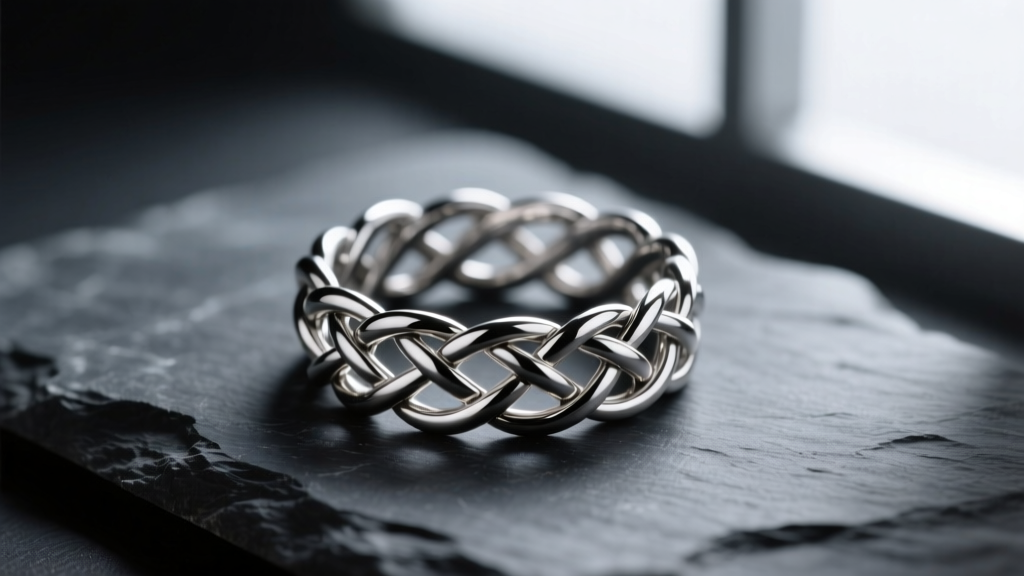
When most jewelers think of findings, they view connectors as mere afterthoughts. However, when designing chainmaille finger rings or adjustable ring shanks, the structural integrity of the entire piece rests entirely on a single component: the jump ring for jewelry. Unlike a pendant bail or a clasp connector, a jump ring integrated into a finger ring is subjected to continuous lateral shear stress, crushing forces, and friction. As we navigate the jewelry design landscape of 2026, the resurgence of heavy, modular chainmaille and adjustable architectural rings demands a rigorous understanding of metallurgy and geometry.
Selecting the wrong wire gauge, metal grade, or aspect ratio will result in a ring that unravels, snags, or permanently deforms within days of wear. This guide breaks down the exact material properties, gauge requirements, and structural configurations needed to engineer durable, high-end chainmaille finger rings.
The Structural Role of the Jump Ring in Finger Jewelry
In a traditional cast or fabricated band, the metal's crystalline structure distributes force evenly across the shank. In a chainmaille ring, that force is concentrated entirely on the seams of the individual jump rings. Every time the wearer bends their finger or grips an object, the rings experience torsional stress. If the yield strength of the metal is too low, the jump rings will pull open. If the metal is too brittle from excessive work-hardening, the rings will snap cleanly at the cut.
Furthermore, the interior of a finger ring is a harsh environment. It is exposed to sweat (which is mildly acidic and high in chlorides), lotions, and constant temperature fluctuations. Therefore, the ideal jump ring for jewelry used in ring bands must possess a triad of properties: high yield strength, excellent corrosion resistance, and precise geometric consistency.
Material Showdown: Yield Strength and Finger Wear
Not all metals behave equally when woven into a ring shank. Here is how the most common chainmaille materials perform under the specific duress of finger wear.
Titanium: The Aerospace Standard
Titanium is arguably the premier choice for structural chainmaille rings, but you must specify the correct grade. Grade 2 (Commercially Pure) titanium offers a yield strength of roughly 275 MPa. It is lightweight, completely hypoallergenic, and can be anodized into a vibrant spectrum of colors without dyes. However, for heavy-duty ring bands, Grade 5 (Ti-6Al-4V) is superior. With a yield strength exceeding 800 MPa, Grade 5 titanium will not deform under hand pressure. The trade-off is that Grade 5 is notoriously difficult to cut; you will need specialized flush cutters or a jewelry saw, and it cannot be anodized as easily as Grade 2.
Niobium: The Colorful Weakling
Niobium is beloved for its anodizing potential, but its yield strength is a mere 125 MPa. If you use 18-gauge or 20-gauge niobium jump rings for a finger ring, the band will crush and oval out almost immediately. To use niobium in ring shanks, you must step up to 14-gauge or 12-gauge wire and utilize weaves that lock the rings tightly together to prevent individual ring rotation.
Sterling Silver vs. Argentium
Traditional Sterling Silver (925) has a tendency to work-harden and become brittle, leading to micro-fractures at the saw cut. Rio Grande and other major suppliers often recommend Argentium Silver (935 or 960) for chainmaille. Argentium contains germanium, which drastically increases tarnish resistance and allows the metal to remain slightly more malleable, reducing the risk of brittle snapping at the seam. For silver ring bands, always use dead-soft wire and work-harden the finished ring in a tumbler with steel shot to lock the weave.
Stainless Steel (316L)
316L Surgical Steel offers incredible tensile strength and a low price point, making it popular for entry-level chainmaille. However, it contains nickel, which can cause contact dermatitis in sensitive individuals when worn snugly against the finger. It also work-hardens rapidly, meaning cutting errors cannot be easily bent back into place.
Aspect Ratio (AR) and Gauge Sizing for Ring Shanks
The geometry of your jump ring is just as critical as the material. In chainmaille, this is defined by the Aspect Ratio (AR), calculated by dividing the Inner Diameter (ID) of the ring by the Wire Diameter (WD). According to the weave archives at the Maille Artisans International League (MAIL), getting the AR wrong will ruin the structural integrity of a finger ring.
| Weave Pattern | Ideal AR | Recommended Gauge (WD) | Structural Notes for Finger Rings |
|---|---|---|---|
| Euro 4-in-1 | 3.5 - 4.2 | 16g (1.29mm) or 14g (1.63mm) | AR below 3.5 makes the band too stiff to curve around a finger. AR above 4.5 causes excessive lateral wobble. |
| Byzantine | 3.5 - 3.8 | 18g (1.02mm) or 16g (1.29mm) | Creates a thick, rope-like band. Requires tight AR to prevent the inner folds from catching on skin. |
| Helm Chain | 3.8 (small) / 5.2 (large) | 14g large / 18g small | Requires two different jump ring sizes. Excellent flexibility for knuckle articulation. |
| Dragonscale | 3.5 (small) / 5.0 (large) | 16g large / 20g small | Dense and heavy. Uses a lot of metal, making it expensive in silver but highly durable. |
For a standard women's size 6-7 ring, a Euro 4-in-1 weave using 16-gauge wire with a 4.5mm ID provides the perfect balance of flexibility and rigidity. For men's rings (size 9-12), stepping up to 14-gauge wire with a 5.5mm ID maintains the same AR while providing the necessary mass and strength to withstand greater grip forces.
Soldered vs. Unsoldered: Preventing the Snag and Snap
The greatest point of failure in any chainmaille finger ring is the cut seam. When you use standard unsoldered jump rings cut from a coil, the seam acts as a microscopic hook. Over time, this hook will catch on textiles, hair, or adjacent metal rings, eventually pulling the jump ring open. In a ring shank, an opened jump ring compromises the entire matrix, leading to a cascading failure where the ring unravels.
To combat this, professional jewelers employ three strategies:
- Orbital Sander Flushing: If soldering every ring is cost-prohibitive, the cut ends must be sanded perfectly flush using an orbital sander with 400-grit to 1000-grit paper. A perfectly flush seam reduces snagging by up to 80%.
- Split Rings: For adjustable ring connectors or heavy charm attachments on the shank, use micro split rings (which function like tiny keychains) rather than open jump rings. They offer double the wire thickness at the seam.
- Laser Welding and Hard Solder: For high-end precious metal chainmaille rings, laser-welding the seam shut after weaving provides a seamless, unbreakable band. If using a torch, hard silver solder (which melts at a higher temperature) is required so the heat of closing one ring doesn't melt the solder of an adjacent, already-closed ring.
Troubleshooting Common Chainmaille Ring Failures
Even with the right jump ring for jewelry, makers frequently encounter structural issues. Here is how to troubleshoot the most common failure modes:
1. The Ring Feels Too Stiff and Won't Bend Around the Knuckle
Cause: Your Aspect Ratio is too low, or your wire gauge is too thick for the chosen inner diameter. The metal is physically binding against itself.
Fix: Increase the mandrel size by 0.5mm to open up the AR, allowing the rings room to pivot. Alternatively, switch from a dense weave like Byzantine to a more articulate weave like Half-Persian 3-in-1.
2. The Band Flattens Out on the Bottom (Palmar Side)
Cause: The metal's yield strength is too low to resist the crushing force of gripping objects (like steering wheels or gym equipment). This is common with pure silver, fine gold, and niobium.
Fix: Line the interior of the chainmaille band with a thin strip of hardened silicone or a solid metal inner liner (a 'comfort fit' core). This transfers the crushing load to the liner rather than the jump rings.
3. Galvanic Corrosion and Discoloration
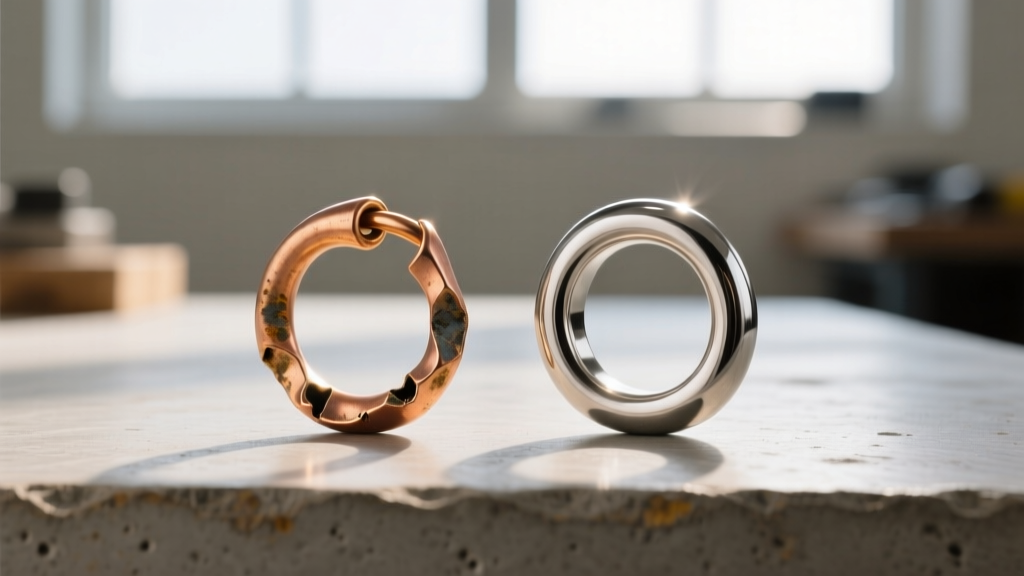
Cause: Mixing dissimilar metals (e.g., copper and sterling silver jump rings) in a ring band that is exposed to sweat creates a galvanic cell, rapidly corroding the more anodic metal (copper).
Fix: Never mix metals with vastly different galvanic potentials in a finger ring. If you must mix colors, use anodized titanium or niobium alongside stainless steel, as their passive oxide layers protect them from galvanic reactions.
Final Sourcing Tips for 2026
As manufacturing techniques advance, the quality of commercially available jump rings has skyrocketed. When sourcing your jump ring for jewelry components, avoid bulk craft-store spools. The kerf (the width of the cut) on cheap rings is often jagged, and the inner diameters vary wildly due to loose mandrel winding.
Invest in machine-cut, precision-wound rings from specialized suppliers like The Ring Lord or Blue Buddha Boutique. These suppliers use CNC coiling machines and zero-kerf laser cutters, ensuring that every single jump ring in your chainmaille finger ring is mathematically identical. This precision is what separates a fragile craft project from a heirloom-quality piece of structural finger jewelry that will last a lifetime.