Troubleshooting Antique Jewelry Ring Box Storage for Heirloom Rings
Discover how to troubleshoot antique jewelry ring box storage issues. Learn to prevent heirloom ring tarnish, repair hinges, and replace toxic linings.

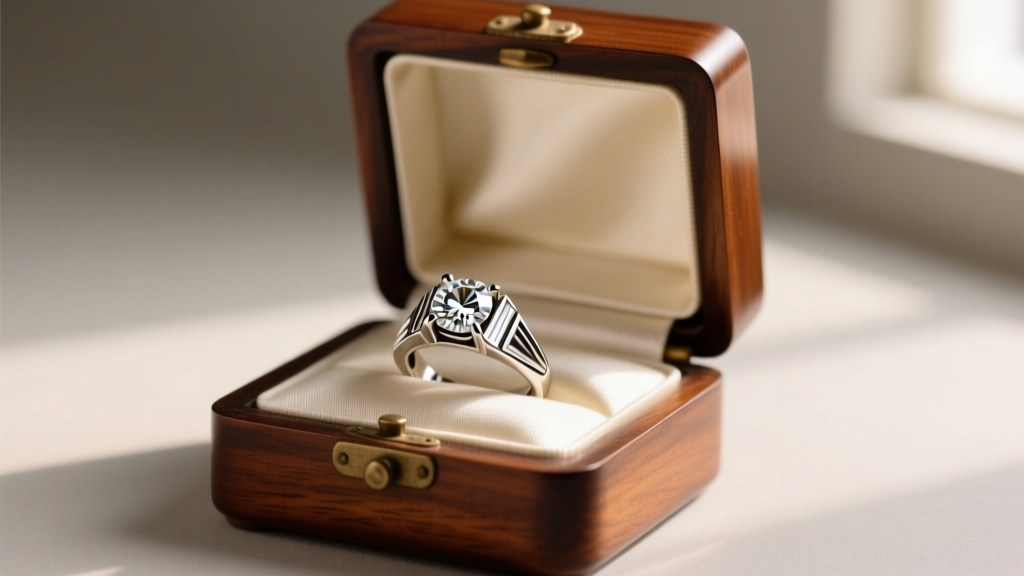
Collecting and preserving heirloom finger rings—from heavy Victorian signet rings to delicate Edwardian stacking bands—requires more than just a beautiful display. For many enthusiasts, housing these treasures in an antique jewelry ring box adds a layer of historical romance. However, vintage storage solutions often harbor hidden chemical and mechanical threats that can actively destroy the very rings they are meant to protect. As a senior conservator of jewelry artifacts, I frequently troubleshoot severe metal degradation, gemstone damage, and mechanical failures caused by improper vintage storage. This guide provides actionable, expert-level troubleshooting steps to restore, stabilize, and safely utilize antique ring boxes for your most prized finger jewelry.
The Hidden Dangers of Vintage Storage Environments
When you acquire an antique jewelry ring box from an estate sale or antique dealer, the interior environment is often a chemical minefield. The primary culprit for accelerated tarnish and metal corrosion in vintage boxes is off-gassing. Many mid-century and older boxes were constructed using materials that degrade over time, releasing corrosive gases into the enclosed microclimate.
For instance, older wooden boxes, particularly those made of oak, naturally emit acetic acid vapor. In an enclosed space, this vapor reacts with the copper alloys found in 14k rose gold, sterling silver (925), and antique coin rings, causing severe oxidation and even 'bronze disease' (a destructive cycle of copper chloride formation). Furthermore, vintage boxes often utilized Polyvinyl Chloride (PVC) in their plastic windows or synthetic velvet backings. As PVC degrades, it releases hydrogen chloride gas, which rapidly pits and corrodes silver and low-karat gold. According to the American Institute for Conservation (AIC), eliminating these off-gassing materials is the single most critical step in preserving metal artifacts.
Material Safety Chart: What to Keep and What to Toss
Before placing any valuable finger rings into an antique box, you must audit its materials. Use the following troubleshooting matrix to determine which components require immediate removal or replacement.
| Material Component | Risk Level | Chemical Threat | Required Action |
|---|---|---|---|
| Oak / Unsealed Wood | High | Acetic acid vapor | Seal with acrylic resin or line with barrier foil |
| PVC Plastic / Vinyl | Critical | Hydrogen chloride gas | Remove entirely; replace with acrylic or glass |
| Rubber-based Glues | High | Sulfur compounds | Scrape off; clean with VM&P Naphtha |
| Wool / Felt Padding | Medium | Moisture retention, sulfur | Replace with unbleached cotton or rayon velvet |
| Brass / Steel Hinges | Low/Med | Galvanic corrosion if touching rings | Clean and coat with micro-crystalline wax |
Troubleshooting Tarnish and Metal Degradation
If your heirloom rings have already suffered from being stored in a compromised antique jewelry ring box, immediate intervention is required. Silver rings stored in sulfur-rich environments (often from decaying rubber bands or cheap vintage velvet) will develop a thick, black silver sulfide layer.
Do not use harsh chemical dips like Tarn-X on antique rings. These thiourea-based dips strip away decades of desirable patina from the engraved crevices of signet and mourning rings, leaving them with an unnatural, flat white appearance. Instead, use a high-quality, non-abrasive polish like Goddard's Silver Polish applied with a soft microfiber cloth. For intricate filigree cocktail rings where polish cannot reach, use a specialized ultrasonic cleaner, but only if the ring contains no porous gemstones (like opals, emeralds, or mood ring liquid crystal vials) and no fracture-filled diamonds. The Gemological Institute of America (GIA) strongly advises against ultrasonic cleaning for any treated or fragile gemstones.
Mechanical Failures: Fixing Hinges and Clasps
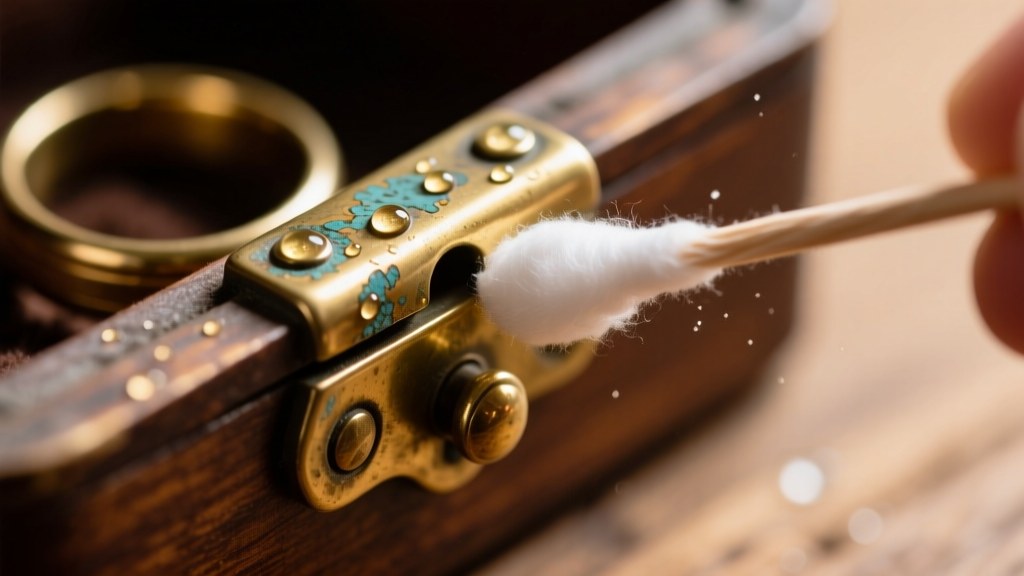
An antique jewelry ring box that does not close securely exposes your rings to dust, UV light, and fluctuating humidity. The most common mechanical failure in vintage boxes is the degradation of the hinge pins and the rusting of steel clasps.
Repairing Sheared Hinge Pins
If the lid of your box is loose or detached, the brass or steel hinge pin has likely sheared or corroded away. To fix this:
- Use a 0.5mm or 1.0mm pin punch and a jeweler's hammer to carefully tap the remnants of the old pin out of the hinge barrel.
- Clean the interior of the barrel with a pipe cleaner dampened with isopropyl alcohol to remove green verdigris (copper oxidation).
- Insert a new brass rod of the exact same gauge. If a precise fit isn't available, use a slightly thicker rod and carefully file it down with a needle file.
- Peen the ends of the new pin gently with a ball-peen hammer to secure it in place.
Lubricating Without Damaging the Box
Never use standard petroleum-based lubricants like WD-40 on antique box hinges. The solvents will stain the surrounding wood and fabric, and the oil will attract abrasive dust. Instead, apply a microscopic amount of Renaissance Wax (a micro-crystalline wax used by museum conservators) to the hinge joint using a fine brush. It provides smooth articulation while sealing the metal against moisture.
Restoring the Interior: Archival Re-lining Techniques
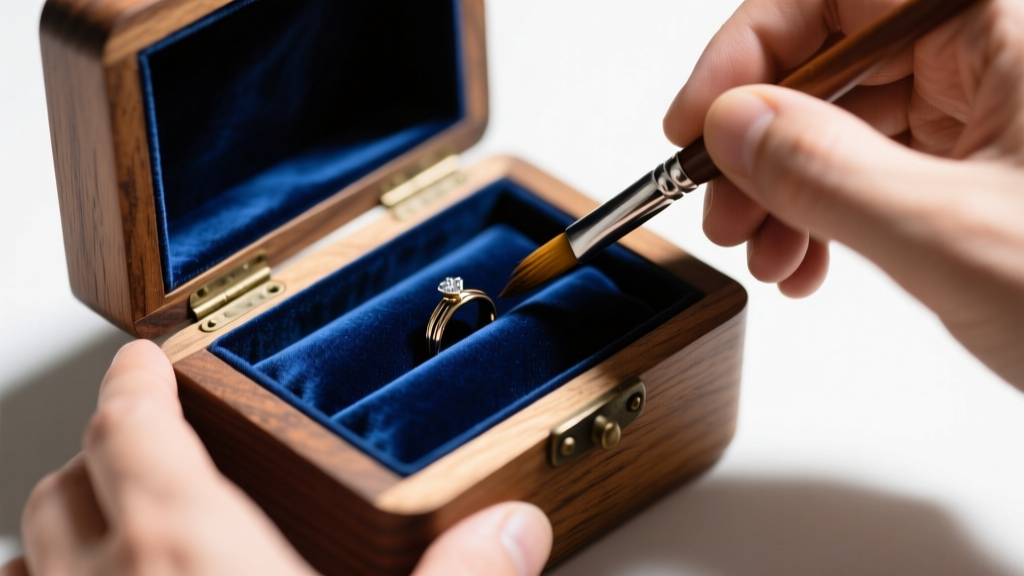
When the original velvet or silk lining of an antique jewelry ring box is crumbling, stained, or off-gassing, it must be replaced. This process requires patience and archival-grade materials to ensure the new interior is safe for delicate finger rings.
Step 1: Safe Adhesive Removal
Removing the old fabric often leaves behind a hardened, crusty layer of animal hide glue or rubber cement. Do not scrape this with a metal blade, as you will gouge the wood. Instead, apply VM&P Naphtha to a cotton swab and gently work it into the glue. Naphtha is a mild, fast-evaporating solvent that breaks down old adhesives without raising the wood grain or damaging the exterior finish.
Step 2: Selecting Archival Adhesives and Fabrics
For the new lining, avoid standard craft glues (which contain acidic plasticizers) and modern polyester velvets (which generate static electricity, attracting dust to your rings). Use an acid-free, pH-neutral PVA adhesive, such as Jade 403 or Lineco Neutral pH Adhesive. For the fabric, choose 100% rayon velvet or unbleached, washed cotton. Rayon velvet provides the luxurious, deep pile necessary to cushion heavy signet rings and prevent stacking rings from scratching one another, without the chemical risks of synthetic polymers.
Step 3: Creating Custom Ring Rolls
If your box lacks individual ring slots, you can construct custom 'finger rolls' to hold your collection. Cut strips of archival cotton batting, roll them tightly to a diameter of roughly 18mm (the average inner circumference of a size 8 ring), and wrap them in your chosen velvet. Secure the velvet at the base with a small dot of Jade 403, ensuring no glue seeps through to the surface where the rings will rest.
Environmental Control for Long-Term Preservation
Even a perfectly restored antique jewelry ring box needs help managing the external environment. Fluctuating humidity is the enemy of both the wooden box and the metal rings inside. To stabilize the microclimate:
- Silica Gel Cassettes: Place a small, rechargeable silica gel cassette (indicating type, which changes color when saturated) in a discreet corner of the box to maintain a relative humidity (RH) of around 45%.
- Tarnish-Preventive Liners: For silver rings, line the underside of the box lid with Pacific Silvercloth. This specialized fabric is embedded with microscopic silver particles that intercept and absorb corrosive gases before they reach your heirloom jewelry.
- Activated Charcoal: If the antique wood itself has a persistent musty odor that threatens to transfer to porous gemstones like pearls or turquoise, place a small sachet of activated bamboo charcoal inside the box for two weeks prior to housing your rings.
"The preservation of antique jewelry is inextricably linked to the preservation of its storage environment. A beautiful box that chemically attacks its contents is not a storage solution; it is a slow-acting destructive agent." — Principles of Jewelry Conservation
By systematically troubleshooting the chemical, mechanical, and environmental flaws of vintage storage, you can safely repurpose an antique jewelry ring box. This ensures your signet, cocktail, and stacking rings remain pristine, allowing the history of the box to complement, rather than compromise, the legacy of the rings within.