A Technical History of Rings Jewelry: Alloys & Casting
Explore the technical history of rings jewelry, from ancient Egyptian faience and Roman iron alloys to Victorian casting and modern metallurgy.

The Metallurgical Dawn: Ancient Egypt and the Faience Technique
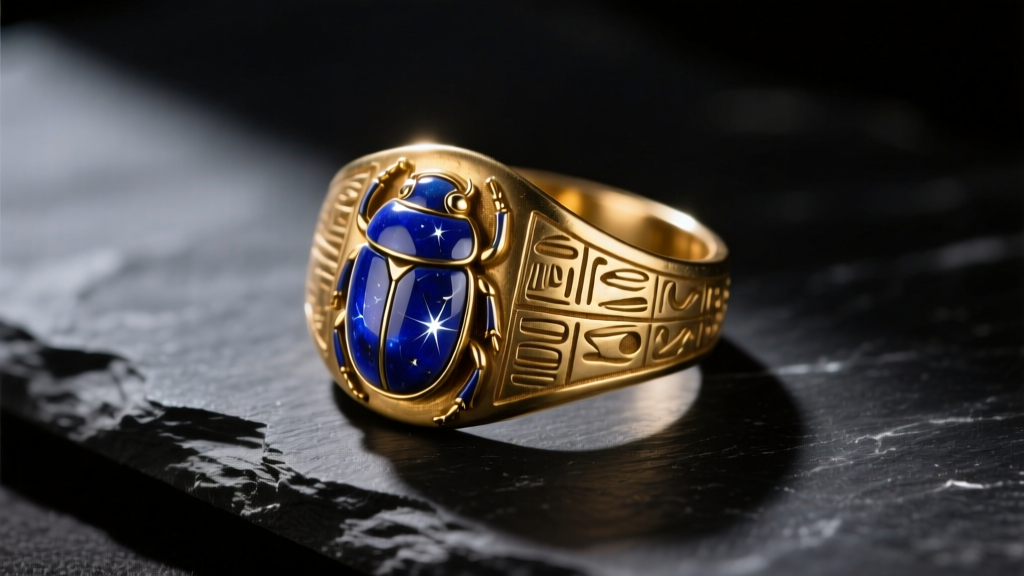
When examining the technical history of rings jewelry, we must look past mere aesthetics and analyze the foundational metallurgy and material science of antiquity. The earliest rings were not cast in precious metals, but engineered from faience—a sintered quartz ceramic. Egyptian artisans combined quartz sand, natron (sodium carbonate), and copper salts to create a vitreous, glass-like material. The copper ions, when fired in an oxidizing kiln atmosphere at approximately 900°C, yielded the iconic turquoise and blue hues.
For the elite, early metalworking introduced electrum, a naturally occurring alloy of gold and silver (typically 70% gold, 30% silver, with trace copper). Unlike pure gold, which is exceptionally soft (Mohs hardness 2.5), electrum offered a hardness of roughly 3.5 to 4.0, making it vastly superior for the structural integrity of a ring shank. According to the Metropolitan Museum of Art's Egyptian Art Department, these early bands were often cast using rudimentary open-mold sand casting, resulting in heavy, porous shanks that required extensive hand-burnishing to achieve a polished luster.
Roman Signets: Iron Oxidation and Intaglio Carving
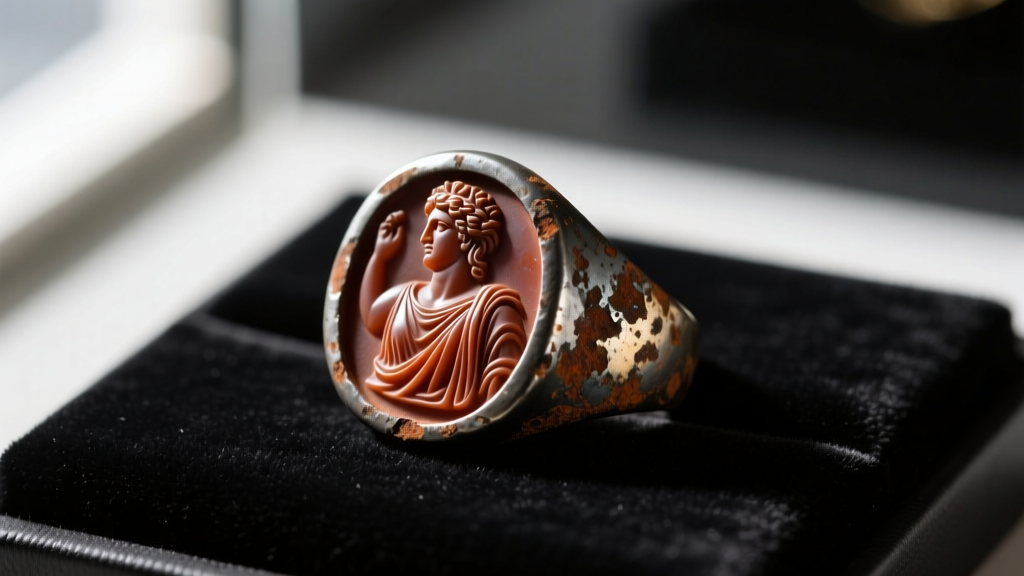
The Roman era introduced strict sumptuary laws that dictated ring materials by social class. While senators wore gold, plebeians and soldiers were restricted to iron (ferrum). From a modern metallurgical perspective, Roman iron rings present a fascinating study in oxidation and failure modes. Unlike gold, iron is highly reactive. Surviving examples in the British Museum Collection often show severe mineralization, where the original metal has entirely converted to iron oxide (rust), leaving a fragile, crystalline structure.
Technical Breakdown: Roman Alloy Compositions and Stone Setting
The Romans were pioneers in bezel setting, specifically for signet rings used as wax seals. The preferred stone was carnelian (a variety of chalcedony) due to its Mohs hardness of 6.5–7.0, which allowed it to be carved with intricate intaglio designs without fracturing, while remaining harder than the wax it was pressed into. The setting technique relied on mechanical friction rather than prongs. Artisans would carve a recess into the metal bezel, place the stone, and use a blunt punch to fold the metal lip over the stone's girdle—a technique still used in modern flush and gypsy settings.
"The transition from purely decorative bands to functional signet rings required a precise understanding of material hardness. The metal bezel had to be malleable enough to fold over the stone, yet rigid enough to protect the carved intaglio from impact." — Historical Jewelry Metallurgy Archives.
The Middle Ages: Posy Rings and the Evolution of Soldering
During the Middle Ages, the technical history of rings jewelry shifted toward complex assembly and surface decoration. The rise of the posy ring—bands inscribed with romantic or religious verses on the interior—required advancements in soldering. Early medieval soldering relied on 'hard solders' (alloys of gold, silver, and copper with melting points close to the base metal), which risked melting the entire ring during the joining process.
By the 14th century, metallurgists began utilizing 'soft solders' with lower melting points, incorporating tin and lead. This allowed for the secure attachment of elaborate bezels and collets without compromising the structural integrity of the forged shank. Furthermore, the era saw the perfection of champlevé enameling. Artisans gouged deep troughs into thick copper or bronze ring shanks, packed them with finely ground potassium-lead glass powder, and fired them at roughly 800°C. The resulting vitreous enamel was highly resistant to wear, a testament to the precise thermal control achieved by medieval kiln masters.
The Industrial Revolution: Stamping, Casting, and Standardized Sizing
The most radical disruption in ring manufacturing occurred during the 19th-century Industrial Revolution. Prior to this, every ring was hand-forged, meaning shank thickness and width varied wildly. The invention of the drop press and hardened steel dies allowed for the mass stamping of ring blanks from sheet metal. This cold-forging process work-hardened the metal, increasing its tensile strength and durability compared to traditional cast rings.
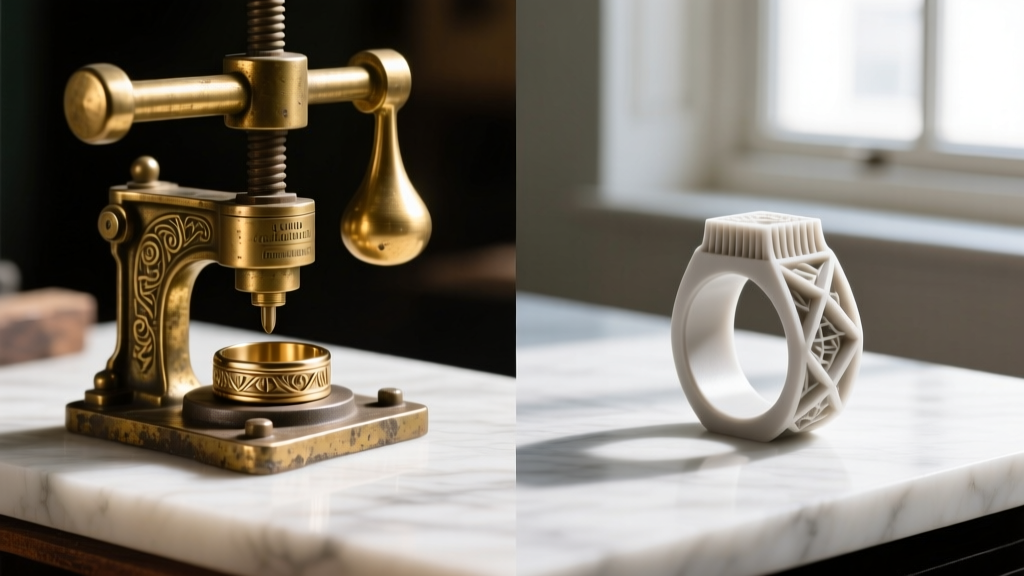
Simultaneously, the vulcanization of rubber in the 1850s revolutionized the lost-wax casting process. Artisans could now press a master ring model into vulcanized rubber molds, inject molten wax to create exact replicas, and cast multiple identical rings in a single flask. This era also birthed standardized ring sizing. The US and UK mandrel scales were formalized, replacing the archaic method of measuring fingers with string and relying on the jeweler's guesswork.
Comparative Analysis: Historical vs. Modern Ring Manufacturing
As we navigate the jewelry landscape in 2026, modern CAD/CAM milling and laser welding stand in stark contrast to historical methods. However, understanding these historical failure modes is crucial for collectors and bespoke jewelers. Below is a technical comparison of ring manufacturing across key eras.
| Era | Primary Base Metal | Stone Setting Technique | Typical Mohs Hardness | Primary Failure Mode |
|---|---|---|---|---|
| Ancient Egypt | Electrum / Faience | Wire wrapping / Bezel | 3.5 (Electrum) | Shank deformation due to high malleability |
| Roman Empire | Iron / Orichalcum | Friction Bezel / Collet | 4.0 (Iron) | Severe oxidation and structural mineralization |
| Medieval | Silver / Copper Alloy | Claw / Champlevé Enamel | 2.5 - 3.0 | Enamel crazing from thermal shock; prong wear |
| Victorian (Industrial) | 15k / 18k Gold | Pavé / Gypsy / Flush | 3.0 - 3.5 | Shank thinning from die-stamping friction |
| Modern (2026) | Platinum 950 / Ti-6Al-4V | Laser-assisted Tension | 4.5 (Pt) / 6.0 (Ti) | Brittle fracture in high-tension settings |
Sourcing Historical Reproductions: What to Look For
For collectors seeking historically accurate reproductions, the GIA Gems & Gemology archives emphasize the importance of metallurgical verification. If you are purchasing a 'Roman-style' signet ring, ensure the artisan is using traditional sand-casting methods rather than modern rubber-mold injection, as the porosity and weight distribution differ significantly. For Victorian reproductions, look for hallmarks that indicate period-correct alloys, such as 15k gold (62.5% purity), which was standard in Britain until 1932, rather than the modern 14k or 18k standards.
Furthermore, examine the interior of the shank. Pre-industrial rings will show microscopic file marks and a slightly uneven cross-section, whereas modern CNC-milled reproductions will possess a mathematically perfect, mirror-polished interior. True historical accuracy lies in these deliberate imperfections.
Conclusion: The Legacy of the Band
The technical history of rings jewelry is a masterclass in applied materials science. From the sintered quartz of the Nile to the laser-welded platinum of today, the evolution of the ring is defined by humanity's relentless pursuit of stronger alloys, more precise casting methods, and more secure stone settings. By understanding the metallurgical triumphs and failures of our predecessors, modern collectors and jewelers can better appreciate, preserve, and innovate upon the world's oldest continuous jewelry tradition.