925 Necklace Metallurgy: Alloys, Tarnish, and Verification
Explore the metallurgy of a 925 necklace. Learn about silver alloys, tarnish mechanics, rhodium plating thickness, and forensic verification.

The Atomic Reality: What "925" Actually Means
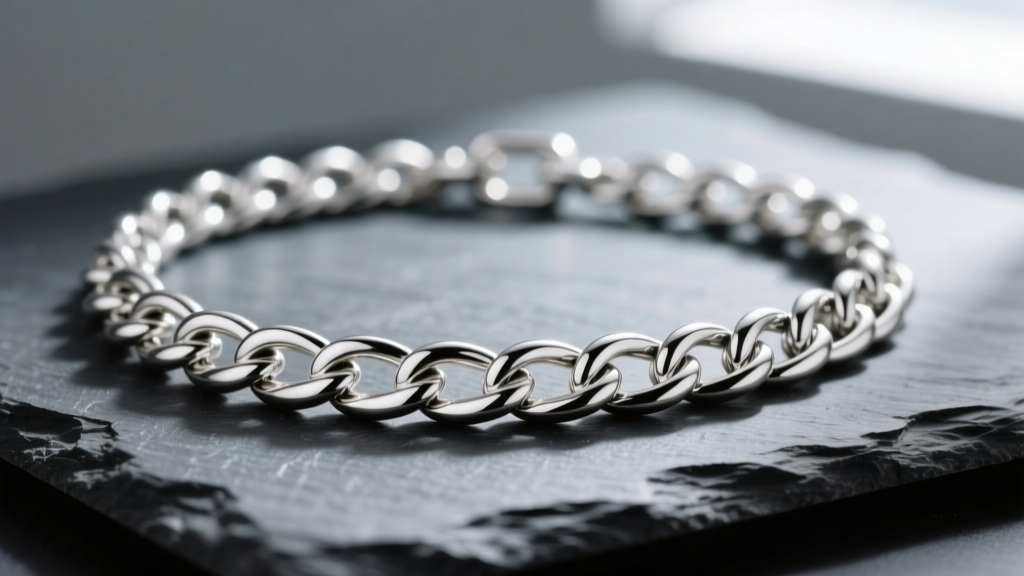
When you purchase a 925 necklace, you are not buying pure silver. You are buying a precisely engineered metallurgical alloy. The "925" hallmark indicates that the piece consists of 92.5% pure silver (Ag) and 7.5% secondary alloy metals, most commonly copper (Cu). This specific ratio is not arbitrary; it is rooted in the crystalline structure of silver and the physical limitations of pure elemental metals in jewelry applications.
Pure silver, often stamped as 999 or "fine silver," has a Mohs hardness of just 2.5 to 3.0. At this softness, a fine silver chain necklace would stretch, warp, and suffer severe abrasion under the mere weight of a pendant. By introducing 7.5% copper into the silver's face-centered cubic crystal lattice, the resulting alloy disrupts the uniform atomic planes. This phenomenon, known in metallurgy as solid solution strengthening, increases the hardness to approximately 3.5 on the Mohs scale and drastically improves the tensile strength, allowing the 925 necklace to withstand daily mechanical stress without permanent deformation.
The Copper Problem: Why Standard 925 Tarnishes
While copper provides necessary structural integrity, it is also the primary culprit behind the tarnishing of standard sterling silver. Pure silver is highly resistant to oxidation and does not react with oxygen at room temperature. However, the copper atoms within the 925 alloy are highly reactive to atmospheric sulfur compounds, specifically hydrogen sulfide (H2S), which is ubiquitous in the environment due to industrial pollution, volcanic activity, and even everyday household items like eggs and wool.
The Chemical Equation of Tarnish
Tarnish is not a surface dirt; it is a chemical conversion coating. When the copper and silver atoms at the surface of your necklace interact with sulfur and ambient moisture, they form silver sulfide (Ag2S). The reaction is accelerated by galvanic micro-cells that form between the anodic copper and cathodic silver in the presence of humidity. This results in the familiar yellow, brown, and eventually black discoloration on the surface of the metal.

Advanced Alloys: Argentium and Deox Silver
To combat the inherent vulnerabilities of the traditional copper-silver matrix, modern metallurgists have developed advanced 925 alloys that maintain the legal sterling standard while fundamentally altering the tarnish mechanics. According to The Silver Institute, these modern alloys represent a significant leap in precious metal engineering.
| Alloy Type | Composition | Tarnish Resistance | Best Use Case |
|---|---|---|---|
| Standard 925 | 92.5% Ag, 7.5% Cu | Low (Requires frequent polishing) | Everyday chains, budget-friendly pendants |
| Argentium 935/960 | 93.5%+ Ag, Cu, Germanium (Ge) | High (Forms self-healing GeO2 layer) | High-end chains, un-plated statement pieces |
| Deox Silver | 92.5% Ag, Cu, Deoxidizers | Medium (Reduces firescale during casting) | Intricate cast pendants, detailed lockets |
| Fine 999 | 99.9% Ag | Very High (No copper to react) | Enamel work, bezel settings (Too soft for chains) |
Argentium silver is particularly noteworthy. By replacing a portion of the copper with the metalloid germanium, the alloy forms a transparent, self-healing layer of germanium dioxide (GeO2) when exposed to oxygen. This microscopic barrier physically blocks sulfur atoms from reaching the silver and copper beneath, rendering the 925 necklace virtually immune to standard atmospheric tarnishing without the need for chemical plating.
Rhodium Plating: Flash vs. Micron Thickness
Because standard 925 silver is prone to tarnish, most commercial 925 necklaces are electroplated with rhodium, a platinum-group metal that is completely inert to sulfur and oxygen. However, not all rhodium plating is created equal, and understanding the thickness is critical for evaluating the longevity of your jewelry.
- Flash Plating (0.01 to 0.05 microns): Often used in mass-produced, low-cost jewelry. This ultra-thin layer provides immediate brilliance but will wear through at the friction points (like the clasp and jump rings) within weeks of daily wear, exposing the reactive copper alloy beneath.
- Standard Plating (0.5 to 1.0 microns): The industry standard for quality 925 necklaces. This thickness provides a durable barrier that can withstand 1 to 3 years of regular wear before requiring re-plating.
- Heavy Plating (2.0 to 5.0+ microns): Reserved for luxury or heirloom-grade pieces. This substantial layer of rhodium mimics the durability of solid white gold and can protect the underlying sterling silver for a decade or more.
When evaluating a rhodium-plated 925 necklace, always inquire about the plating thickness. A reputable manufacturer will provide this specification in microns (μm). Furthermore, be aware that rhodium plating masks the natural warmth of silver, giving it a slightly darker, steel-like reflectivity. If you prefer the bright, white luminescence of bare silver, seek out un-plated Argentium or high-polished standard 925.
Forensic Verification: Testing Your 925 Necklace
The market is saturated with counterfeit silver, often consisting of a base metal core (like brass or nickel) with a microscopic silver electroplate. Relying solely on a "925" stamp is insufficient, as stamps are easily forged. As noted by the Gemological Institute of America (GIA), rigorous verification requires testing the physical or elemental properties of the metal.
1. The Specific Gravity (SG) Test
This is a highly accurate, non-destructive test you can perform at home with a precise digital scale (accurate to 0.01g) and a cup of distilled water. Pure silver has a specific gravity of 10.49, while copper is 8.96. Therefore, a genuine 925 alloy will have a specific gravity of approximately 10.36.
- Weigh the necklace in the air (e.g., 20.00g).
- Suspend the necklace in water using a fine thread and weigh it again (e.g., 18.07g).
- Calculate the difference (20.00 - 18.07 = 1.93g, which is the volume in cm³).
- Divide the air weight by the volume (20.00 / 1.93 = 10.36). If the result is between 10.2 and 10.5, the alloy is mathematically consistent with genuine 925 sterling silver.
2. X-Ray Fluorescence (XRF) Spectrometry
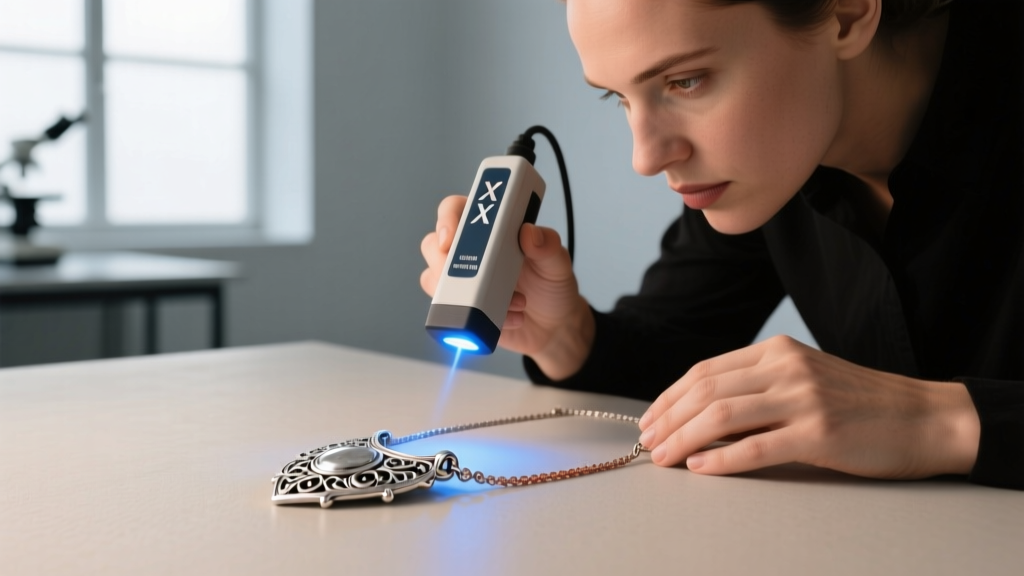
For absolute certainty, professional jewelers use XRF analyzers. These devices shoot X-rays into the metal and measure the fluorescent energy emitted back, providing an exact elemental breakdown to the hundredth of a percent. An XRF test will instantly reveal if a necklace is solid 925, heavily plated brass, or an advanced alloy like Argentium. While XRF machines are too expensive for consumer purchase, most reputable local jewelers will perform this test for a nominal fee or free of charge when verifying a piece for repair or appraisal.
3. The Magnet Test (First-Line Defense)
While not definitive proof of authenticity, the magnet test is a vital first step. Silver and copper are paramagnetic, meaning they exhibit no measurable attraction to a magnet. If your 925 necklace clings to a neodymium magnet, it contains a ferromagnetic core (like iron or steel) and is unequivocally a counterfeit. However, passing the magnet test does not guarantee authenticity, as non-magnetic base metals like brass and copper are frequently used in high-quality fakes.
Conclusion: Engineering Your Jewelry Wardrobe
Understanding the technical realities of a 925 necklace transforms you from a passive consumer into an informed collector. By recognizing the mechanical necessity of the 7.5% alloy, understanding the chemical mechanics of tarnish, and knowing how to verify the metallurgical integrity of your pieces, you can make purchasing decisions that prioritize longevity, material science, and genuine value. Whether you opt for traditional rhodium-plated sterling, advanced Argentium alloys, or heavy-gauge un-plated chains, the science of silver remains a fascinating intersection of geology, chemistry, and artisan craftsmanship.


