Is an Acrylic Necklace Holder Worth It? A Value & Budget Guide
We assess the true value of an acrylic necklace holder, comparing cast vs. extruded plastics, pricing tiers, and long-term jewelry safety.

The Hidden Costs of Cheap Jewelry Storage
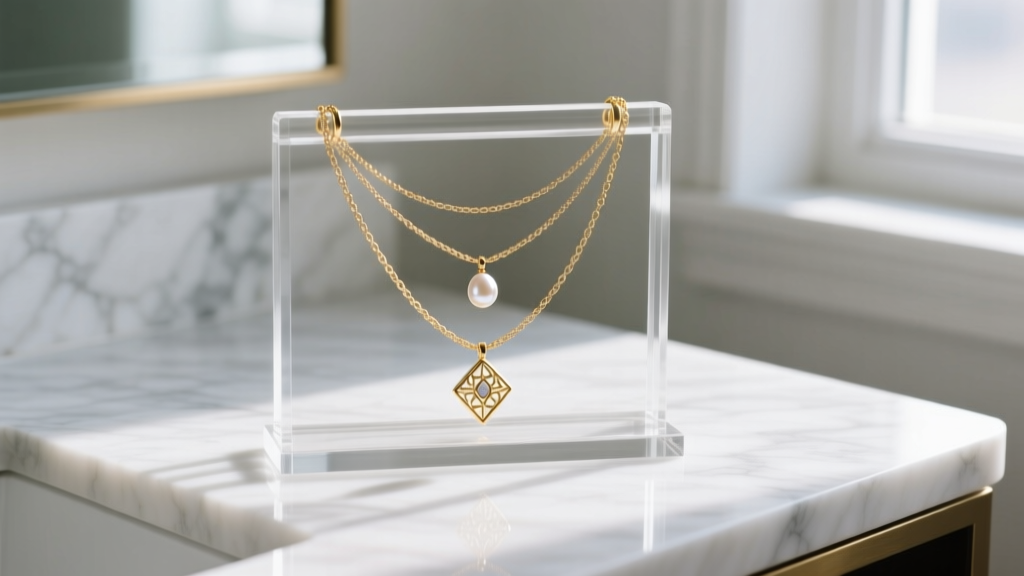
If you own more than three necklaces, you have likely experienced the frustration of tangled chains. The modern market is flooded with organizational solutions, but the clear acrylic necklace holder has emerged as a dominant favorite for its minimalist aesthetic and space-saving design. However, when evaluating jewelry storage from a strict budget and value assessment perspective, the initial price tag is only a fraction of the equation. True value must account for material longevity, structural integrity, and most importantly, the chemical safety of the plastic in direct contact with your precious metals and gemstones.
While a $6 acrylic stand might seem like a bargain compared to a $45 velvet-lined mahogany box, the wrong type of plastic can actively degrade your jewelry over time. In this comprehensive guide, we break down the material science, structural limits, and true cost-per-year of acrylic necklace organizers to help you make an informed, value-driven purchasing decision.
Cast vs. Extruded Acrylic: The Material Breakdown
Not all clear plastics are created equal. The term "acrylic" is frequently misused by e-commerce sellers to describe various transparent polymers. True acrylic is Polymethyl Methacrylate (PMMA). Within the PMMA family, there are two distinct manufacturing processes that drastically affect the value and lifespan of your necklace holder:
- Extruded Acrylic: Created by pushing liquid plastic through a die. It is cheaper to produce, softer, and highly susceptible to micro-scratching. More critically, extruded acrylic carries internal manufacturing stresses, making it prone to spontaneous stress-cracking at the base of the hooks where the weight of the necklace concentrates.
- Cell-Cast Acrylic: Poured into molds and cured slowly. This process creates a denser, harder, and more chemically stable material. Cast acrylic is optically clearer, resists UV yellowing, and can be polished to remove scratches, making it a superior long-term investment.
When assessing value, a cast acrylic holder priced at $25 offers significantly better ROI than an extruded holder at $10, as the cast version will not require replacement due to cracking or severe yellowing within a single year.
Pricing Tiers: What You Actually Get for Your Money
To accurately assess the budget landscape, we have categorized the current market offerings into three distinct tiers based on material grade, manufacturing quality, and hardware.
| Tier | Price Range | Material & Build | Expected Lifespan | Best Use Case |
|---|---|---|---|---|
| Budget | $5 - $12 | Extruded PMMA or PVC; glued joints | 1 - 2 Years | Lightweight fashion jewelry, temporary display |
| Mid-Range | $15 - $28 | Cell-Cast PMMA; interlocking laser-cut slots | 3 - 5 Years | Everyday gold/silver chains, moderate pendants |
| Premium | $30 - $65 | Museum-Grade Cast Acrylic w/ UV inhibitors; solvent-welded | 10+ Years | Fine jewelry, heavy gemstone pendants, archival storage |
The mid-range tier represents the "sweet spot" for most consumers. By spending roughly $20, you transition from glued joints—which fail when exposed to ambient humidity and temperature fluctuations—to precision laser-cut interlocking slots that require no adhesives and maintain structural rigidity indefinitely.
Long-Term Value: Chemical Safety and Off-Gassing
The most critical, yet frequently overlooked, aspect of jewelry storage value is chemical inertness. According to guidelines from the American Institute for Conservation (AIC), certain plastics off-gas volatile organic compounds (VOCs) as they degrade.
Many ultra-cheap "acrylic" necklace holders sold on mass-market platforms are actually manufactured from Polyvinyl Chloride (PVC) or low-grade PETG. As PVC degrades, it releases trace amounts of hydrochloric acid. In an enclosed space, or even in close proximity over several months, this acidic off-gassing will accelerate the tarnishing of sterling silver and can cause irreversible pitting on copper alloys and low-karat gold.
Expert Insight: True PMMA (acrylic) is chemically inert and considered archival-safe by museum conservators. It will not off-gas acidic compounds that harm precious metals. Always verify that the product description explicitly states "PMMA" or "cast acrylic" rather than just "clear plastic."
For long-term preservation of fine jewelry, the Gemological Institute of America (GIA) recommends storing pieces in environments free from corrosive chemicals and excessive humidity. A high-quality cast acrylic holder fulfills the chemical safety requirement perfectly, provided it is kept in a climate-controlled room rather than a humid bathroom.
Weight Capacity and Structural Failure Modes
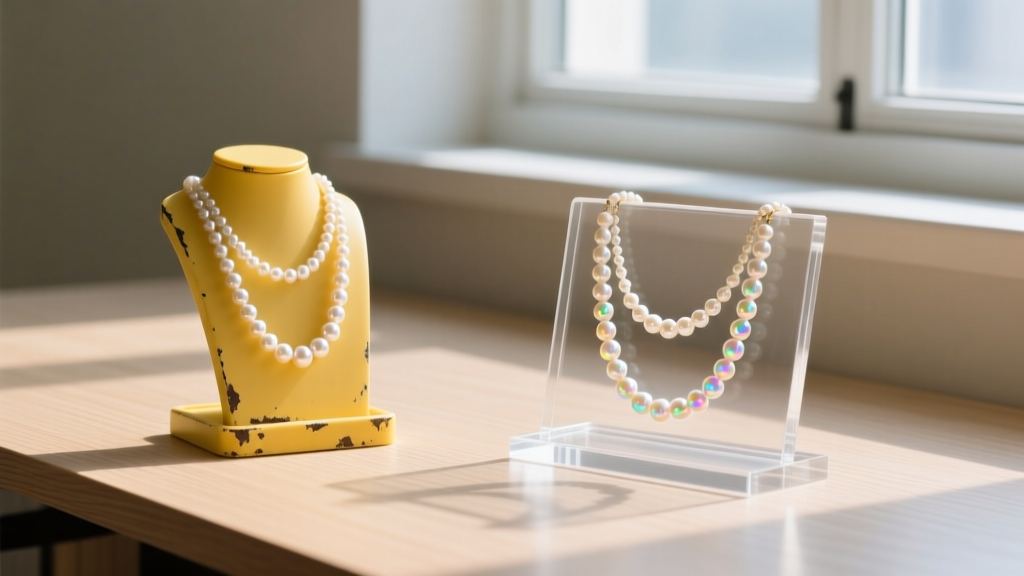
A common failure point in budget acrylic necklace holders is hook deformation. Acrylic exhibits "creep"—a tendency to slowly deform under constant mechanical stress. If you hang a heavy solid gold chain or a pendant featuring a large, dense gemstone (like a 50-carat smoky quartz or a heavy cabochon), the continuous downward force will eventually cause the acrylic hook to bend outward or snap.
Here are the practical weight limits based on acrylic thickness:
- 2mm - 3mm Hooks (Budget Tier): Maximum safe load of 80 grams. Suitable for delicate chains, pearls, and lightweight pendants.
- 4mm - 5mm Hooks (Mid to Premium Tier): Maximum safe load of 250 grams. Capable of supporting heavy link chains, multiple layered necklaces on a single hook, and substantial gemstone pendants.
When assessing value, check the thickness specifications. A holder that uses 5mm acrylic for the hooks and an 8mm base plate will resist tipping and hook deformation, justifying a higher upfront cost by eliminating the risk of your jewelry falling onto a hard floor.
Maintenance: Dealing with Micro-Scratches and Dust
Acrylic is highly susceptible to static electricity, making it a magnet for household dust. Furthermore, wiping an acrylic holder with a standard paper towel will introduce thousands of micro-scratches, as paper towels contain wood pulp fibers that are harder than the plastic surface. Over time, this cloudiness degrades the aesthetic value of the organizer.
To maintain the optical clarity and justify your investment, you must factor in the cost of proper maintenance. The industry standard for acrylic care is the Novus Plastic Polish system. Using Novus #1 (Clean & Shine) with a microfiber cloth safely removes dust without scratching. If your holder does accumulate minor scratches, Novus #2 (Fine Scratch Remover) can buff the cast acrylic back to a factory-clear finish. This restorability is a unique value proposition of cast acrylic that extruded plastics and glass cannot match.
Final Verdict: Budgeting for the Right Acrylic Holder
Is an acrylic necklace holder worth the investment? The answer depends entirely on the grade of acrylic you choose. If you are storing inexpensive fashion jewelry, a $10 extruded acrylic stand provides adequate short-term utility. However, if you are storing fine jewelry, sterling silver, or heavy pendants, the budget option becomes a liability due to structural creep and potential chemical off-gassing from mislabeled plastics.
For the best long-term value, allocate $20 to $35 for a cell-cast PMMA holder featuring laser-cut interlocking joints and a minimum hook thickness of 4mm. By prioritizing material integrity and archival safety over the absolute lowest price, you secure a functional, elegant display that protects your jewelry collection for a decade or more. For further guidance on protecting your precious metals, consult the Jewelers of America care guidelines to ensure your storage environment complements your cleaning routine.


