Preventing The Affair Of The Necklace: Heirloom Diamond Care
Discover how to preserve high-carat heirlooms and avoid a jewelry tragedy. Expert cleaning, prong maintenance, and storage tips for complex diamond necklaces.

The Historical Hook: Why 'The Affair of the Necklace' Matters Today
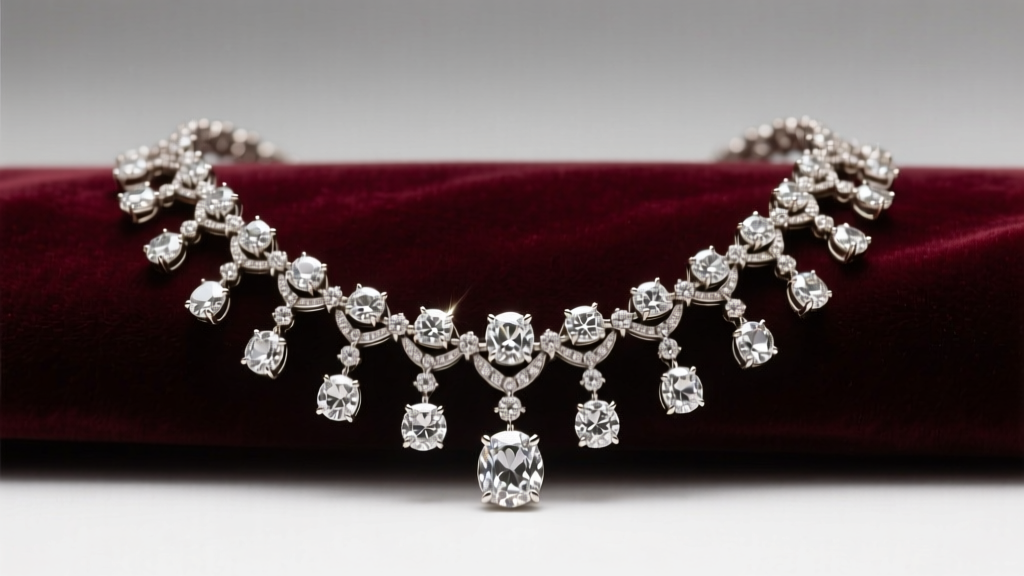
In 1785, 'the affair of the necklace' scandalized France and helped precipitate the French Revolution. At the center of the intrigue was a staggering 647-diamond festoon necklace, originally commissioned for Madame du Barry and later falsely attributed to Marie Antoinette. The piece was ultimately dismantled, its stones scattered and lost to history. While modern jewelry owners are unlikely to trigger a geopolitical crisis, the underlying lesson remains profoundly relevant: complex, high-carat diamond necklaces are inherently fragile ecosystems. Without meticulous care, maintenance, and security, a priceless heirloom can easily suffer its own tragic 'affair,' resulting in lost stones, degraded settings, and irreversible financial damage.
Preserving a multi-strand, bib, or festoon diamond necklace requires moving beyond basic jewelry care. It demands an understanding of metallurgical fatigue, gemological vulnerabilities, and environmental threats. This guide provides a master jeweler’s protocol for maintaining the structural integrity and brilliance of high-stakes diamond necklaces.
Anatomy of a High-Stakes Necklace: Where Failures Occur
A complex diamond necklace is only as strong as its weakest prong. In a piece featuring hundreds of stones, the statistical probability of a setting failure increases exponentially if routine maintenance is ignored.
Prong Wear and Tear in Multi-Carat Settings
The most common point of failure in heirloom necklaces is the prong. Over decades of wear, 0.8mm platinum or 18k gold prongs experience friction against clothing, skin, and other jewelry. This friction slowly wears the metal down, reducing the 'bearing'—the tiny groove cut into the prong that secures the diamond's girdle. Furthermore, antique pieces often feature Old European or Mine Cut diamonds, which have larger culets and thinner girdles, requiring highly specialized V-prongs or custom-fitted bezels to prevent chipping.
Chain Link Fatigue and Articulated Joints
Festoon and lariat necklaces rely on articulated joints—tiny interlocking rings that allow the piece to drape fluidly. According to the American Institute for Conservation, metal fatigue in these micro-joints is a silent killer of antique jewelry. Repeated bending causes work-hardening, eventually leading to microscopic fractures that snap without warning, often dropping the central pendant or diamond motif.
The Master Jeweler’s Cleaning Protocol for Complex Pieces
While ultrasonic cleaners are a staple in modern jewelry care, they are exceptionally dangerous for complex, antique, or multi-stone necklaces. The high-frequency vibrations (typically 40 kHz) can easily shake a fatigued prong loose, sending a diamond into the bottom of the tank. More critically, if any diamond in the necklace has undergone Yehuda fracture-filling treatment, the ultrasonic waves and heat can melt the glass-like filler, permanently clouding the stone.
The Safe Soak and Brush Method
To safely clean an intricate diamond necklace without risking structural compromise, follow this professional manual protocol:
- The Solution: Mix warm distilled water with a few drops of neutral pH, ammonia-free dish soap (such as original Dawn). Avoid harsh detergents that can leave a film on platinum.
- The Soak: Submerge the necklace for exactly 15 minutes. This softens sebum and cosmetic buildup trapped beneath the pavilion of the diamonds.
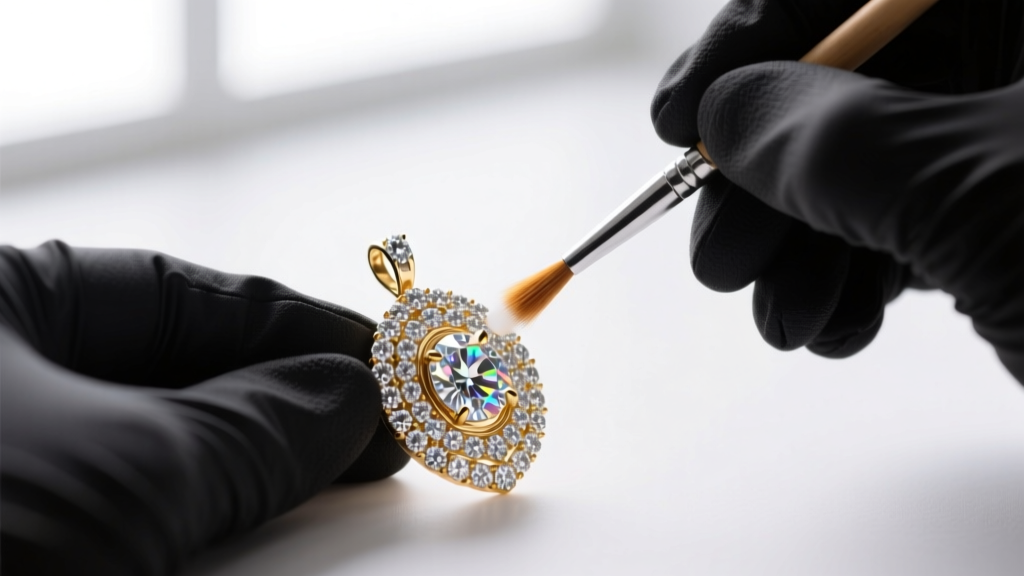
- The Agitation: Use a specialized 0.05mm nylon bristle brush (or a brand-new, ultra-soft baby toothbrush). Gently sweep the bristles across the table of the diamonds and carefully work them under the settings to dislodge debris.
- The Rinse: Rinse under a gentle stream of lukewarm distilled water. Never rinse over an open drain; always use a plugged basin or a fine-mesh strainer.
- The Dry: Pat dry with a lint-free microfiber cloth and use a specialized jewelry air-blower to remove water spots from beneath the settings.
Environmental Controls and Storage Strategies
How you store a complex necklace is just as critical as how you clean it. Tossing a multi-strand diamond piece into a communal jewelry box guarantees tangled chains, scratched metals, and stressed clasps.
| Environmental Threat | Impact on Heirloom Necklaces | Preservation Solution |
|---|---|---|
| Ambient Humidity | Promotes tarnish on silver alloys and degrades silk threading in pearl/diamond hybrids. | Store with silica gel desiccant packets in a climate-controlled safe (40-50% RH). |
| Sulfur & Airborne Pollutants | Causes rapid blackening of sterling silver and copper alloys in lower-karat gold. | Use 3M anti-tarnish strips inside individual sealed polyethylene bags. |
| Chlorine Exposure | Triggers stress corrosion cracking in 18k gold prongs, leading to sudden stone loss. | Never wear heirloom necklaces in pools; store away from household cleaning chemicals. |
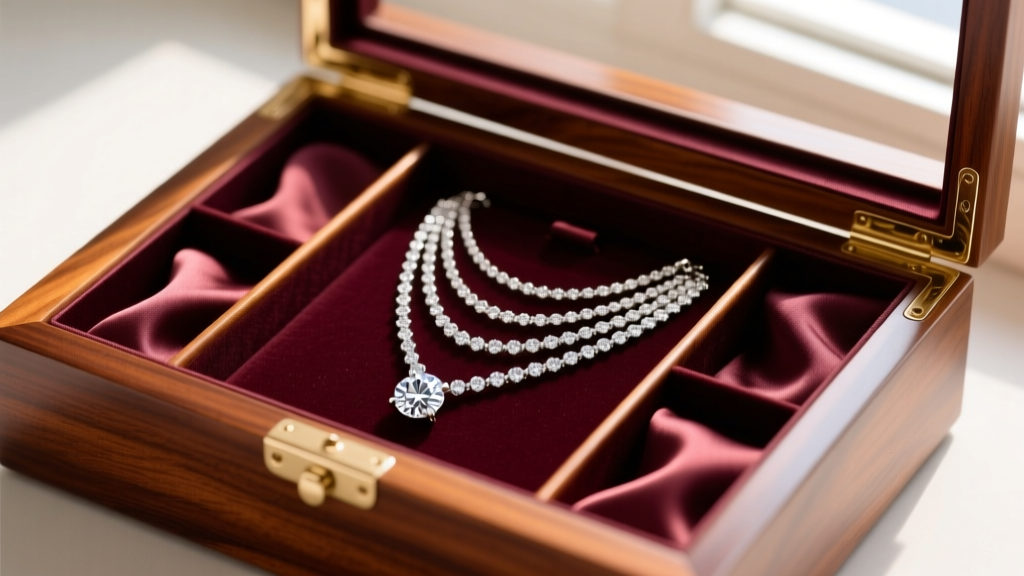
| Gravity & Tangling | Stretches delicate chain links and warps the structural drape of festoon motifs. | Hang on padded, velvet-lined neck forms or lay perfectly flat in compartmentalized trays. |
Professional Maintenance Schedules: When to See a Gemologist
Even with meticulous home care, the Gemological Institute of America (GIA) recommends that high-value, complex necklaces undergo professional inspection at least twice a year. A master jeweler will use a 10x triplet loupe to inspect the structural integrity of every individual setting.
Laser Welding vs. Traditional Soldering
When a prong on an heirloom necklace requires re-tipping, the method of repair is crucial. Traditional torch soldering introduces massive heat to the piece, which can cause thermal shock to included diamonds or melt the antique enamel work often found on the reverse of Victorian and Edwardian pendants. Modern conservation relies on laser welding. Laser welders use pinpoint, high-energy light beams to fuse new platinum or gold wire to the worn prong in a fraction of a second, generating virtually no ambient heat and leaving the surrounding gemstones completely unharmed.
Clasp Mechanism Overhauls
The clasp is the single most critical security feature of any necklace. Over time, the internal springs of lobster clasps or the tension of fold-over safety clasps weaken. During a professional service, the jeweler should test the clasp's tension with a calibrated gauge and replace the internal mechanism or upgrade the entire clasp to a modern, double-locking safety box clasp to ensure the piece remains secure around the wearer's neck.
'The true value of an heirloom necklace is not just in its carat weight, but in its survival. Treating a complex diamond piece with the reverence of a museum artifact is the only way to ensure it outlives the next generation.'
Conclusion: Securing Your Legacy
The historical 'affair of the necklace' was born of deception and greed, resulting in the destruction of a masterpiece. Modern jewelry tragedies are born of negligence. By understanding the mechanical vulnerabilities of complex settings, abandoning dangerous ultrasonic cleaning methods, and committing to rigorous professional inspections, you ensure that your diamond necklace remains a source of pride rather than a cautionary tale. Treat your heirlooms with the expertise they demand, and they will continue to capture the light—and the imagination—for centuries to come.


