Expert Care and Cleaning for Your Alexis Kirk Necklace
Preserve your Alexis Kirk necklace with expert cleaning tips for gold vermeil, hand-painted enamel, and porous semi-precious stones.

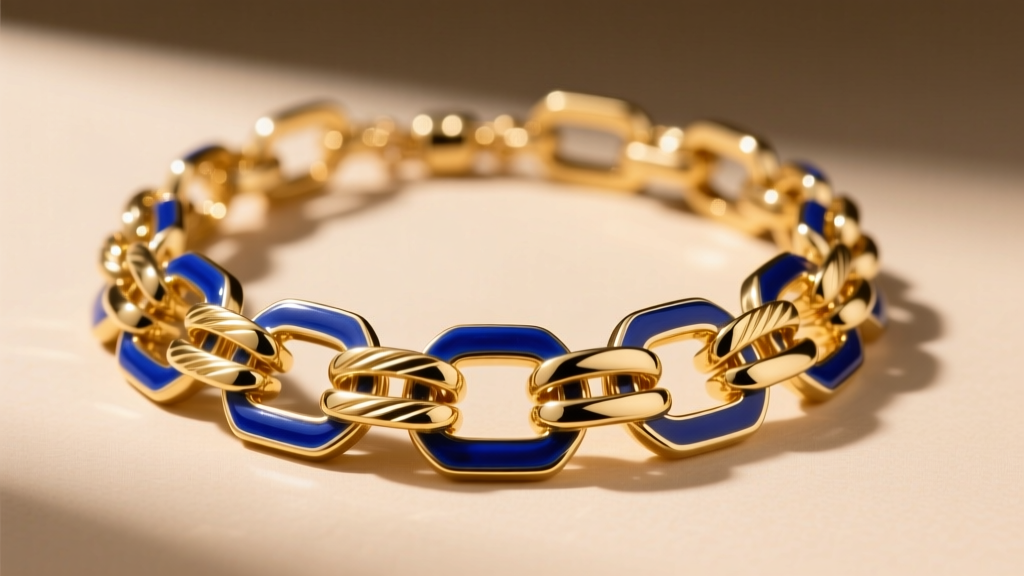
The Unique Anatomy of Alexis Kirk Necklaces
Alexis Kirk jewelry is celebrated for its bold, architectural designs and the masterful blending of disparate materials. Unlike standard solid gold or platinum fine jewelry, an Alexis Kirk necklace is typically a complex mixed-media construction. To properly care for these pieces, you must first understand the specific material grades and structural vulnerabilities inherent in their design. Standard jewelry cleaning methods that work for a simple diamond solitaire can permanently destroy the intricate finishes of a Kirk statement piece.
Material Breakdown and Vulnerabilities
- Gold Vermeil: According to the Federal Trade Commission Jewelry Guides, true vermeil must consist of a sterling silver base plated with at least 2.5 microns of 10k or higher gold. Alexis Kirk often utilizes thicker 22k gold plating for a richer, vintage-inspired hue. However, this soft, high-karat gold layer is highly susceptible to micro-abrasions and chemical stripping.
- Hand-Painted Enamel: Kirk frequently incorporates both vitreous (fused glass) and cold (epoxy-based) enamels. Vitreous enamel can chip upon impact with hard surfaces, while cold enamel can yellow when exposed to prolonged UV light or melt when exposed to high heat.
- Porous Semi-Precious Stones: Many Alexis Kirk designs feature carved turquoise, lapis lazuli, and agate. As noted by the Gemological Institute of America (GIA), turquoise ranks between 5 and 6 on the Mohs hardness scale and is highly porous, meaning it will absorb oils, perfumes, and harsh chemicals, leading to irreversible discoloration.
The Step-by-Step Cleaning Protocol
Because your necklace likely combines all three of the materials listed above, you cannot submerge the entire piece in a liquid bath. Instead, you must employ a targeted, multi-stage cleaning protocol that respects the most delicate component of the assembly.
Step 1: Dry Dusting and Debris Removal
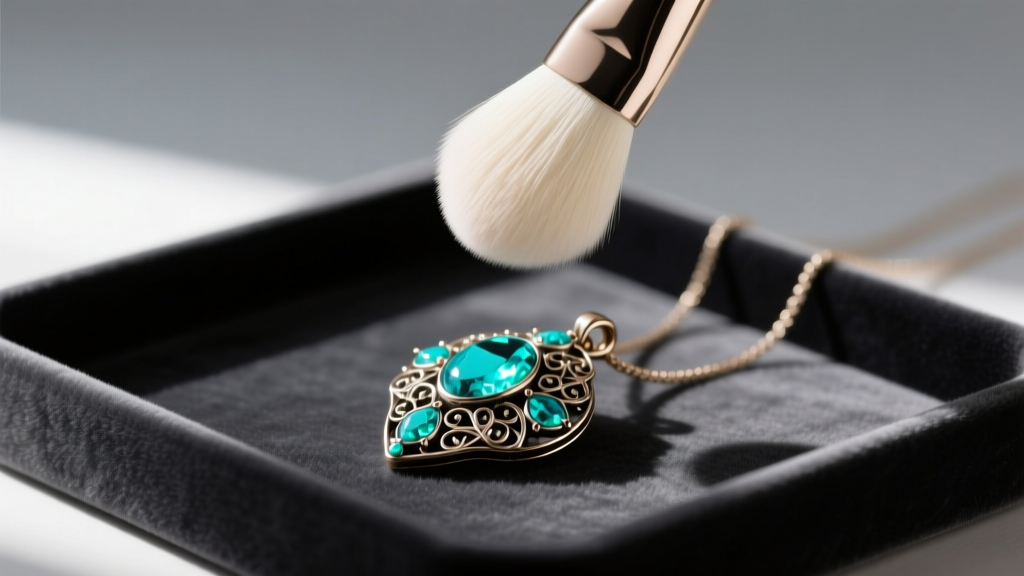
Before introducing any moisture, you must remove microscopic dust and skin cells. Dust particles often contain silica, which has a Mohs hardness of 7. If you wipe a dusty necklace with a cloth, you will drag silica across the 22k gold vermeil, creating permanent micro-scratches. Use a clean, soft-bristled makeup brush (like a goat-hair powder brush) to gently sweep out the crevices of the links and the bezels surrounding the stones.
Step 2: Targeted Spot Cleaning
For areas with visible oils or lotion buildup, prepare a specialized cleaning solution. Do not use tap water, as the chlorine and dissolved minerals can leave calcified deposits on the gold and dull the polish of carved agate. Instead, mix distilled water with two drops of a pH-neutral, phosphate-free surfactant (such as Dawn Free & Clear). Dip a cotton swab into the solution, squeeze out the excess so it is merely damp, and gently roll it over the soiled metal areas. Avoid touching the enamel or the porous stones with the swab.
Step 3: The Drying Process
Never rub a wet vermeil or enamel surface with a terry cloth towel. The loops in the fabric can catch on microscopic prongs or abrasive dust particles. Instead, use a can of compressed air, held at least six inches away to avoid propellant residue, to blow water out of the tight linkages. Follow this by gently patting the piece with a lint-free microfiber cloth.
Hazard Matrix: What to Avoid at All Costs
The most common way collectors ruin vintage and contemporary Alexis Kirk necklaces is by applying blanket cleaning methods to mixed-material pieces. Refer to the table below to understand how common cleaning agents interact with the specific materials in your necklace.
| Cleaning Agent / Method | Effect on Gold Vermeil | Effect on Enamel | Effect on Turquoise / Lapis |
|---|---|---|---|
| Ultrasonic Cleaners | Can cause plating to delaminate | High risk of shattering vitreous enamel | Cavitation will fracture porous stones |
| Silver Dip Solutions | Strips gold plating instantly | Causes chemical clouding | Acids dissolve calcite in lapis lazuli |
| Ammonia-Based Cleaners | Oxidizes the copper alloy in the gold | Can soften cold epoxy enamels | Alters the chemical color of turquoise |
| Steam Cleaners | Safe for the metal, but risky for joints | Thermal shock will crack enamel | Heat expands internal moisture, cracking stone |
Storage and Maintenance Framework
Proper storage is arguably more important than cleaning when it comes to preserving the structural integrity of a heavy Alexis Kirk statement necklace. The weight of the interlocking links can cause severe stress on the solder joints if stored improperly.
The Flat-Storage Rule
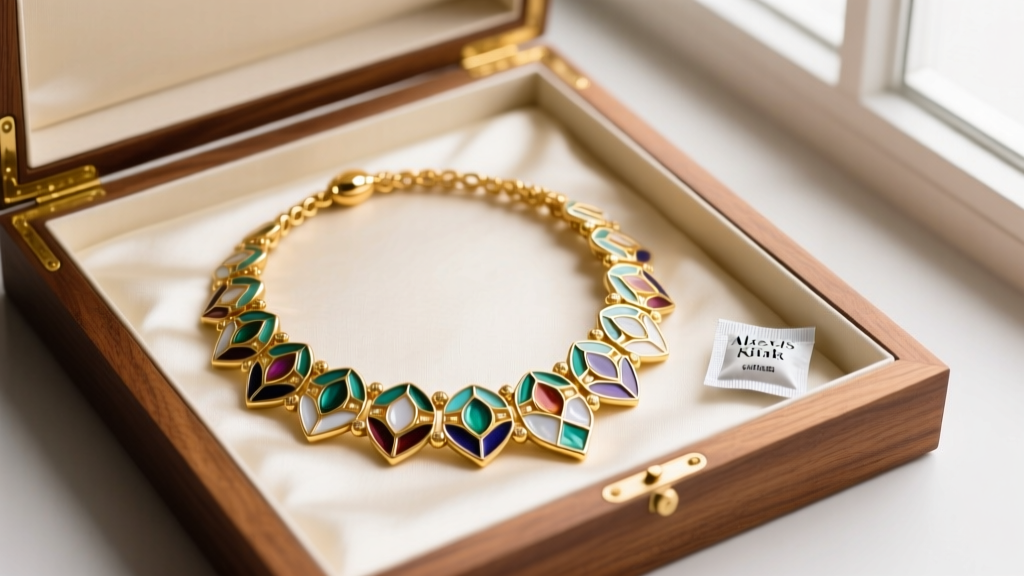
Never hang a heavy, multi-link Alexis Kirk collar or statement necklace on a standard jewelry hook. The constant downward pull of gravity will eventually stretch the metal, weaken the solder points, and cause the necklace to snap under its own weight. Always store these pieces flat in a lined, shallow wooden or archival plastic box.
Humidity and Tarnish Control
Because the base metal beneath the gold vermeil is sterling silver, it is prone to tarnishing when exposed to sulfur and humidity. Tarnish occurs when silver reacts with hydrogen sulfide in the air to form silver sulfide. To prevent this, store your necklace with 3M anti-tarnish strips, which actively absorb sulfur gases. Additionally, include a small silica gel desiccant packet in the storage box to maintain a relative humidity level below 40 percent, which is the threshold where silver oxidation accelerates rapidly.
Expert Insight: If you live in a coastal or highly humid environment, consider storing your Alexis Kirk pieces in a Pacific Silvercloth bag. These specialized bags are impregnated with microscopic silver particles that act as a sacrificial anode, tarnishing themselves so your jewelry remains pristine.
When to Seek Professional Restoration
While meticulous home care will preserve your necklace for decades, certain issues require the intervention of a master jeweler or a specialized jewelry conservator. If the gold vermeil begins to wear thin on the high-friction areas (such as the clasp or the center-front links), exposing the dark sterling silver beneath, do not attempt to polish it. Polishing will only remove more metal. Instead, consult a professional about re-plating the piece. Furthermore, if a piece of vitreous enamel chips or a carved stone becomes loose in its bezel, consult the GIA Gem Care Guide for recommendations on finding certified lapidaries and enamelists who specialize in mixed-media artisan jewelry. Never use commercial superglue to reseat a stone, as the cyanoacrylate will cloud the porous gem and create a brittle bond that fails under temperature changes.


