Expert Guide: Evaluating an Amethyst Diamond Necklace
Discover technical specs, grading metrics, and setting styles for an amethyst diamond necklace. Learn how to evaluate quality, pricing, and durability.

The Gemological Profile: Hardness Discrepancies and Pleochroism
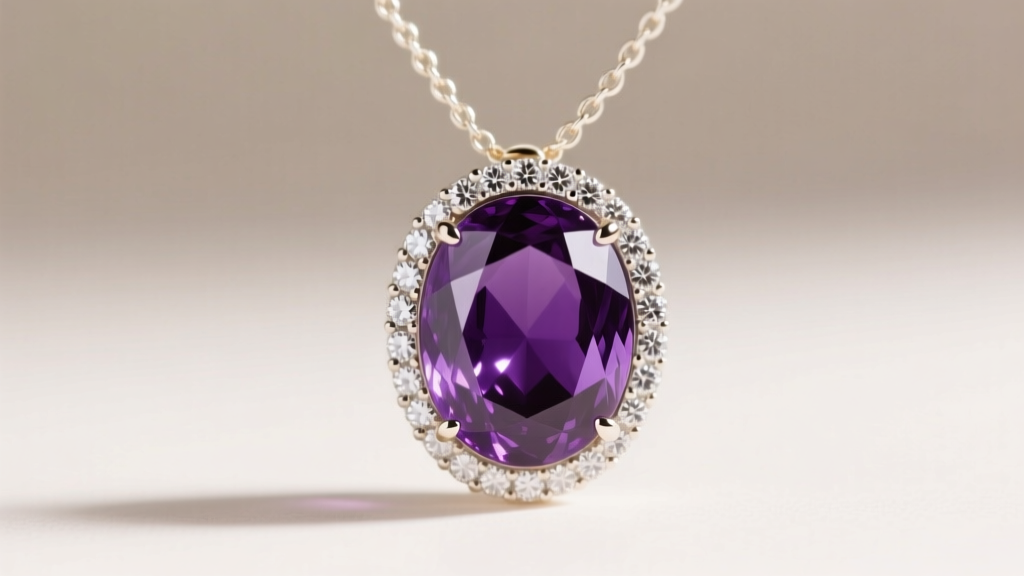
When evaluating an amethyst diamond necklace, the most critical technical consideration is the extreme hardness discrepancy between the two gemstones. On the Mohs scale of mineral hardness, diamond sits at an absolute 10, while amethyst—a macrocrystalline variety of quartz—registers at a 7. While a 7 is sufficiently durable for everyday pendant wear, it is highly susceptible to abrasion if it comes into direct, repeated friction with diamond melee. This hardness gap dictates the structural requirements of the setting, which we will explore in detail below.
Beyond hardness, a master gemologist evaluates the amethyst's pleochroism. Amethyst exhibits weak to strong pleochroism, meaning it displays different colors when viewed from different crystallographic axes. The cutter must orient the gemstone's table facet perpendicular to the c-axis to maximize the desirable purple and red hues while avoiding the "dead" yellow-green zones. If an amethyst appears muddy or washed out in a pendant setting, it is often due to poor rough orientation rather than low material quality.
Color Grading: Siberian vs. Uruguayan Origins
The value of the center stone in your necklace is heavily dictated by its color saturation and origin profile:
- Siberian Amethyst: The historical benchmark for luxury. It features a primary purple hue (75-80%) with secondary red and blue flashes (15-20%) under incandescent lighting. True Siberian material is rare and commands a premium.
- Uruguayan Amethyst: Known for its deep, saturated, and consistent purple tones. While slightly lacking the red flash of Siberian stones, high-grade Uruguayan amethyst offers incredible depth and is the most common choice for premium diamond halo pendants.
- Rose de France: A pale lilac variety. We generally advise against pairing this with bright diamond halos, as the high refractive index of the diamonds will visually wash out the pastel amethyst, making it appear nearly colorless in direct sunlight.
For authoritative grading metrics, always refer to the color saturation charts provided by the Gemological Institute of America (GIA).
Technical Setting Analysis: Mitigating the Hardness Gap
The most popular design for an amethyst diamond necklace is the halo setting, where a center amethyst is encircled by micro-pave diamonds. However, this design harbors a hidden structural risk if executed poorly.
The Danger of Flush Halos
If the diamond melee is set at the exact same girdle level as the amethyst, everyday micro-movements will cause the diamonds to act as a lapidary wheel against the softer quartz. Over 3 to 5 years, this will result in severe abrasion, frosting the amethyst's girdle and dulling its light return. To prevent this, expert jewelers utilize a tiered gallery or a bezel-bearing. The diamond halo must sit at least 0.5mm to 1.0mm higher than the amethyst's table, or the amethyst must be secured in a raised bezel that physically separates the two stones.
Prong Configurations and Culet Protection
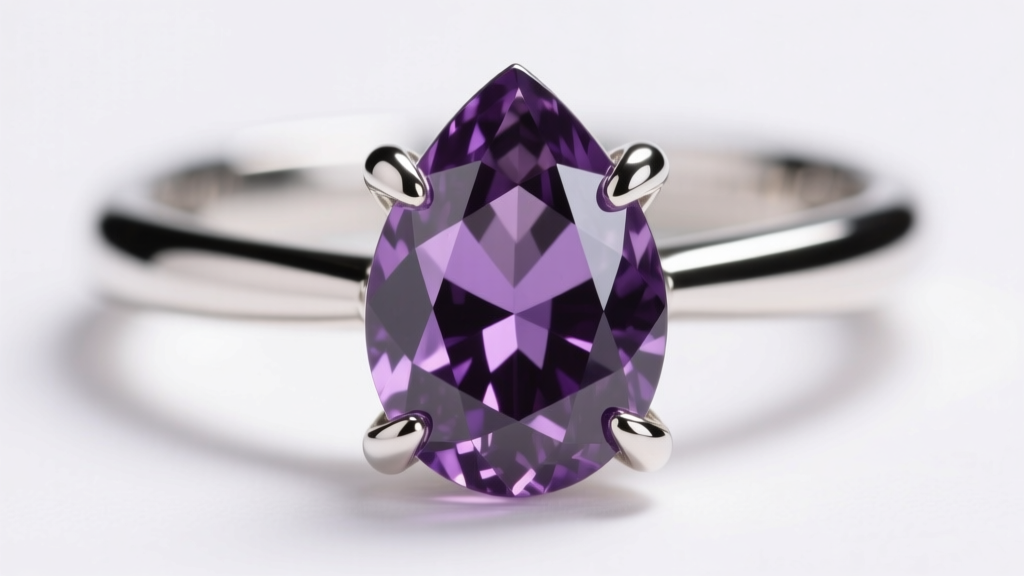
For pear, marquise, or trillion-cut amethysts, standard V-prongs are non-negotiable. The acute points of these shapes are highly vulnerable to chipping from minor impacts against doorframes or desks. A V-prong caps the point entirely in metal. Furthermore, the pendant's basket must feature a reinforced culet-bearing (a small metal pad at the base of the setting) to prevent the amethyst's culet from snapping under downward pressure.
Chain Metallurgy, Gauge, and Clasp Mechanics
A high-carat amethyst pendant surrounded by diamond melee can easily weigh between 8 and 18 grams. The chain supporting this dynamic load must be selected based on tensile strength, not just aesthetic delicacy.
| Metal Type | Recommended Gauge | Chain Style | Tensile Notes |
|---|---|---|---|
| 14k Yellow/White Gold | 1.0mm - 1.2mm | Cable or Box | Excellent durability; 14k alloy provides high rigidity and resists stretching under pendant weight. |
| 18k Yellow Gold | 1.2mm - 1.5mm | Wheat or Rope | Higher gold content (75%) makes the metal softer. Requires a thicker gauge to prevent link elongation over time. |
| Platinum (950) | 0.9mm - 1.1mm | Box or Curb | Extremely dense and strong. Even at 0.9mm, platinum offers superior tensile strength compared to 1.2mm 18k gold. |
Clasp Failure Points
Never pair a heavy amethyst diamond necklace with a standard spring-ring clasp. The internal spring mechanism in a spring ring is rated for roughly 3 to 5 pounds of tension before failing or popping open under dynamic movement. Always upgrade to a solid lobster clasp or a fold-over safety clasp, which can withstand upwards of 15 to 20 pounds of tensile force, ensuring your investment remains secure.
Market Valuation and Pricing Tiers (2026 Outlook)
As of 2026, the integration of CVD (Chemical Vapor Deposition) lab-grown diamond melee has significantly shifted the pricing structure of amethyst pendants. Jewelers can now allocate more of the manufacturing budget toward higher-grade, unheated center amethysts and heavier precious metal settings without inflating the retail price.
- Entry Tier ($400 - $900): Features heat-treated Uruguayan or Zambian amethyst (3-5 carats), set in 10k or 14k gold with commercial-grade (I-J, I1-I2) natural or lab-grown diamond melee. Chains are typically lightweight (under 1.0mm).
- Mid Tier ($900 - $2,500): Unheated, deeply saturated amethyst (5-10 carats) in 14k or 18k gold. The diamond halo consists of G-H color, VS clarity lab-grown diamonds with precision micro-pave setting. Includes a sturdy 1.2mm box chain.
- High Tier ($2,500 - $5,000+): Rare, unheated Siberian amethyst with distinct red pleochroic flashes. Set in 950 Platinum with a tiered gallery to protect the stone. Features D-E color, VVS clarity natural or premium lab-grown diamonds, finished with a custom fold-over clasp.
Advanced Care: Ultrasonic Risks and Inclusion Management
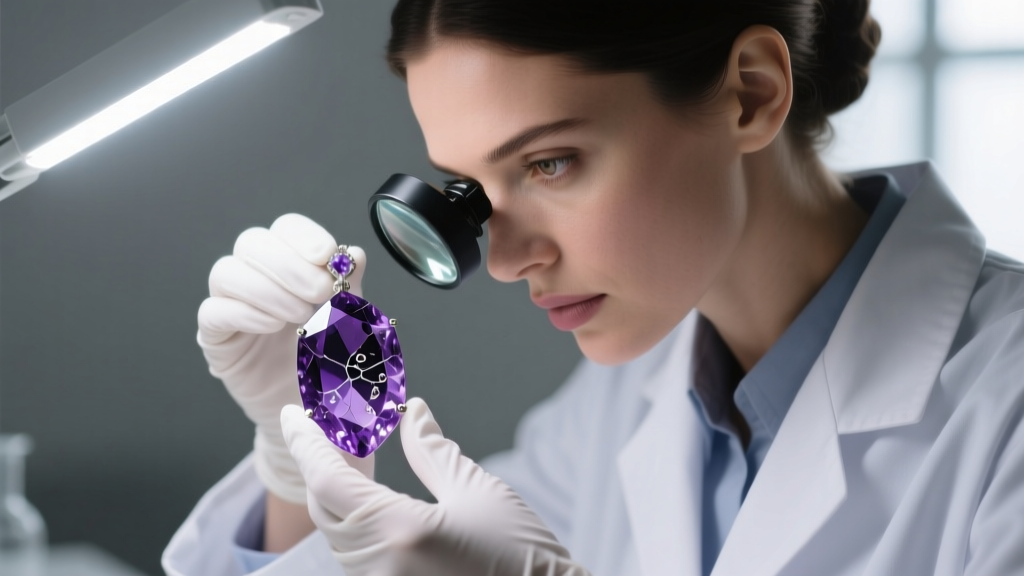
Proper maintenance of an amethyst diamond necklace requires understanding the internal anatomy of the quartz. Unlike diamonds, which are largely impervious to standard cleaning methods, amethyst frequently contains internal liquid inclusions.
The Ultrasonic Danger
Many amethysts contain two-phase or three-phase inclusions (pockets of liquid and gas trapped during crystal formation). When subjected to the high-frequency cavitation of an ultrasonic jewelry cleaner, the rapid temperature fluctuations and microscopic shockwaves can cause these fluid pockets to expand violently. This results in internal fracturing, commonly known as "feathering," which can completely destroy the structural integrity of the stone. Never place an amethyst pendant in an ultrasonic or steam cleaner.
Safe Cleaning Protocols
To maintain the brilliance of both the amethyst and the diamond halo without risking thermal shock or inclusion expansion, follow this protocol:
- Submerge the necklace in a bowl of lukewarm (never hot) water mixed with a few drops of mild, non-detergent dish soap.
- Allow it to soak for 10 to 15 minutes to loosen skin oils and cosmetic residue from the diamond pave.
- Gently agitate the setting using a soft-bristled baby toothbrush, paying special attention to the underside of the amethyst (the pavilion) where light-blocking grease accumulates.
- Rinse under a gentle stream of room-temperature distilled water and pat dry with a lint-free microfiber cloth.
For comprehensive maintenance guidelines, consult the GIA Amethyst Care Guide to ensure your gemstone retains its optical clarity for decades.


