Amethyst Teardrop Necklace: Stone Grades & Metal Settings
Discover how to choose an amethyst teardrop necklace by comparing stone origins, color grades, and metal settings for lasting durability and style.

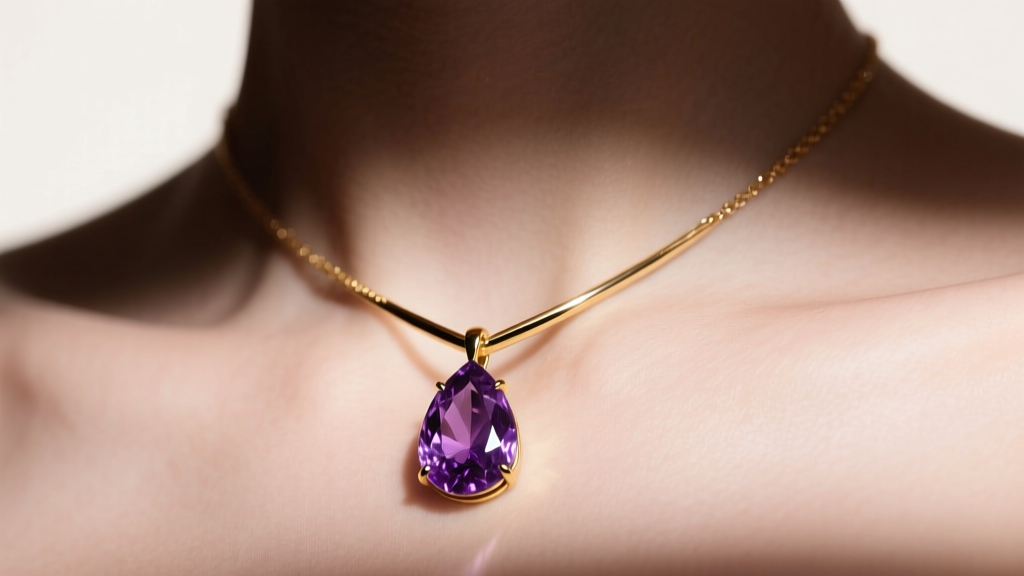
The Anatomy of an Amethyst Teardrop Necklace
The amethyst teardrop necklace remains a cornerstone of fine jewelry, combining the romantic silhouette of the pear cut with the regal depth of purple quartz. However, selecting the right piece requires looking beyond basic aesthetics. The teardrop (or pear) cut is notoriously difficult to execute perfectly in amethyst due to the stone's natural color zoning. When paired with the wrong metal setting or an inadequate chain gauge, even a high-quality gemstone can become a structural liability. This guide breaks down the exact material properties, gemological grades, and metallurgical specifications you need to evaluate before investing in an amethyst teardrop pendant.
Understanding Color Zoning and Gemological Origins
Amethyst is a variety of quartz (Mohs hardness 7) that owes its purple hue to iron impurities and natural irradiation. According to the Gemological Institute of America (GIA), the most prized amethyst exhibits a strong reddish-purple body color without visible color zoning. In a teardrop cut, color zoning is magnified. Because the pear shape tapers to a point, lapidaries must orient the rough crystal carefully; otherwise, the pendant will appear dark and inky at the tip while looking washed out at the rounded base.
- Siberian Grade: The highest tier, featuring deep purple tones with secondary red and blue flashes under incandescent light. Expect to pay $100 to $300 per carat for a well-cut 15x10mm teardrop.
- Uruguayan Grade: Known for a rich, saturated "grape" purple. It lacks the intense red flashes of Siberian stones but offers excellent consistency, typically pricing between $30 and $70 per carat.
- Brazilian Grade: Lighter, more pastel lavender tones. While beautiful, these stones often show severe color banding in pear cuts and are generally priced below $20 per carat.
When inspecting an amethyst teardrop necklace, look for the "bow-tie effect"—a dark shadow across the width of the stone caused by poor facet alignment. A precision-cut teardrop will reflect light evenly from the rounded lobe up to the tapered point.
Metal Setting Comparison: Silver vs. Gold vs. Platinum
The metal you choose dictates not only the visual contrast against the purple quartz but also the structural integrity of the setting. Amethyst is relatively hard, but a teardrop pendant is top-heavy and subjects the setting to continuous kinetic stress. Below is a technical comparison of the three primary metals used for amethyst pendants.
| Metal Grade | Vickers Hardness (HV) | Tarnish Resistance | Avg. Price Range (Setting Only) | Best For |
|---|---|---|---|---|
| 925 Sterling Silver | 60-70 HV | Low (Requires Rhodium Plating) | $50 - $150 | Budget-friendly, bezel settings |
| 14k Yellow/White Gold | 130-150 HV | High | $300 - $800 | Prong settings, daily wear |
| 18k Yellow Gold | 110-125 HV | High | $500 - $1,200 | Heirloom pieces, rich color contrast |
| 950 Platinum | 120-135 HV (Work-hardens) | Very High (Develops Patina) | $800 - $2,000+ | Heavy stones, maximum security |
While 18k gold offers a richer yellow hue that beautifully complements the reddish flashes of Siberian amethyst, its lower alloy content makes it softer than 14k gold. For a heavy teardrop pendant secured by prongs, 14k gold is metallurgically superior because its higher copper and zinc content provides better "springiness" and memory, keeping the prongs tightly gripped around the stone's girdle over years of wear.
Prong vs. Bezel: Securing the Vulnerable Tip
The tapered point of a teardrop amethyst is its most fragile anatomical feature. A sharp impact to the tip can cause a catastrophic cleavage fracture.
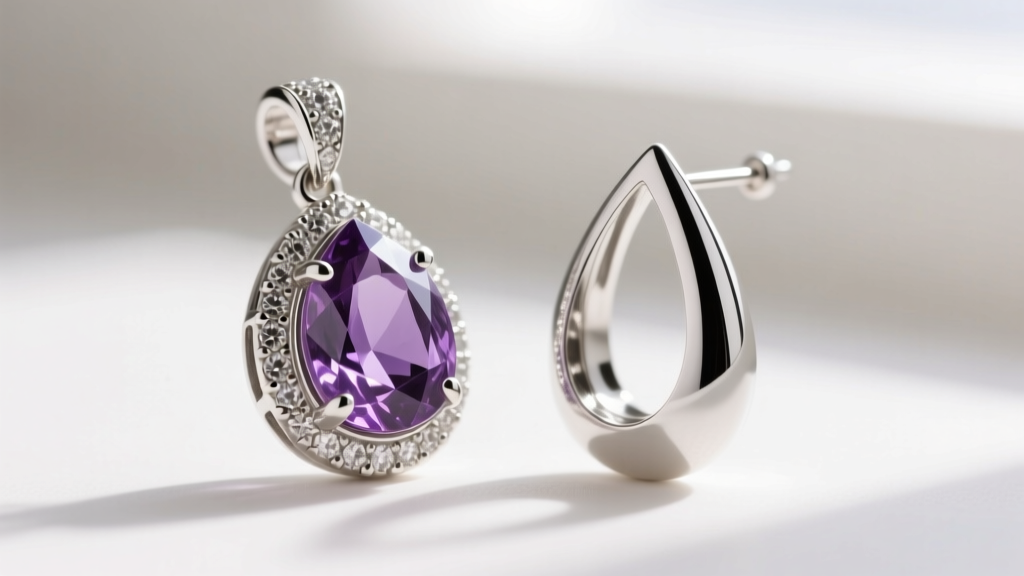
If you prefer a prong setting to maximize light entry, the setting must utilize a V-prong at the tapered tip. A standard rounded prong leaves the apex of the stone exposed. Conversely, a full bezel setting offers maximum protection and is highly recommended for 925 sterling silver, as the softer silver is more prone to bending and releasing the stone if struck.
Chain Gauge & Length Specifications for Pendants
A common failure mode in amethyst teardrop necklaces is chain snap or bail deformation. A 10-carat amethyst teardrop set in 14k gold can easily weigh between 12 and 18 grams. Suspending this weight on a delicate 0.8mm chain is a structural error.
Matching Chain Tensile Strength to Pendant Weight
Expert Rule of Thumb: Your chain's breaking strength should be at least five times the weight of the pendant to account for sudden kinetic shocks (e.g., the pendant catching on a sweater or being pulled).
- Box Chains (1.2mm - 1.5mm): Ideal for heavy teardrops. The interlocking square links distribute weight evenly and resist kinking. A 1.5mm 14k gold box chain can withstand over 25 lbs of tensile force.
- Cable Chains (1.5mm - 2.0mm): A classic choice, but ensure the jump rings are soldered shut. Unsoldered jump rings will pull apart under the pendulum motion of a heavy teardrop stone.
- Rope Chains (1.5mm+): Excellent tensile strength, but the twisted links can catch on the bail of the pendant, causing micro-abrasions to the metal over time.
For length, a 16-inch (choker) or 18-inch (princess) chain is optimal for a teardrop pendant. These lengths ensure the stone rests on the upper chest, allowing the teardrop to lay flat rather than flipping backward, which is a common issue with longer 24-inch chains.
Bail Mechanics and Weight Distribution
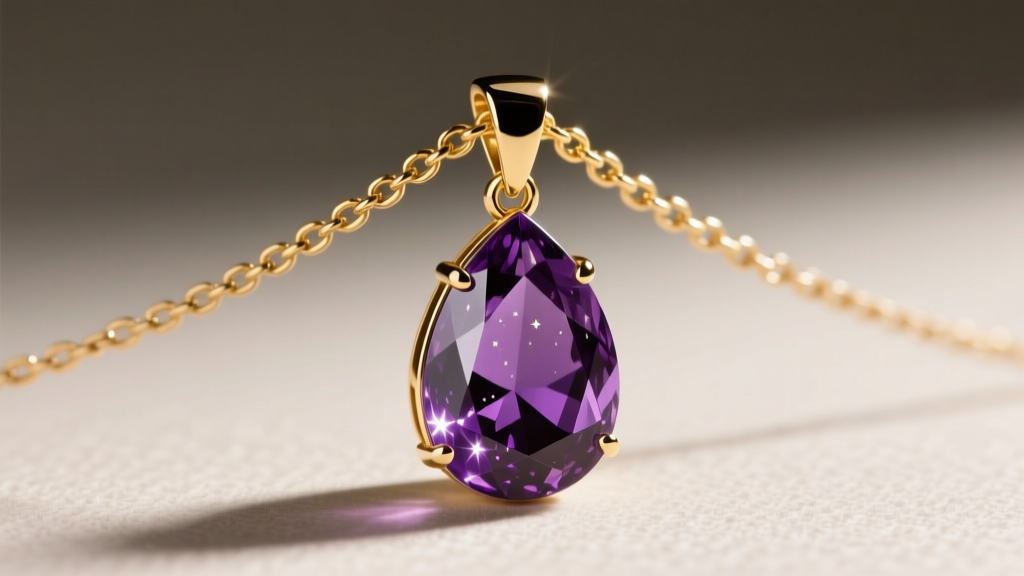
The bail—the loop that connects the pendant to the chain—is the primary stress point. For an amethyst teardrop necklace, avoid simple "glued-on" bails. The adhesive degrades over time due to skin oils and temperature fluctuations. Instead, look for a soldered gallery bail or a wrap bail where the metal physically wraps around the stone's setting head and is soldered at the base. A diamond-shaped or tapered bail also helps the teardrop hang perfectly plumb, preventing the chain from sliding through and causing the pendant to sit crookedly.
Care, Maintenance, and Common Failure Modes
Amethyst requires specific care protocols to maintain its optical properties and structural integrity. As noted by Jewelers of America, improper cleaning is the leading cause of preventable damage in quartz-family gemstones.
Preventing Color Fading and Thermal Shock
Amethyst is photosensitive and thermally reactive. Prolonged exposure to direct UV light (such as leaving the necklace on a sunny dashboard) can cause the purple hue to fade to a dull grayish-brown over several months. More critically, amethyst undergoes a permanent color change at temperatures exceeding 300°C to 400°C, turning into yellow citrine. While you won't encounter these temperatures in daily wear, this thermal sensitivity means you must never use steam cleaners or ultrasonic cleaners with heated solutions on your amethyst teardrop necklace. The rapid thermal expansion can also cause internal fluid inclusions to expand, fracturing the stone from the inside out.
Routine Cleaning Protocol
- Fill a bowl with lukewarm distilled water and a few drops of mild, phosphate-free dish soap.
- Submerge the necklace for 10 minutes to loosen sebum and cosmetic buildup from the pavilion facets.
- Gently scrub the back of the teardrop stone (the pavilion) with a soft-bristled baby toothbrush. The pavilion attracts the most oils, which dulls the stone's refractive brilliance.
- Rinse under cool running water and pat dry with a lint-free microfiber cloth.
- If using a silver setting, store the necklace in an anti-tarnish pouch with activated charcoal or silver-shield strips to prevent sulfur-induced blackening.
By understanding the interplay between the amethyst's gemological grade, the metallurgical properties of the setting, and the physics of the chain, you can select an amethyst teardrop necklace that is not only visually striking but engineered to last a lifetime.


