The Anatomy of Bold Statement Necklaces: Weight & Clasps
Discover the structural engineering behind bold statement necklaces. Explore weight distribution, clasp tensile strength, and metallurgy for heavy jewelry.

The Physics of Drape: Weight Distribution and Ergonomics
When discussing bold statement necklaces, most style guides focus on aesthetics, color theory, and neckline pairings. However, from a master jeweler's perspective, a true statement piece—typically defined as exceeding 80 grams in total mass—is an exercise in structural engineering and ergonomic physics. The primary challenge of high-mass jewelry is managing the center of gravity to prevent the 'choke effect,' where the weight of the central pendant pulls the chain taut against the wearer's cervical spine.
To mitigate this, expert fabricators utilize a technique known as counter-weighting. For a bold statement necklace featuring a 120-gram central pendant, a 15- to 20-gram 'balance tag' or counter-drop is integrated into the chain near the nape of the neck. This shifts the center of gravity backward, allowing the necklace to drape naturally across the clavicle and sternum. Furthermore, the optimal drop length for heavy pieces is between 20 and 24 inches. Anything shorter than 18 inches on a 150-gram necklace concentrates the kinetic load on the trapezius muscles, leading to rapid wearer fatigue and accelerated stress on the chain links.
Metallurgy and Material Grades for Heavy Pendants
The structural integrity of bold statement necklaces relies heavily on the Vickers Hardness (HV) and yield strength of the chosen alloys. While 22k and 24k gold offer rich color, their low HV (roughly 40-60 HV) makes them entirely unsuitable for the bails and jump rings that must support massive pendants. According to fabrication standards outlined by the Rio Grande metals guide, 14k yellow gold (alloyed with copper and silver) achieves an optimal hardness of approximately 130-140 HV, providing the necessary rigidity to resist deformation under heavy static loads.
The Platinum Advantage for High-Stress Components
For statement pieces incorporating heavy, tension-set gemstones or massive structural bails, Platinum 950 (alloyed with Ruthenium) is the industry gold standard. Unlike white gold, which possesses 'metal memory' and can slowly spring open under continuous tension, platinum exhibits a unique displacement property. When subjected to the sheer stress of a 200-gram pendant swinging, platinum prongs and bail loops will bend and displace rather than snap or fatigue. This makes it the premier choice for the critical connection points in high-mass jewelry.

Clasp Engineering: Securing High-Mass Necklaces
The clasp is the most common point of catastrophic failure in heavy jewelry. A standard spring-ring clasp, designed for delicate chains under 20 grams, relies on a tiny internal steel spring that will rapidly fatigue under the lateral torque of a bold statement necklace. Upgrading the clasp mechanism is not optional; it is a safety requirement.
Below is a technical breakdown of clasp types and their maximum recommended weight capacities for statement jewelry, based on tensile testing data frequently discussed at the Santa Fe Symposium on jewelry manufacturing:
| Clasp Mechanism | Max Recommended Mass | Primary Failure Mode | Structural Recommendation |
|---|---|---|---|
| Spring Ring | < 25g | Internal spring fatigue; hollow body crushing | Never use for statement pieces |
| Cast Lobster | 25g - 70g | Porosity fractures; internal lever snapping | Avoid for pieces over 50g |
| Forged/Machined Lobster | 70g - 150g | Clasp ring deformation under extreme torque | Use stamped/forged stainless or 14k gold |
| Toggle (Cast/Solid) | 80g - 250g | Bar slipping through ring (improper ratio) | Bar must be 1.5x the inner ring diameter |
| Neodymium Magnetic | 80g - 120g | Shear force sliding; sudden impact detachment | Must include a secondary mechanical safety catch |
For necklaces exceeding 150 grams, a heavy-duty forged lobster clasp paired with a reinforced figure-8 safety latch is mandatory. The figure-8 wire must be crafted from 1.2mm spring-hard wire to ensure it maintains tension over years of use.
Chain Gauge and Link Welding: Preventing Structural Failure
The chain supporting a bold statement necklace must be evaluated not just by its visual thickness, but by its wire gauge and welding methodology. Hollow electroformed chains, while visually massive and lightweight, are a structural trap. They dent easily upon impact and cannot be repaired or soldered if a link pulls apart under the weight of a heavy pendant.
Solid Wire Geometry and Laser Welding
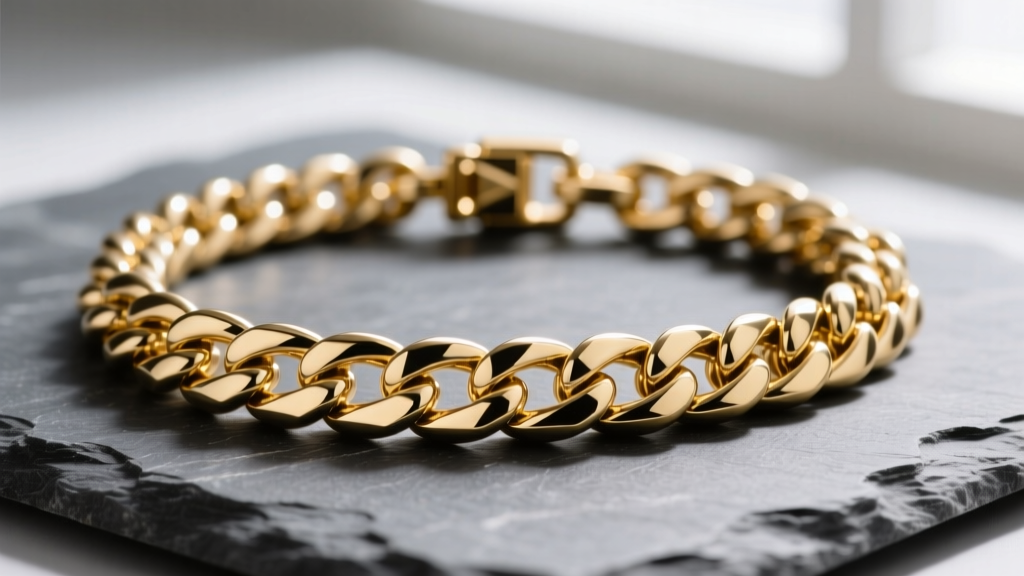
True statement chains—such as 8mm to 12mm Cuban or Curb links—must be cut from solid wire. The critical metric here is the link's aspect ratio and the welding technique used to close it. Traditional torch soldering requires heating the entire link, which anneals (softens) the surrounding work-hardened metal, creating a weak point. Modern master fabricators utilize GIA-recognized laser welding techniques. Laser welding concentrates thermal energy into a 0.5mm spot, fusing the link closed without altering the crystalline structure or tensile strength of the adjacent wire. This ensures that an 8mm solid 14k gold chain can safely support dynamic loads exceeding 20 kilograms without link separation.
Maintenance and Stress-Testing Your Statement Pieces
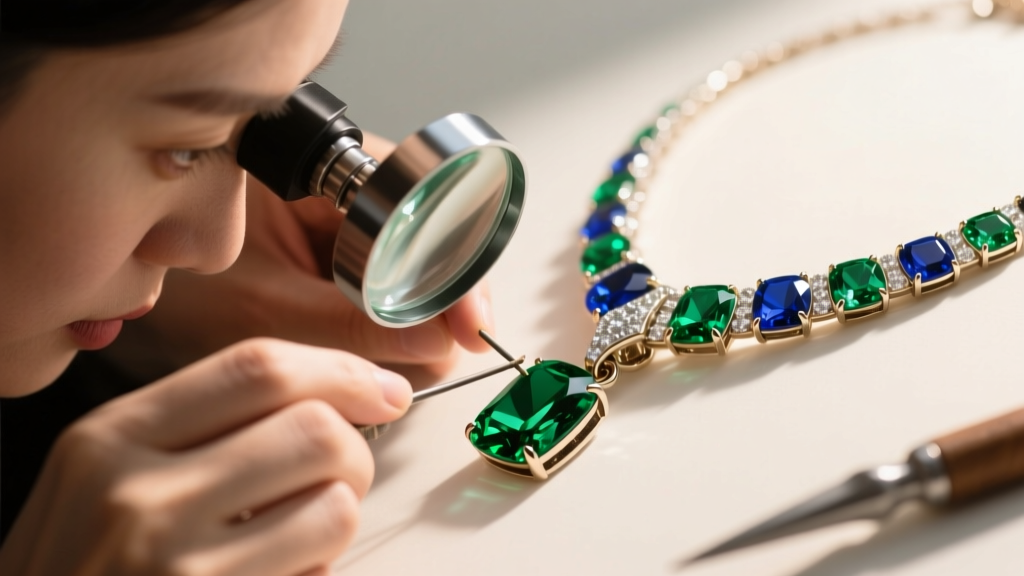
Owning bold statement necklaces requires a rigorous maintenance protocol. The sheer mass of these pieces means that every time the wearer moves, kinetic energy is transferred directly to the bail (the loop connecting the pendant to the chain). Over time, this creates a 'sawing' effect, where the chain slowly wears away the interior of the bail.
- Bail Inspection: Every six months, inspect the bail thickness. If the original 2.5mm wire has worn down to 1.5mm, the piece must be sent to a jeweler for a bail replacement before catastrophic failure occurs.
- Ultrasonic Risks: Never clean heavy, tension-set statement pieces in an ultrasonic cleaner. The high-frequency vibrations can compromise the structural grip of the prongs, especially if the metal has experienced micro-fractures from daily kinetic stress.
- Clasp Lubrication: For mechanical clasps on heavy pieces, a microscopic drop of synthetic watch oil applied to the hinge pin once a year will prevent metal-on-metal galling and ensure smooth operation.
By understanding the metallurgy, physics, and mechanical engineering that go into these magnificent pieces, collectors and wearers can ensure their bold statement necklaces remain both visually striking and structurally invincible for generations.


