The Anatomy of a Floating Diamond Solitaire Necklace: An Expert Guide
Discover the technical anatomy of a floating diamond solitaire necklace, from laser-drilled settings and chain gauges to diamond grading.

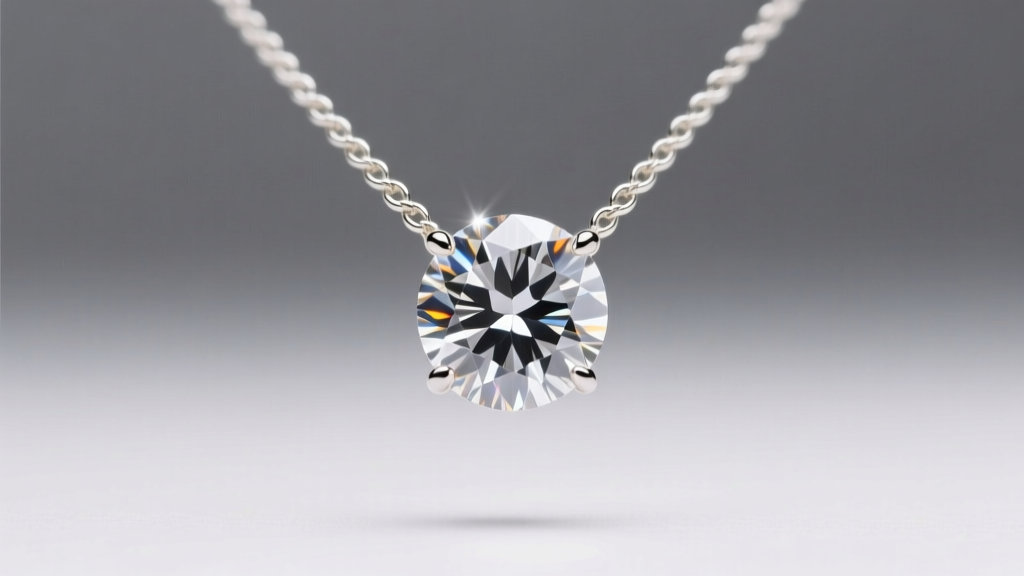
The Illusion of Suspension: Engineering the Float
The floating diamond solitaire necklace is a masterclass in minimalist jewelry design, creating the optical illusion that a brilliant gemstone is hovering weightlessly against the wearer's collarbone. However, achieving this ethereal look requires precise structural engineering. Unlike traditional pendants that rely on a metal bail, basket, or bezel to suspend the stone, a true floating solitaire utilizes either a horizontal laser-drilled channel through the diamond's girdle or a micro-tension setting with ultra-fine jump rings.
In the laser-drilling method, gemologists use an Nd:YAG laser to bore a microscopic channel—typically between 0.3mm and 0.5mm in diameter—directly through the stone's girdle. The chain is then threaded through this channel. While this eliminates the need for visible metal settings, it fundamentally alters the diamond's structural integrity. If the laser channel is not drilled perfectly parallel to the table, or if it intersects with a natural feather inclusion, it creates a critical fault line that can lead to catastrophic cleavage under stress.
Chain Metallurgy: Gauge, Tensile Strength, and Work-Hardening
The chain is the unsung hero of the floating diamond solitaire necklace. Because the chain must pass through a microscopic drill hole or attach to micro-jump rings, manufacturers are forced to use ultra-fine gauges, typically ranging from 0.40mm to 0.65mm. At these dimensions, the metallurgical properties of the alloy dictate the necklace's survival.
18-karat gold, while prized for its rich color and high purity, is inherently softer and more prone to work-hardening and stretching at sub-millimeter gauges. A 0.5mm 18k yellow gold box chain can lose its structural memory and permanently elongate within six months of daily wear. Conversely, 14k white gold offers a superior tensile yield point due to its alloy composition (often mixed with nickel or palladium), making it the industry standard for floating settings. Platinum, despite its premium status, is highly malleable and can snap abruptly without warning when drawn into a 0.5mm wire and subjected to sudden tensile shocks.
| Chain Material | Gauge (mm) | Approx. Tensile Yield | Max Recommended Carat |
|---|---|---|---|
| 14k White Gold | 0.50mm | ~3.5 lbs (1.58 kg) | 0.75ct |
| 18k Yellow Gold | 0.50mm | ~2.2 lbs (1.00 kg) | 0.50ct |
| Platinum (950) | 0.60mm | ~4.0 lbs (1.81 kg) | 1.00ct |
| 14k Rose Gold | 0.50mm | ~3.0 lbs (1.36 kg) | 0.65ct |
Gemological Requirements: Grading for Naked Diamonds
When a diamond is set in a traditional 4-prong or 6-prong basket, the metal reflects light back into the pavilion, masking light leakage and hiding minor inclusions. A floating diamond solitaire necklace offers no such forgiveness. The stone is entirely 'naked,' meaning light enters and exits from all angles, and the unobstructed pavilion is fully visible to the observer.
According to GIA cut grading guidelines, a floating diamond must possess an 'Excellent' or 'Ideal' cut grade, preferably with Hearts and Arrows symmetry. If the proportions are off, the lack of a reflective metal basket will result in a dark, lifeless center. Furthermore, GIA clarity grading standards dictate that SI1 or SI2 diamonds are entirely unsuitable for floating settings. The exposed pavilion makes carbon spots and structural feathers glaringly obvious. Experts mandate a minimum clarity of VS2, with VS1 or VVS2 being optimal. Color grading should also be restricted to the D-F (colorless) range, as the naked girdle and pavilion will readily display the yellow or brown tints found in G-J near-colorless stones when suspended against the skin.

Common Failure Modes and Preventative Maintenance
Despite their beauty, floating diamond necklaces are highly susceptible to specific mechanical failures. Understanding these failure modes is critical for both jewelers and consumers.
- The Pendulum Effect: As the wearer moves, the diamond slides back and forth along the chain. Over time, the sharp interior edge of the laser-drilled channel acts like a microscopic saw against the metal chain, eventually fraying and snapping the links at the point of contact.
- Snagging and Tensile Spikes: Ultra-fine 0.5mm chains can withstand steady, static weight, but they fail catastrophically under dynamic shock. Snagging the diamond on a knit sweater or towel creates a sudden tensile spike that exceeds the chain's yield strength, usually resulting in a break at the solder point near the clasp.
- Clasp Incompatibility: Standard spring-ring clasps are prone to internal spring failure and accidental depression. A floating solitaire must always be fitted with a high-quality lobster clasp or a magnetic neodymium safety clasp to prevent accidental unfastening.
Expert Maintenance Protocol: To mitigate the pendulum effect, jewelers should apply a microscopic drop of UV-curing optical resin inside the laser channel after threading the chain. This cushions the metal against the diamond's girdle, preventing friction wear without compromising the floating illusion.
Pricing Framework: What You Should Actually Pay
The pricing of a floating diamond solitaire necklace is heavily weighted toward the diamond itself, as the labor required for laser drilling and the cost of the ultra-fine chain are relatively marginal in the grand scheme of fine jewelry manufacturing. Based on current 2026 market data and Stuller jewelry manufacturing benchmarks, here is a realistic pricing framework for a high-quality, laser-drilled floating solitaire on a 16-inch 14k white gold chain:
- 0.30ct (F Color, VS1 Clarity, Ideal Cut): $850 – $1,100
- 0.50ct (F Color, VS1 Clarity, Ideal Cut): $1,600 – $2,200
- 0.75ct (E Color, VVS2 Clarity, Ideal Cut): $2,800 – $3,600
- 1.00ct (D Color, VVS1 Clarity, Hearts & Arrows): $5,500 – $7,500
Consumers should be highly suspicious of floating solitaires priced significantly below these thresholds, as they almost certainly utilize poorly cut diamonds with visible inclusions, or rely on fragile, mass-produced base-metal chains that pose a severe risk of gemstone loss.
Final Verdict: Is the Floating Trend Right for Daily Wear?
The floating diamond solitaire necklace is an unparalleled choice for evening wear, minimalist office styling, and layering. However, from a purely technical standpoint, it is not a 'sleep, shower, and sweat' piece of jewelry. The inherent vulnerabilities of sub-millimeter chains and exposed girdles require a wearer who is mindful of their environment. By selecting a 14k white gold chain, insisting on a VS1+ clarity grade, and committing to bi-annual professional inspections of the drill channel integrity, you can safely enjoy the breathtaking illusion of a floating diamond for decades.


