Technical Guide to Buying a Handcrafted Glass Starfish Necklace
Discover the technical details behind artisan glass starfish necklaces, from borosilicate durability and annealing to chain gauge matching and pricing.

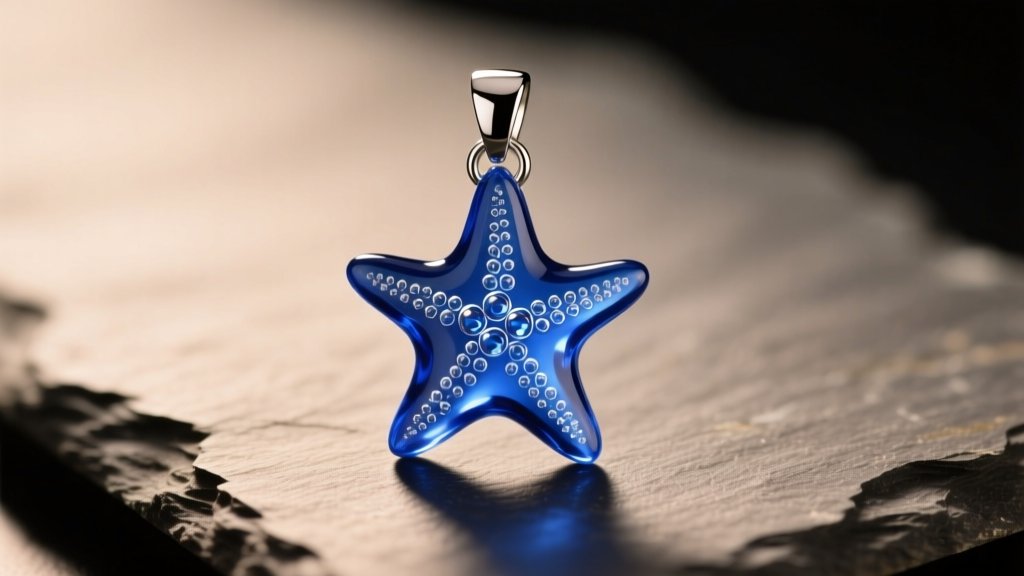
The market for ocean-inspired jewelry is saturated with mass-produced trinkets, but a true artisan glass starfish necklace represents a complex intersection of metallurgy, thermal dynamics, and lapidary science. For collectors and daily wearers alike, understanding the technical specifications of glass pendants is crucial for ensuring longevity, comfort, and structural integrity. This deep dive explores the material science, annealing protocols, and hardware integrations that separate fine art jewelry from fragile novelty items.
Material Science: Borosilicate vs. Soda-Lime Glass
Not all glass is created equal. The durability of a glass starfish pendant depends entirely on its chemical composition and its Coefficient of Expansion (COE). The COE measures how much the glass expands when heated and contracts when cooled. Mismatched COE in jewelry making leads to immediate structural failure.
Borosilicate Glass (COE 33)
Master lampworkers primarily use borosilicate glass (often known by the brand name Pyrex) for high-end pendants. With a low COE of approximately 33, borosilicate is highly resistant to thermal shock and physical stress. When a borosilicate starfish limb is dropped on a hard surface, its tensile strength allows it to absorb the impact energy without shattering, provided the piece has been properly annealed. Furthermore, borosilicate accepts metallic fuming (like silver and gold fume) and dichroic coatings without compromising its structural matrix.
Soda-Lime Glass (COE 90+)
Mass-produced necklaces typically utilize soda-lime glass, the same material used for windows and bottles. It has a much higher COE (around 90 to 96) and is significantly more brittle. Soda-lime starfish pendants are prone to micro-fractures from everyday temperature fluctuations, such as stepping out of an air-conditioned car into summer heat. According to the Corning Museum of Glass, the chemical stability of borosilicate makes it vastly superior for wearable art that interacts with human skin oils and environmental humidity.
The Annealing Process: Why Your Pendant Cracks
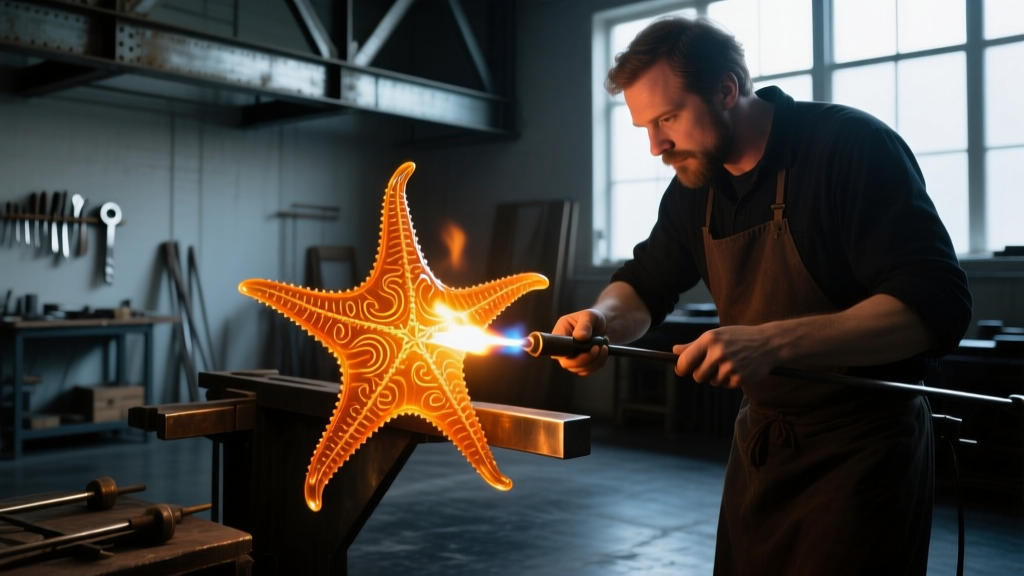
The most critical, yet invisible, step in creating a glass starfish necklace is kiln annealing. When glass is shaped under a 2000°F torch flame, the outer layers cool faster than the core, creating immense internal tension. If a starfish pendant is cooled at room temperature, this tension remains locked inside the glass.
Un-annealed glass is essentially a frozen explosion. The stress concentrates at the thinnest points of the design—usually the tips of the starfish limbs—causing them to snap off spontaneously weeks or months after purchase.
Proper annealing requires soaking the glass in a digital kiln at its specific annealing point (approximately 1050°F for borosilicate) to allow the molecular structure to relax. The kiln is then ramped down slowly through the strain point (around 960°F) over several hours. Master artisans verify their work using a polariscope, an optical instrument that reveals hidden stress lines via polarized light. When purchasing from a studio artist, always verify that their pieces are kiln-annealed and polariscope-tested.
Hardware Integration: Bails, Jump Rings, and Chain Gauges
A flawless glass starfish is useless if the hardware fails. The integration point between the glass and the metal chain is the most common failure point in necklace design. Here is a technical breakdown of bail mechanics and chain sizing.
Bail Attachment Methods
- Epoxy-Glued Bails: The cheapest and least reliable method. Cyanoacrylate or E6000 adhesives degrade when exposed to UV light, skin sebum, and temperature changes. Expect failure within 6 to 12 months of daily wear.
- Wire-Wrapping: A superior method using 20-gauge or 22-gauge half-hard sterling silver or 14k gold-filled wire. The wire is mechanically locked around the starfish's upper limb or a kiln-formed loop, relying on tension and work-hardening rather than chemical adhesives.
- Kiln-Formed Holes: The most durable option. The artist punches a hole through the glass while it is in a molten, plastic state, then lines it with a metal grommet or leaves it bare for a chain to pass through. This eliminates the need for a bail entirely.
Chain Gauge and Clasp Specifications
A solid borosilicate starfish pendant measuring 1.5 inches across typically weighs between 12 and 18 grams. To support this weight without kinking, the chain must be appropriately gauged. According to Rio Grande jewelry suppliers, a 1.2mm to 1.5mm cable or rolo chain, constructed from 18-gauge wire with soldered links, provides the optimal strength-to-weight ratio. Avoid hollow-cored chains or unsoldered jump rings, which will pull apart under the pendulum swing of a heavy glass pendant. Always insist on a stamped lobster clasp (minimum 10mm) rather than a spring ring, which lacks the internal spring tension to secure heavier art glass.
Pricing Tiers and Craftsmanship Indicators
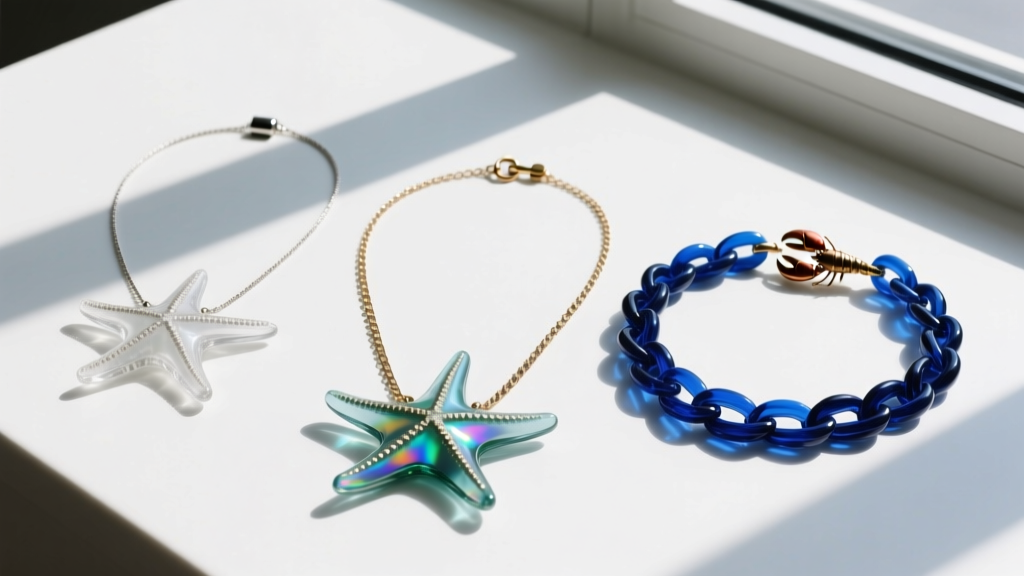
Understanding the technical effort required to produce a high-quality glass starfish necklace helps contextualize market pricing. Use the following framework to evaluate whether a piece is priced fairly based on its manufacturing origin.
| Category | Glass Type & Process | Hardware Integration | Expected Price Range |
|---|---|---|---|
| Mass-Produced | Soda-lime, mold-cast, un-annealed | Glued base-metal bail, unsoldered chain | $15 - $35 |
| Studio Lampworked | Borosilicate, torch-sculpted, kiln-annealed | Wire-wrapped sterling silver, soldered links | $65 - $160 |
| Fine Art Kiln-Cast | Dichroic/Fused, slow-cooled, custom molds | Precious metal bezel or integrated gold loop | $250 - $600+ |
Care, Maintenance, and Failure Prevention
Glass is an amorphous solid, and its durability is governed by the Gemological Institute of America's Mohs scale of mineral hardness. Standard borosilicate glass ranks between 5.5 and 6.5 on the Mohs scale. While it is harder than a steel knife blade (5.5), it is softer than quartz (7.0).
This means that everyday dust, which contains microscopic quartz particles, can scratch the surface of your glass starfish over time, dulling its optical clarity. To maintain the pendant's refractive index and brilliance, follow these strict care protocols:
- Cleaning: Never use ultrasonic jewelry cleaners. The high-frequency cavitation bubbles can exploit microscopic surface flaws and shatter the glass. Instead, use a solution of warm water and mild, non-citrus dish soap, gently agitating with a microfiber cloth.
- Storage: Store the necklace in a dedicated soft pouch. Do not toss it into a jewelry box where it can collide with diamonds (Mohs 10), sapphires (Mohs 9), or even topaz (Mohs 8), all of which will easily gouge the glass surface.
- Chemical Exposure: While borosilicate is highly resistant to acids and alkalis, the metallic fuming or silver leaf encased within the starfish can oxidize if exposed to sulfur-rich environments, chlorine pools, or heavy perfumes. Always put your necklace on after applying cosmetics and aerosols.
By prioritizing borosilicate composition, verified annealing, and mechanically sound hardware, you can acquire a glass starfish necklace that functions not just as a fleeting summer accessory, but as a durable, heirloom-grade piece of wearable sculpture.


