Hand Necklace Troubleshooting: Fixing Flips, Tangles & Tarnish
Solve common hand necklace problems. Learn how to stop pendants from flipping, prevent chain tangles, and fix skin irritation from mixed metals.

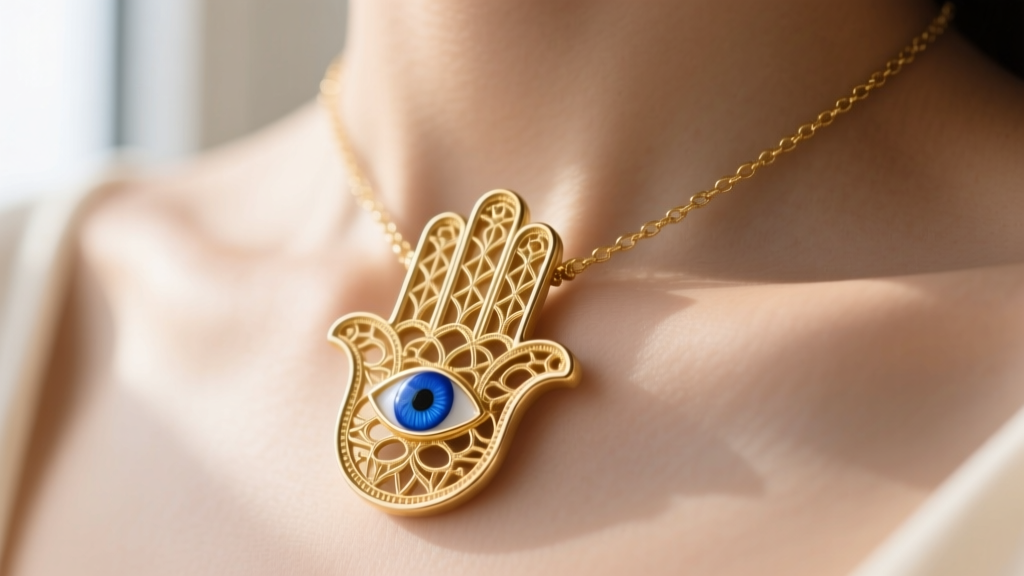
When you search for a 'hand necklace,' you are generally navigating two distinct categories of jewelry: symbolic hand pendants (like the Hamsa, Mano Fico, or Hand of Fatima) and literal hand-draping body chains that connect the neck to the wrist or fingers. While both styles are visually striking, they present unique mechanical and dermatological challenges that standard necklaces do not. As of 2026, jewelry manufacturing has evolved, yet the fundamental physics of uneven weight distribution and high-friction skin contact remain persistent issues for wearers.
In this comprehensive troubleshooting guide, we will dissect the most common failure modes associated with hand necklaces. From pendants that stubbornly flip upside down to body chains that snag on clothing and cause contact dermatitis, we provide actionable, expert-level solutions to restore your jewelry's form and function.
Problem 1: The Pendant Flip (Center of Mass Issues)
The most frequent complaint regarding hand pendant necklaces is the 'flip.' Because hand motifs are inherently asymmetrical, the fingers are significantly heavier and longer than the wrist or palm base. When suspended from a standard bail attached at the top center of the wrist, the pendant's center of mass sits too low and off-axis. As you move, gravity forces the heavy fingers to swing upward, leaving the necklace displaying an upside-down hand.
Solution: Bail Modification and Counterweights
To fix this, you must alter the suspension point to align with the pendant's true center of gravity.
- The V-Bail Modification: Take the piece to a bench jeweler and have them remove the standard loop bail. Instead, request a 'V-bail' or a soldered jump ring that attaches directly to the top center finger (usually the middle finger). This shifts the axis of rotation and allows the heavier palm to naturally anchor the bottom.
- Micro-Counterweights: If altering the bail ruins the design, a jeweler can laser-weld a micro-counterweight (such as a 1.5mm tungsten bead) inside the hollow cast of the palm or wrist base. Tungsten is incredibly dense, and a tiny bead will pull the center of mass downward without adding visible bulk.
- Chain Tensioning: Use a slightly heavier chain (e.g., a 2.0mm rope chain instead of a 0.8mm cable). The added weight of the chain pulling against the bail creates lateral tension that restricts the pendant's ability to rotate freely.
Problem 2: Chain Snagging on Hand-Drape Styles
For hand necklaces that function as body drapes (chains that travel from the nape of the neck, over the shoulder, and attach to a ring or hand harness), snagging is a major structural failure. These pieces are often made with delicate 0.5mm to 0.8mm gauge chains to maintain a 'barely there' aesthetic. However, certain link profiles act like microscopic saw blades against arm hair, lace, and knitwear.
Chain Link Profile Comparison
Not all chains are created equal when it comes to friction. Below is a breakdown of common chain types used in hand-drape necklaces and their snag risk.
| Chain Type | Link Profile | Snag Risk | Tensile Strength (0.8mm) | Best Use Case |
|---|---|---|---|---|
| Snake Chain | Tightly packed, smooth but with micro-seams | High (Grabs hair) | Low (Prone to kinking) | Short, rigid collars only |
| Box Chain | Square, angular edges | Medium-High (Catches lace) | Medium | Pendant necklaces, not drapes |
| Cable Chain | Uniform oval links, flat soldered seams | Low | Medium-High | Ideal for body drapes |
| Curb Chain | Interlocking flat links, smooth top/bottom | Very Low | High | Best for hand-to-neck harnesses |
The Fix: If your current hand-drape necklace snags, swap the chain. According to the Rio Grande Jewelry Supply chain guide, flat-profile chains like the curb or flat-cable distribute tension evenly and glide over skin and fabric. Avoid snake chains entirely for body jewelry, as their interlocking cups trap hair and are nearly impossible to repair once kinked.
Problem 3: Green Skin and Contact Dermatitis
The nape of the neck and the hands are high-sweat, high-friction zones. When a hand necklace causes green skin or an itchy, red rash, you are dealing with either metallic oxidation or Allergic Contact Dermatitis (ACD). Many affordable hand necklaces are crafted from brass or copper alloys and finished with a 'flash' gold plating that is a mere 0.1 microns thick. Sweat breaks down this microscopic layer in weeks, exposing the reactive base metals.
Metal Grade Troubleshooting Guide
According to the American Academy of Dermatology, nickel is the most common culprit for jewelry-induced contact dermatitis, often hidden in the solder joints or base alloys of white gold and silver-plated pieces.
To permanently solve skin irritation, you must upgrade your material grades. Here is what to look for when replacing or commissioning a hand necklace:
- ASTM F136 Titanium: The gold standard for hypersensitive skin. It is entirely nickel-free, biocompatible, and immune to sweat-induced tarnish. Ideal for the ring-attachment points of hand drapes.
- Solid 14k or 18k Gold: Avoid gold-plated or gold-filled chains for body drapes. The friction against the collarbone will wear through the gold-filled outer layer (which is mechanically bonded, not alloyed) within a year of daily wear.
- Vermeil Verification: If you must buy gold over silver, ensure it is genuine Vermeil. The Gemological Institute of America (GIA) notes that true vermeil requires a sterling silver base and a minimum of 2.5 microns of gold plating, offering vastly superior longevity compared to standard plated brass.
Problem 4: Clasp Failure and Slippage on Body Drapes
Hand necklaces that incorporate hand-harnesses or ring attachments endure multidirectional lateral tension. Every time you move your arm, you pull the chain sideways. Standard lobster clasps are designed for vertical drop (pendant weight), not lateral shear force. Under side-pulling tension, the tiny spring mechanism inside a lobster clasp can warp, causing the lever to pop open unexpectedly.
Upgrading Your Closure System
To secure a hand-drape necklace, replace the standard lobster clasp with one of the following alternatives:
- Locking Carabiner Clasps: Featuring a secondary micro-screw or snap-lock gate, these are engineered for multi-directional tension and are heavily favored in the 2026 festival and body-chain market.
- Spring Ring Clasps (For Lightweight Drapes): While seemingly basic, a high-quality 5mm spring ring with a robust internal steel spring often handles lateral shifting better than a cheap, hollow-cast lobster clasp.
- Magnetic Neodymium Closures: For easy on-and-off without stressing the chain links, dual-magnet clasps with a silicone grip sleeve provide a secure hold that safely detaches if the hand-chain catches on an object, preventing the chain from snapping or choking the wearer.
Final Maintenance Checklist for Hand Necklaces
Keep your hand necklaces in peak condition by following this quick troubleshooting checklist:
- Inspect the Bail Monthly: Check for thinning metal where the chain rubs against the pendant loop. Apply a drop of jeweler's wax to reduce friction.
- Ultrasonic Cleaning Warning: Never put hand pendants with enamel (like evil eye accents) or porous stones (like turquoise or opal) in an ultrasonic cleaner. The high-frequency vibrations will shatter the enamel and fracture the stones. Use a soft brush and mild dish soap instead.
- Storage Separation: Store hand-drape chains fully unclasped and laid flat in a velvet-lined tray. Hanging them or tossing them in a box guarantees micro-kinks in the links, which weakens the structural integrity of the chain.
By understanding the physics of pendant weight, the mechanics of chain links, and the chemistry of skin-metal interactions, you can transform a problematic hand necklace into a flawless, everyday statement piece.


