Arts and Crafts Necklaces: A Material & Durability Comparison Guide
Discover the metallurgical and gemological properties of arts and crafts necklaces, from hand-hammered silver to fragile plique-à-jour enamel.

The Metallurgical Rebellion: Understanding Arts and Crafts Jewelry
Emerging in the late 19th century as a direct rebellion against the sterile perfection of mass-produced, machine-stamped Victorian jewelry, the Arts and Crafts movement championed the 'honest' expression of materials and the visible hand of the maker. Today, the market for arts and crafts necklaces encompasses both highly prized antique artifacts from pioneers like Arthur and Georgie Gaskin, and modern artisan interpretations that honor the same design philosophies. For collectors, appraisers, and contemporary jewelers, understanding the specific material properties of these pieces is not merely an academic exercise—it is critical for authentication, valuation, and long-term preservation.
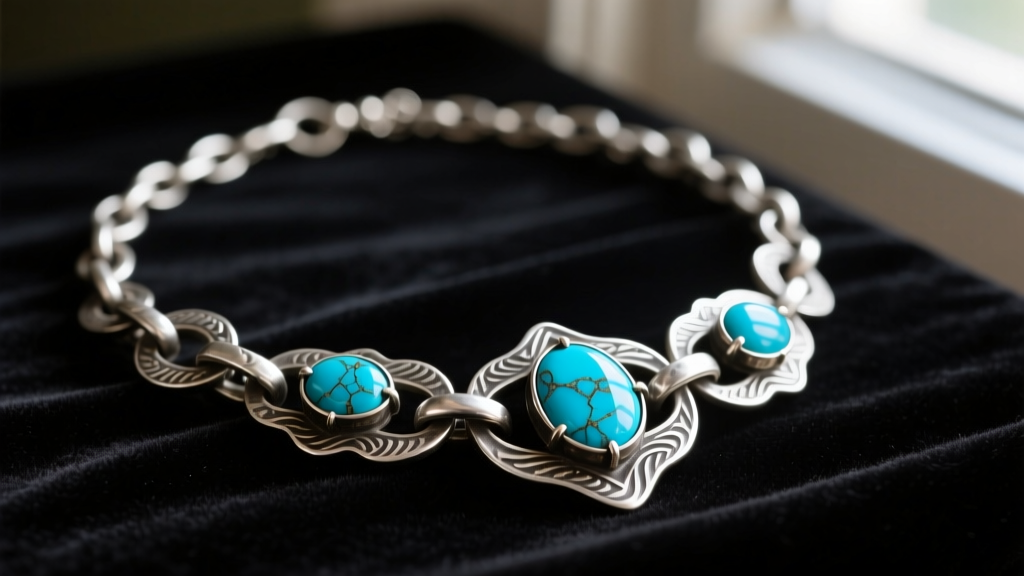
Unlike contemporary fine jewelry, which often prioritizes high-karat gold and brilliant-cut diamonds, authentic arts and crafts necklaces rely on a deliberate selection of lower-karat metals, oxidized finishes, and opaque cabochon gemstones. This material matrix creates unique structural vulnerabilities and maintenance requirements that standard jewelry care protocols simply cannot address. In this guide, we deconstruct the core materials used in these artisan pieces, analyzing their physical properties, failure modes, and optimal care strategies.
The Core Metals: Sterling Silver, Copper, and Brass
The foundation of any arts and crafts necklace lies in its metalwork, characterized by visible planishing marks (hammer strikes) and organic, asymmetrical link structures. Artisans historically favored sterling silver, copper, and brass, each offering distinct metallurgical behaviors when subjected to hand-forging.
Sterling Silver and Work Hardening
Sterling silver (92.5% silver, 7.5% copper) is the most prevalent metal in high-end period pieces. In its annealed (softened) state, sterling silver has a Vickers hardness (HV) of approximately 60-65, making it highly ductile. However, the signature hand-hammered texture of arts and crafts jewelry is achieved through work hardening. As an artisan repeatedly strikes a 14-gauge (1.6mm) silver wire to form a link, the metal's crystalline structure deforms, increasing its tensile strength and pushing its hardness up to 120+ HV. While this prevents the necklace from stretching under its own weight, it also increases brittleness. If a vintage clasp or jump ring is bent repeatedly without intermediate annealing, it will suffer from metal fatigue and snap cleanly.
Copper and Brass: The Patina Factor
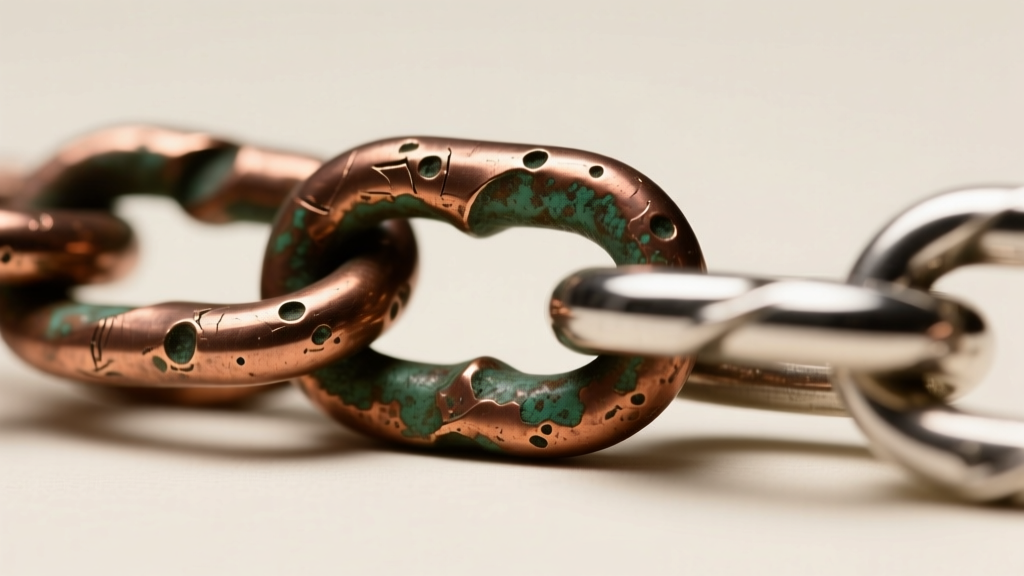
Copper and brass (a copper-zinc alloy) were heavily utilized by designers like Liberty & Co. for their warm, earthy tones and affordability. Copper is exceptionally malleable but highly reactive. When exposed to atmospheric oxygen, moisture, and the natural acids in human skin, copper develops a patina that eventually progresses to verdigris (copper carbonate). While many collectors prize this dark, antique oxidation as a hallmark of authenticity, active green verdigris can be corrosive to adjacent materials, particularly porous gemstones and silk threading.
Vitreous Enameling: Plique-à-jour vs. Champlevé
No discussion of arts and crafts necklaces is complete without addressing vitreous enamel. The movement revived medieval enameling techniques, fusing powdered silica glass to metal substrates at temperatures exceeding 800°C. The visual impact is stunning, but the structural implications are severe.
Plique-à-jour (backless enamel) creates a stained-glass effect where light passes through the transparent enamel. Because it lacks a metal backing, it is inherently fragile. The enamel must be held entirely by surface tension and the capillary action of the silver or gold cloisonné wires. A sudden thermal shock—such as washing hands in hot water while wearing the necklace—can cause the glass to craze or shatter due to a mismatch in the Coefficient of Thermal Expansion (CTE) between the metal frame and the silica glass.
Champlevé enamel, where the glass is set into carved-out troughs in the metal base, is significantly more durable. However, the opaque or translucent enamels used in these pieces are still susceptible to micro-fractures if the underlying copper or silver base is flexed or dropped onto a hard surface.
Gemological Choices: The Dominance of the Cabochon
The Arts and Crafts movement explicitly rejected the brilliant-cut faceted stones favored by mainstream Victorian society, viewing them as overly commercial and ostentatious. Instead, designers favored cabochon-cut (smooth, domed) stones that exhibited mystical optical phenomena or rich, opaque colors. Understanding the Mohs hardness and porosity of these specific stones is vital for maintaining arts and crafts necklaces.
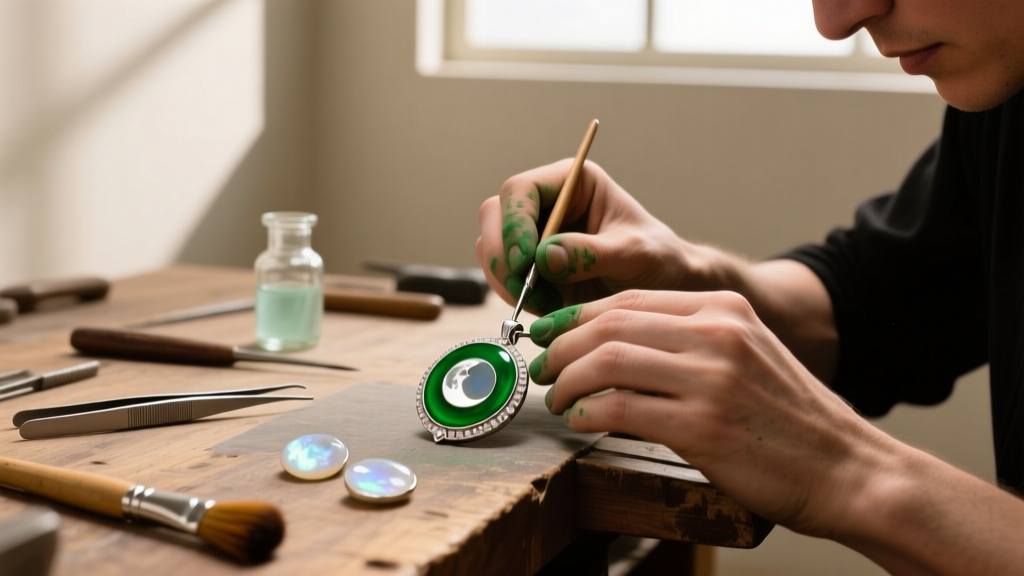
- Moonstone (Orthoclase Feldspar): Prized for its adularescence (a billowy internal glow). With a Mohs hardness of 6-6.5, it is relatively soft and possesses two distinct planes of perfect cleavage, meaning a sharp impact to the bezel edge can cause the stone to split entirely in half.
- Turquoise: A porous hydrous phosphate of copper and aluminum (Mohs 5-6). Untreated turquoise acts like a sponge, absorbing skin oils, cosmetics, and lotions, which permanently alters its color matrix from vibrant blue to a muddy green.
- Amber and Copal: Fossilized and semi-fossilized tree resins, respectively. Extremely soft (Mohs 2-2.5) and highly sensitive to solvents. Even a brief exposure to alcohol-based perfumes can dissolve the surface of an amber cabochon, leaving it permanently tacky and clouded.
- Opal: Specifically the milky or fire opals favored in the era. Opals contain up to 20% water. If stored in low-humidity environments (like a safety deposit box or near heating vents), they can undergo 'crazing,' developing a network of internal cracks that destroys their structural integrity.
Material Durability & Maintenance Matrix
| Material | Hardness / Scale | Primary Vulnerability | Approved Cleaning Protocol |
|---|---|---|---|
| Sterling Silver (Work-Hardened) | ~120 HV | Metal fatigue at clasp joints | Polishing cloth; avoid liquid dips that strip intentional oxidation. |
| Copper / Brass | ~100 HV | Verdigris corrosion | Mild soap, distilled water; dry immediately to halt oxidation. |
| Plique-à-jour Enamel | ~5.5 Mohs (Glass) | Thermal shock, flexing | Dry dusting only; never submerge in liquid. |
| Turquoise (Cabochon) | 5-6 Mohs | Chemical absorption, oils | Damp microfiber cloth; zero chemical exposure. |
| Moonstone | 6-6.5 Mohs | Cleavage plane fracturing | Soft brush, lukewarm soapy water; no ultrasonic. |
Authentication and Sourcing in the Modern Market
As the demand for authentic period jewelry surges, the market has seen an influx of high-quality reproductions. Distinguishing a genuine 1905 Gaskin necklace from a 2024 artisan replica requires a forensic look at material degradation. According to the Victoria and Albert Museum's archives, original pieces will exhibit specific wear patterns: the silver bezels holding the cabochons will show microscopic abrasions consistent with decades of friction, and the enamel will often have a subtle, web-like crazing visible only under 10x magnification.
Furthermore, modern reproductions often use commercial sterling silver sheet that is laser-cut or stamped before being tumbled to simulate hammer marks. True arts and crafts metalwork features asymmetrical planishing marks that vary in depth and angle, reflecting the biomechanics of a human arm swinging a hammer. The links will also vary slightly in gauge thickness, a deliberate or unavoidable consequence of hand-drawing wire through a draw plate.
Care Protocols for Mixed-Material Artisan Pieces
The most common cause of catastrophic damage to arts and crafts necklaces is the application of modern jewelry cleaning technology. Never place these pieces in an ultrasonic cleaner. The high-frequency cavitation bubbles generated by ultrasonic machines will violently shake fragile bezel settings, shatter plique-à-jour enamel, and strip the delicate, intentional oxidation (patina) from the recesses of hand-hammered silver. According to the Gemological Institute of America (GIA), porous stones like turquoise and amber can also suffer internal micro-fractures from ultrasonic vibrations.
Instead, adopt a localized, conservative cleaning approach. Use a soft, horsehair detailing brush dipped in a solution of distilled water and a single drop of pH-neutral conservation soap (such as Orvus WA Paste, commonly used by textile and metal conservators). Gently agitate the metal links, avoiding the gemstone bezels. Rinse with a slow stream of distilled water—never tap water, as the chlorine and fluoride can react with copper alloys—and pat dry with a lint-free cotton cloth. For storage, wrap the necklace in acid-free, unbuffered tissue paper to prevent sulfur exposure, which accelerates silver tarnishing, and store it flat to prevent gravity-induced stress on the historic solder joints.
By respecting the metallurgical and gemological realities of these materials, collectors and wearers can ensure that the rebellious, handcrafted spirit of the Arts and Crafts movement survives for another century.